
You’ve just taken on a commercial property. Maybe it’s a retail unit that’s been sitting empty for two years. Maybe it’s an office block due for full renovation. Either way, the next step is a commercial building strip out, and that’s where most property owners get into serious trouble.
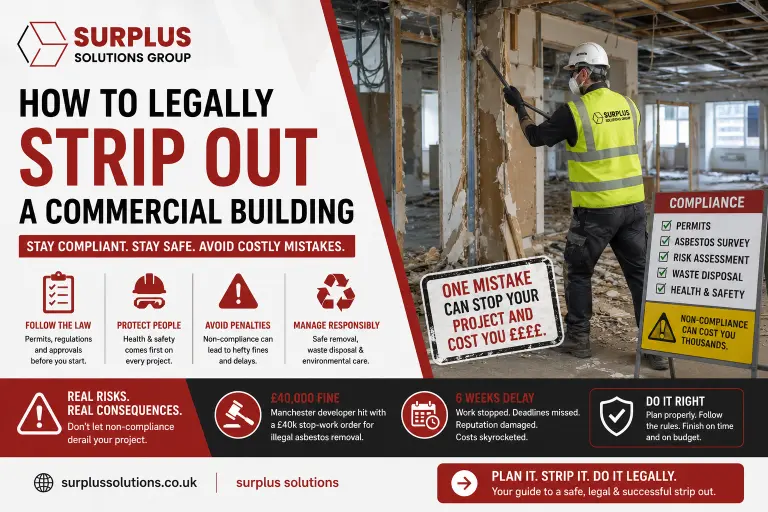
I’ve spoken to facility managers who skipped the permit stage. One developer in Manchester faced a £40,000 stop-work order in early 2026 because his team removed asbestos-containing ceiling tiles without a licensed abatement contractor. The work stopped for six weeks. The penalties were brutal.
The truth is, commercial interior demolition is far more regulated than most people realize. Miss one step and you’re looking at fines, legal action, or a complete project delay. This guide walks you through every legal requirement, permit, and safety rule you need to know before a single wall comes down.
What Is a Commercial Building Strip Out?
A commercial building strip out is the process of removing all non-structural interior components from a building before renovation or redevelopment. Think flooring, ceilings, partitions, fixtures, HVAC systems, and electrical fittings. It’s not full demolition, but it still carries serious legal obligations.
Strip-Out vs Demolition
“Strip out” and “demolition” sound similar, but they’re legally different. A commercial strip-out removes the interior fit-out while the structure stays standing. Full demolition brings down walls, floors, and the building shell itself.
Strip outs tend to carry lighter permit requirements than full demolition, but that doesn’t mean they’re unregulated. Interior work that touches fire-rated assemblies, structural elements, or hazardous materials triggers its own set of compliance requirements in the UK.
What Gets Removed During a Strip Out?
A typical commercial interior demolition project removes:
- Interior partition walls (non-load-bearing)
- Suspended ceilings and ceiling tiles
- Carpet, vinyl, and raised access flooring
- Lighting fixtures and electrical systems
- Plumbing and drainage installations
- Air conditioning and HVAC ducting
- Office furniture and built-in joinery
Common Reasons for Strip Outs
Most commercial strip-out projects happen before a change of tenancy, a full building renovation, or a change of use. Some are driven by outdated mechanical systems that no longer meet current building regulations. Others happen simply because an occupier wants to hand back a property in a stripped condition.
Legal Requirements Before Starting a Commercial Strip-Out
Here’s what nobody tells you at the start: the legal work before a commercial building stripout often takes longer than the stripout itself. I’ve seen projects where owners assumed they could start on Monday and be done by Friday. In reality, they were still waiting on permits three weeks later.
Property Ownership Verification
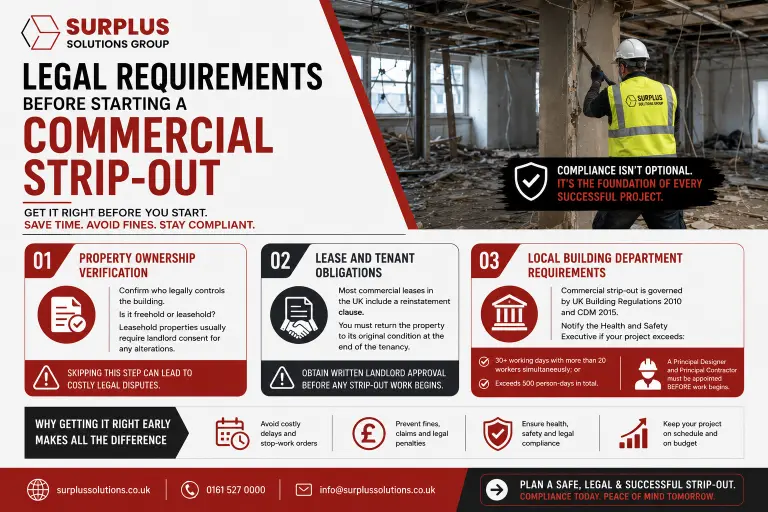
Before any work starts, confirm who legally controls the building. Is it freehold or leasehold? If it’s leasehold, the lease agreement almost always restricts what alterations can be made without the landlord’s written consent. Skipping this step has landed tenants with dilapidation claims running into six figures. strip-out
Lease and Tenant Obligations
Check your lease carefully. Most commercial leases in the UK include a reinstatement clause. This means the tenant is legally obliged to return the property to its original condition at the end of the tenancy. Any strip-out work must be pre-approved in writing by the landlord to avoid breach of contract.
Local Building Department Requirements
In the UK, commercial demolition regulations fall under the Building Regulations 2010 and the Construction (Design and Management) Regulations 2015, known as CDM 2015. CDM 2015 requires that any commercial building strip-out project notify the Health and Safety Executive if it lasts more than 30 working days with more than 20 workers simultaneously or exceeds 500 person-days in total.
If your project hits those thresholds, a principal designer and principal contractor must be appointed before work begins. This isn’t optional.
Permits You May Need Before Interior Demolition
Do you need a permit for commercial interior demolition in the UK? The answer depends on what’s being removed and what building you’re working in.
Interior Demolition Permits
Under UK Building Regulations, a commercial interior demolition permit is required whenever structural changes are made, fire compartmentation is affected, or the work involves notifiable alterations to mechanical and electrical systems. Even if you’re only removing non-structural partitions, notify your local building control authority first.
Environmental Permits
If your commercial building demolition project generates significant waste, you may need an environmental permit from the Environment Agency. Businesses that transport, store, or dispose of demolition waste must hold a valid waste carrier license. Skipping this generates fines of up to £5,000 per offense under the Environmental Protection Act 1990.
Our team at Surplus Solutions handles “commercial waste disposal” as part of full strip-out support, ensuring everything is processed in line with current UK environmental law.
Historic Building Restrictions
If you are working in a listed building or a building within a conservation area, you’ll need listed building consent before carrying out any internal strip-out work. This applies even to removing original features like fireplaces, cornices, or period flooring. Failure to obtain consent is a criminal offense under the Planning (Listed Buildings and Conservation Areas) Act 1990.
Hazardous Material Inspections and Environmental Compliance
This is the section most property owners wish they’d read six months earlier. I’ve seen deals fall apart because a hazardous materials survey wasn’t commissioned before the strip-out quote was accepted.
Asbestos Inspections
Any commercial building constructed before the year 2000 must have an asbestos survey carried out before commercial interior demolition begins. This is a legal requirement under the Control of Asbestos Regulations 2012. There are two types of surveys: a management survey for routine maintenance and a refurbishment and demolition survey specifically required before any strip-out work.
The refurbishment survey is more invasive and must be carried out by a UKAS-accredited analyst. Costs typically range from £300 to £2,000 depending on building size. Do not skip this.
Lead-Based Paint Assessments
Buildings constructed before 1978 often contain lead-based paint. In commercial settings, disturbing lead paint during a building stripout can create serious health risks. A lead survey should be conducted by a qualified assessor before demolition of any painted surfaces begins.
Mold Identification
Mold isn’t always visible. Before a commercial stripout, check for dampness and mold within wall cavities and above suspended ceilings. Disturbing mold-contaminated materials without protection spreads spores throughout the building and can cause respiratory illness in workers.
Hazardous Waste Handling
All hazardous waste generated during a commercial building stripout must be consigned using the correct waste transfer documentation. Hazardous materials including asbestos, fluorescent lamps containing mercury, and lead components must be segregated and disposed of through licensed waste carriers only.
Compliance Checklist:
- Asbestos refurbishment survey completed
- Lead paint assessment carried out
- Mold inspection done before work begins
- Hazardous waste carrier licenses confirmed
- Waste transfer notes prepared for all hazardous materials
Utility Disconnections Before Demolition
Three months before a strip-out job in Preston, I watched a contractor cut through a live electrical cable because the utility disconnection hadn’t been verified. Nobody was hurt, but work stopped for two days while the power was isolated and the incident reported. Don’t let this happen on your site.
Electrical Shutdown Procedures
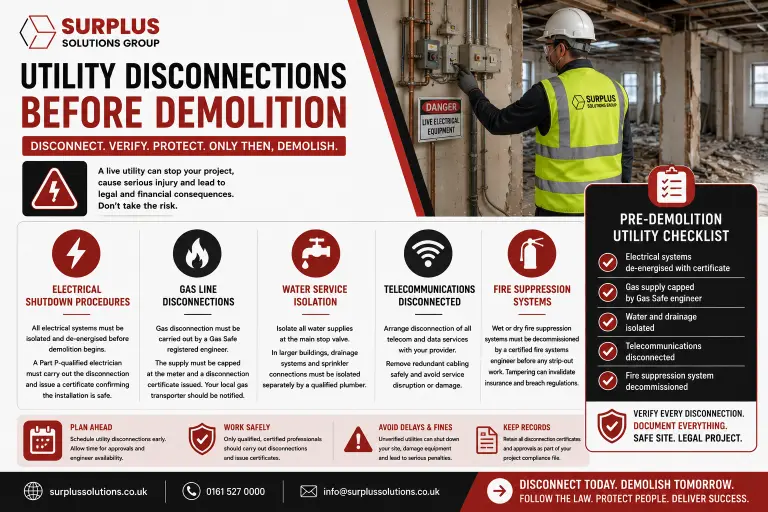
All electrical systems must be isolated and de-energized before commercial interior demolition begins. A Part P-qualified electrician must carry out the disconnection and issue a certificate confirming the installation is safe. This is not a job for your general laborer.
Gas Line Disconnections
Gas disconnection in a commercial building must be carried out by a Gas Safe registered engineer. The supply must be capped at the meter and a disconnection certificate issued. Your local gas transporter should also be notified.
Water Service Isolation
Isolate all water supplies at the main stop valve. In larger commercial buildings, drainage systems and sprinkler connections must be isolated separately by a qualified plumber.
Fire Suppression Systems
This one is frequently overlooked. If your building has a wet or dry fire suppression system, it must be decommissioned by a certified fire systems engineer before any strip-out work touches the pipework or ceiling voids. Tampering with fire suppression systems without authorization can invalidate your building’s insurance.
Pre-Demolition Utility Checklist:
- Electrical systems de-energised with certificate
- Gas supply capped by Gas Safe engineer
- Water and drainage isolated
- Telecommunications disconnected
- Fire suppression system decommissioned
Safety Requirements for Commercial Strip Outs
Safety on a commercial strip worksite isn’t just about wearing a hard hat. It’s about planning for every possible risk before anyone sets foot in the building.
Site Safety Planning
Under CDM 2015, a construction phase plan must be prepared before work begins on any commercial building demolition project. This document covers the site hazards, method statements, emergency procedures, and welfare arrangements. It must be available on site at all times.
Worker Protection Standards
All workers on a commercial interior demolition site must hold a valid CSCS card appropriate to their trade. Workers handling hazardous materials must hold additional competency certificates. Supervisors overseeing asbestos removal must hold a P405 qualification as a minimum.
Personal Protective Equipment
Standard PPE for a commercial strip out includes hard hats, steel-capped boots, high-visibility vests, safety glasses, and gloves. For asbestos work, full PPE, including type 5 disposable coveralls, FFP3 respirators, and nitrile gloves, is mandatory under the Control of Asbestos Regulations 2012.
Dust Control Measures
Construction dust is a serious occupational health risk. Fine dust from cutting concrete, plasterboard, or drywall can cause long-term lung disease. Use wet methods, on-tool dust extraction, and H-class vacuum systems during commercial demolition work.
Occupied Building Considerations
If parts of the building remain in use during the commercial strip out, a segregation plan must be in place. Hoarding, negative pressure units, and controlled access zones must separate the live areas from the demolition zones at all times.
Step-by-Step Commercial Strip-Out Process
How does a commercial strip out work from start to finish? Here’s the process every property owner and contractor should follow.
- Site Assessment: Survey the entire building. Identify structural elements, hazardous materials, utility locations, and access constraints. Document everything.
- Permit Acquisition: Apply for all required building control notifications, environmental permits, and any specialist consents before work begins.
- Hazardous Material Testing: Commission asbestos and lead surveys. Allow 10 to 15 working days for laboratory results before scheduling work.
- Utility Isolation: Arrange certified disconnection of all utilities in the correct sequence: electrical first, then gas, then water, then telecoms.
- Interior Removal: Work from top to bottom. Remove suspended ceilings first, then partitions, then flooring, then mechanical and electrical systems.
- Waste Management: Segregate hazardous from non-hazardous waste on site. Use licensed carriers for all waste removal. Retain all transfer documentation.
- Final Site Inspection: The building control officer inspects the completed stripout. Compliance certificates are issued. The site is handed back clean.
If you’re planning a full interior clearance, our “commercial strip out services” cover every stage from initial survey to final site sign-off across the UK.
What Can and Cannot Be Removed During a Strip-Out?
This question causes more disputes between contractors and clients than almost any other. Let’s be clear about the boundaries.
| Component | Can Be Removed | Requires Specialist | Structural Risk |
| Non-load-bearing partitions | Yes | No | Low |
| Suspended ceilings | Yes | If asbestos present | Low |
| Carpet and flooring | Yes | No | None |
| HVAC ducting | Yes | Yes | Low |
| Load-bearing walls | No | Structural engineer | High |
| Fire-rated walls | Restricted | Building control approval | High |
| Mains electrical systems | Restricted | Part P electrician | High |
| Sprinkler systems | Restricted | Fire systems engineer | High |
Waste Disposal and Recycling Requirements
A commercial building strip out generates significant quantities of waste. In the UK, businesses are legally responsible for how that waste is managed under the Environmental Protection Act 1990 and the Waste (England and Wales) Regulations 2011.
Construction Debris Management
All waste must be segregated on site into categories: inert waste (concrete, bricks, tiles), non-hazardous waste (clean timber, plasterboard), and hazardous waste (asbestos, lead, fluorescent tubes). Mixed loads of hazardous and non-hazardous waste are illegal.
Metal and Concrete Recycling
Steel, copper, and aluminum from commercial demolition are highly recyclable. Most licensed contractors will strip out copper pipework and steel sections separately for recycling, which can offset some of your strip-out costs. Concrete and masonry can be crushed and reused as aggregate.
Our “recycling solutions” service ensures materials from commercial strip outs are diverted from landfill wherever possible, keeping your project compliant with UK waste reduction targets.
Electronic Waste Disposal
Old commercial buildings often contain IT infrastructure, server rooms, and specialist electronic equipment. Electronic waste from a commercial strip out must be disposed of under the Waste Electrical and Electronic Equipment Regulations 2013, known as WEEE. Use a licensed WEEE-compliant carrier for all electronic waste.
Common Legal Mistakes Property Owners Make
I’ve seen every one of these mistakes made by experienced property developers. None of them are cheap to fix.
Starting Work Without Permits
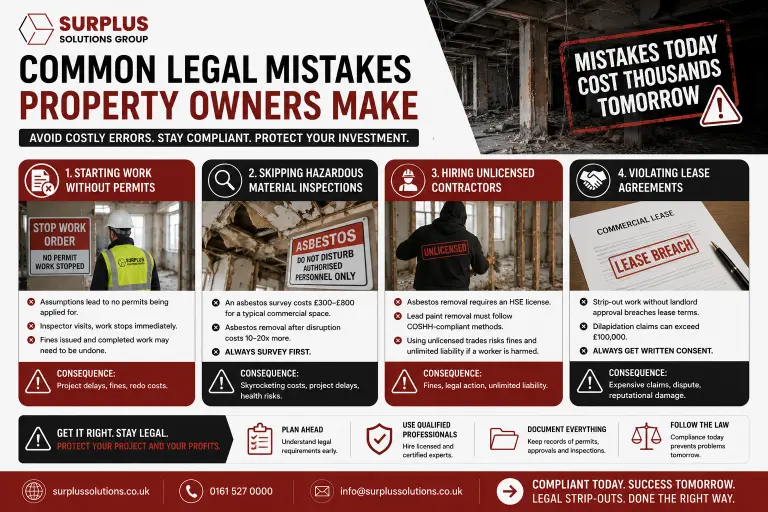
This is the most common. A property owner assumes the contractor will handle permits. The contractor assumes the owner has already sorted it. Nobody applies. Work begins. An inspector visits. Everything stops. Fines are issued and all completed work may need to be undone.
Skipping Hazardous Material Inspections
An asbestos survey costs £300 to £800 for a typical commercial space. Asbestos removal, when it’s found after the fact and work is already disrupted, costs ten to twenty times more. Always survey first.
Hiring Unlicensed Contractors
Contractors carrying out notifiable asbestos removal work must hold an HSE license. Contractors removing lead paint must follow COSHH-compliant methods. Using unlicensed trades doesn’t just risk fines. It exposes you to unlimited liability if a worker is harmed.
Violating Lease Agreements
Commercial tenants have been hit with dilapidation claims of over £100,000 for strip-out work that wasn’t pre-approved by the landlord. Always get written consent before committing to a commercial building strip out program.
How to Choose a Commercial Strip Out Contractor
Choosing the right contractor for your commercial strip out project is not about finding the cheapest quote. It’s about finding the team that keeps you compliant, on schedule, and out of court.
What to check before the program.
- Valid Public Liability Insurance of at least £5 million
- Employer’s Liability Insurance
- Current HSE Asbestos license (if asbestos is present)
- Licensed waste carrier registration with the Environment Agency
- CHAS, SafeContractor, or Constructionline accreditation
- References from similar commercial strip-out projects in the last 12 months
Always ask for a written scope of work before signing anything. A professional contractor like Surplus Solutions Group will break down exactly what is included, what permits they’ll handle, how waste will be managed, and what the timeline looks like.
Cost Factors for Commercial Building Strip Outs
Most of the people ask us how much does a commercial strip out cost in the UK? Prices in 2025 and 2026 range widely depending on building size, materials, and location.
| Cost Factor | Estimated Range |
| Basic strip out per sq ft | £4 to £12 |
| Asbestos removal per square meter | £50 to £150 |
| Hazardous waste disposal per tonne | £200 to £600 |
| Building control notification | £200 to £800 |
| Environmental permit | £150 to £1,500 |
| Structural engineer (if needed) | £500 to £2,500 |
A 5,000 sq ft office strip-out in a major UK city typically costs between £25,000 and £60,000 all in, including waste disposal and hazardous material handling. Buildings with significant asbestos, complex HVAC systems, or listed status will always fall at the higher end.
Commercial Strip Out Checklist
Pre-Project Checklist
- Verify ownership or obtain landlord’s written consent
- Review lease agreement reinstatement clauses
- Commission asbestos refurbishment and demolition survey
- Commission lead paint assessment if pre-1978 building
- Notify local building control authority
- Obtain all required permits and consents
- Arrange certified utility disconnections
During Project Checklist
- Construction Phase Plan on-site and up-to-date
- All workers hold valid CSCS cards
- Daily site inspections and signed records
- Waste segregation in place from day one
- Hazardous waste transfer notes completed for each collection
Post-Project Checklist
- Final building control inspection booked
- All waste transfer documentation retained for two years
- Compliance certificates from utility disconnection engineers filed
- Reinstatement survey completed if required by lease
Final Thoughts on Legally Stripping Out a Commercial Building
Commercial building strip out projects go wrong most often not because of the demolition itself, but because of what happens in the weeks before it. The planning, the permits, the surveys, and the compliance paperwork determine whether your project runs smoothly or grinds to a costly halt.
My strongest advice: treat the pre-work as seriously as the work itself. Commission the surveys early. Apply for permits as soon as the project scope is confirmed. Appoint a licensed contractor who takes compliance as seriously as you do.
The UK regulatory environment around commercial demolition is only getting tighter. In 2025 and 2026, building control authorities have increased enforcement activity significantly. Projects without proper documentation are being stopped and investigated more frequently than ever before.
If you’re planning a commercial strip out and want it done legally, safely, and on schedule, our team at Surplus Solutions handles “commercial strip out services” across the UK. From initial surveys to full interior clearance and “waste disposal” management, we coordinate the entire process so nothing is missed.
What’s the biggest challenge holding your stripout project back right now? Let us know in the comments.