
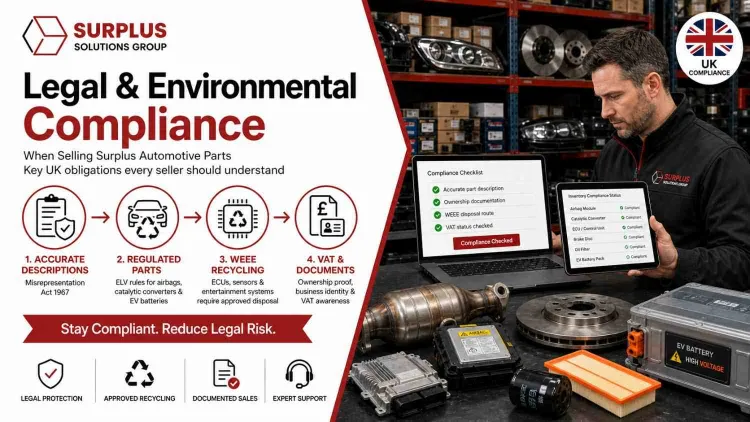
Surplus automotive parts are one of the most common forms of trapped capital in the UK motor trade. Whether you are a dealership parts manager sitting on thousands of pounds of slow-moving OEM parts, an independent garage with a bulging parts bin, or a fleet operator clearing decommissioned vehicle stock, that surplus automotive inventory represents real money.
The problem is not the parts. The problem is not knowing which channel to use, how to price what you have, or where to start.
This guide gives you a complete, structured approach to how to sell surplus automotive parts UK from first audit to final clearance, with the right strategy for every parts category.
TL;DR — 5 Actions That Drive Maximum Returns:
- Conduct a thorough parts audit and categorisation before choosing any sales channel
- Identify New Old Stock (NOS) and obsolete parts before pricing anything
- Add vehicle compatibility data to every online listing; it is the single biggest discoverability factor
- Multi-channel selling consistently outperforms a single bulk-trade sale
- Legal and environmental compliance obligations apply to specific categories of automotive parts
What Counts as Surplus Automotive Parts and Why Acting Quickly Matters
Before you can sell anything, you need to understand what you actually have. Surplus car parts fall into four distinct categories, and each one requires a different approach.
The four main categories:
- Overstock: Parts ordered in excess of demand, still current and fully sellable
- End-of-line stock: Parts for models recently discontinued or no longer in active production
- Obsolete stock: Parts with no current vehicle application or extremely limited demand
- New Old Stock (NOS): Genuine original parts, never used, often in original packaging; the premium tier
Most sellers treat all four the same way. That is the single most expensive mistake in selling excess auto parts in the UK.
Why acting quickly matters:
Rubber components, seals, gaskets, and electronic parts deteriorate in storage. An ECU or sensor that is worth £180 today may be worth £40 in two years if stored incorrectly. The longer surplus automotive inventory sits, the less it returns. Capital tied up in unsold parts also affects your business liquidity in very real, very immediate ways.
The shift to electric vehicles is accelerating this urgency. As ICE (internal combustion engine) vehicle servicing declines over the next decade, demand for many conventional parts will contract. The window for maximum value on much of this stock is now, not later.
Step 1: Audit and Categorise Your Surplus Parts Inventory
You cannot price, list, or sell what you have not accurately counted. The audit is the foundation of every subsequent decision in how to sell surplus automotive parts.
Step-by-step parts audit process:
- Freeze all parts’ movements before you begin: nothing in, nothing out
- Count every part by physical location: bin, shelf, rack, and drawer
- Record part number, description, manufacturer, quantity, and condition
- Cross-reference against vehicle compatibility data. What vehicles does this part actually fit?
- Check current market availability. Is this part still in production, or has it been superseded?
- Assign a category: overstock, end-of-line, obsolete, or NOS
- Note condition: new sealed, new unsealed, used serviceable, or damaged
- Enter everything into a master parts inventory spreadsheet
Tools that speed up the audit:
- Parts management software such as Pinnacle, Revolution, or MAM Autocat for dealership environments
- Online cross-reference databases, including TecDoc, Partslink24, and AutoData, for compatibility verification
- Barcode scanning apps for serialised parts
The audit is also your legal protection. If you later list parts online, the accuracy of your listing depends entirely on what you recorded during this phase. Misdescribed parts create disputes, returns, and in some cases claims under the Misrepresentation Act 1967.
For businesses handling surplus automotive inventory disposal as part of a business closure or insolvency, our company clearance service supports the physical audit phase before any parts are moved or consigned.
Step 2: Value Your Parts Correctly Before You Price Anything
Here is something most guides on how to sell surplus automotive parts never say directly: blanket discount logic destroys value. Applying a flat 30% discount across your entire parts inventory without researching actual market prices will cost you significantly more than the time you save.
The three pricing benchmarks to use:
- Current retail price: What the part sells for new today, your RRP baseline
- Current market price: What the same or equivalent part is actually selling for on live marketplaces right now
- Replacement cost: What it would cost the buyer to source an alternative, especially relevant for obsolete and NOS parts
Pricing strategy by category:
| Parts Category | Pricing Strategy | Typical Range vs. RRP | Key Factor |
|---|---|---|---|
| Overstock (current parts) | 20–40% below retail | 60–80% of RRP | Speed of movement |
| End-of-line parts | At or above retail if scarce | 80–120% of RRP | Availability check |
| Obsolete parts | Research specialist markets | 50–200%+ of original RRP | Scarcity premium |
| NOS parts | Full retail or above | 100–180%+ of RRP | Provenance and packaging |
| Used serviceable parts | 40–60% of the new equivalent | 40–60% of RRP | Condition grading |
For selling obsolete car parts in the UK, the scarcity premium is real and consistently underused. A part that is no longer manufactured, for which there is no aftermarket equivalent, commands prices that defy standard discount logic. Check eBay Motors’ completed listings (actual sale prices, not asking prices) and specialist classic parts platforms before pricing anything in this category.
Step 3: Choose the Right Sales Channels
The right channel depends on what you have, how much of it you have, and how quickly you need the money. There is no single best channel for automotive parts resale in the UK. The best approach is almost always multi-channel.
Online consumer-facing platforms:
eBay Motors UK remains the largest individual parts marketplace in the country. It works best for identifiable parts with clear vehicle compatibility data, strong photography, and accurate condition descriptions. The fees are meaningful (typically 12.8% plus listing fees), but the audience depth is unmatched for individual parts sales.
Amazon Automotive UK works well for new, branded, OEM and aftermarket parts in current demand. It is catalogue-based, which means you need an existing product listing to sell against. Less suited to specialist or obsolete stock.
Facebook Marketplace and Facebook automotive groups are underused for surplus parts. Marque-specific groups, classic car communities, and performance vehicle forums on Facebook reach highly motivated buyers who will pay well for the right parts. And it costs nothing to list.
Specialist platforms worth knowing:
- Motorhog and Green Parts UK for used and recycled parts
- Heritage-parts.com and BMIHT-affiliated platforms for classic and vintage stock
- Autodoc Marketplace for aftermarket parts in current demand
For bulk and trade sales:
B2B automotive marketplaces and trade platforms connect sellers with wholesalers, factors, and independent garage buyers. The return per unit is lower than individual sales, but the speed of clearance is significantly higher.
| Platform | Part Type | Fee Structure | Speed | Best For |
|---|---|---|---|---|
| eBay Motors UK | All categories | 12.8% + listing | Medium | Individual high-value parts |
| Amazon Automotive | New, branded | Referral fee 7–15% | Fast | OEM and aftermarket current stock |
| Facebook Marketplace | All, classic focus | Free | Fast | Local, classic, specialist |
| Motorhog / Green Parts | Used serviceable | Commission-based | Medium | Used parts recycling |
| B2B trade platforms | Bulk, mixed | Negotiated | Fast | Trade and wholesale clearance |
Our automotive surplus stock disposal service uses a multi-channel approach for every consignment, matching part categories to their strongest buyer audience rather than defaulting to a single channel.
Step 4: Create Listings That Actually Get Found and Convert
Listing quality is the biggest variable in the performance of online automotive parts resale channels. Parts with identical specifications regularly sell at vastly different prices based purely on listing quality.
The anatomy of a high-converting automotive parts listing:
- Part number: OEM number and all known aftermarket cross-references
- Descriptive title: Make, model, year range, engine variant, and part type, all in the title
- Vehicle compatibility data: This is the single most important factor for search discoverability on eBay Motors UK. Use eBay’s fitment data tool or TecDoc to verify and add compatibility
- Condition: Clearly graded, new sealed, new unsealed, used serviceable, or used with defects
- Brand: State whether OEM, genuine aftermarket, or pattern clearly and honestly
- Known defects: Fully disclosed. Honest disclosure builds buyer trust and reduces returns
- Photography: Cover shot on plain background, part number label close-up, all faces photographed, any damage shown clearly
Weak listing: “Car part, used, collection available.”
Strong listing: “Ford Transit 2.2 TDCi EGR Valve (2011–2014), Ford Genuine OEM Part No. 1786416. “Condition Grade B was removed from the running vehicle and tested to work. Minor surface carbon deposits are visible, as shown in the images. Original Ford packaging. Fits: Transit MK8 2.2 TDCi 125 ps. Postage available.”
The difference in hammer price or sale price between these two listings for the same physical part is consistently 40 to 80%. Vehicle compatibility data and honest condition disclosure do more work than any discount.
Step 5: Decide Between Individual Lots and Bulk Trade Sales
This is the strategic decision that most affects your total return when selling excess auto parts in the UK. And most sellers get it wrong because they default to bulk without testing individual channels first.
When an individual listing makes sense:
- High-value OEM parts and NOS stock with clear identification
- Parts for popular, high-demand vehicles with large owner bases
- Specialist, performance, or classic parts with motivated buyer communities
- Any part where vehicle compatibility data is available and verifiable
When bulk trade sales make sense:
- Large volumes of low-value, mixed, or unidentified parts
- Parts with no compatible vehicle application data available
- Time-critical clearance: lease end, insolvency, or site closure
- Parts that have been superseded and have no realistic individual sale market
The hybrid approach that works best for most inventories:
Sell the top 20% as individual listings on eBay Motors UK or specialist platforms. Create curated category lots for the middle tier. Bundle the bottom 30% for bulk clearance. This structure consistently outperforms an all-bulk or all-individual approach for surplus automotive inventory disposal.
“Our surplus stock buyers team” regularly works through exactly this kind of tiered disposal framework, separating high-value individual parts from bulk clearance stock before any offer is accepted.
Step 6: Find and Approach Bulk Automotive Parts Buyers
If bulk disposal is the right route for part or all of your inventory, knowing who to approach and how to present your stock professionally makes a significant difference to the offer you receive.
Who buys surplus automotive parts in bulk in the UK:
- Automotive parts wholesalers and factors are buying stock to supplement their range
- Independent garages purchasing parts at trade prices for workshop use
- Automotive dismantlers and salvage yards acquire new parts alongside vehicles
- Specialist classic and vintage parts dealers seeking to expand their catalogue
- Automotive parts exporters, particularly for UK-market parts destined for Africa, the Middle East, and Eastern Europe (strong demand markets for surplus UK automotive stock)
How to present your parts to bulk buyers professionally:
Create a complete parts manifest including part number, description, brand, quantity, condition, and unit price. Photograph representative samples of key lots. State your terms clearly: payment, collection timeline, warranty position, and returns policy.
Always get a minimum of three quotes before accepting any offer. The spread between the lowest and highest offer for the same bulk automotive parts lot is regularly 30 to 50%.
Red flags to avoid:
Walk away from any buyer who creates artificial urgency, refuses to provide a written offer, or will not confirm payment terms before collection. Legitimate bulk automotive parts buyers will always provide documentation.
Selling New Old Stock (NOS) and Obsolete Parts: A Different Strategy Entirely
New Old Stock (NOS) parts and genuinely obsolete parts deserve their own section because standard pricing and channel logic simply do not apply to them.
A NOS part in original packaging, for a desirable classic or discontinued vehicle, regularly sells at or above its original RRP. In some cases, significantly above. Classic Land Rover parts, original Ford Escort RS components, and NOS Rover P6 stock have all sold at 150 to 200% of original retail through specialist channels.
Where to sell NOS and obsolete parts:
- Classic and heritage vehicle parts specialists and dealers
- Marque-specific owner clubs and forums (many have active classified sections)
- eBay Motors UK, the global NOS marketplace with international bidder reach
- Specialist Facebook classic car groups and Instagram restoration communities
- International auction houses for rare or valuable NOS collections
How to present NOS parts:
Original packaging is sometimes worth more than the part itself. Photograph it carefully and describe its condition separately. Provenance matters: original receipts, dealership stamps, and period documentation add measurable value. Never bundle NOS parts into job lots without exhausting individual sale options first. This is one of the most expensive mistakes in selling obsolete car parts in the UK.
Legal and Environmental Compliance When Selling Surplus Automotive Parts
Selling excess auto parts comes with compliance obligations that many sellers overlook until something goes wrong.
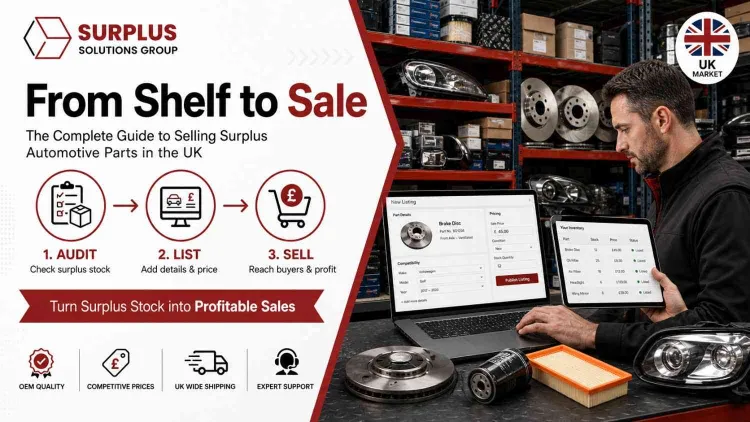
The Misrepresentation Act 1967 makes an accurate description a legal obligation. If a buyer was induced to purchase by an inaccurate part description, they can seek to void the sale. Honest condition disclosure is not just ethical. It is your legal protection.
End-of-Life Vehicles (ELV) Regulations apply when certain components are removed from vehicles for disposal or resale. Catalytic converters, airbag modules, and high-voltage EV batteries all require specific handling. Disposing of these through unregistered channels creates legal liability.
WEEE Regulations cover electronic components, including ECUs, sensors, entertainment systems, and EV battery packs. Parts falling under WEEE cannot simply be disposed of in general waste. If they cannot be resold, they must go through an approved recycling route. “Our recycling solutions service” handles WEEE-compliant disposal for automotive electronic components as part of broader business clearances.
Catalytic converters: Since 2022, UK legislation requires anyone selling a catalytic converter to provide documentation proving legitimate ownership and business identity. This was introduced specifically to disrupt the supply chain for catalytic converter theft. Compliance is straightforward for legitimate sellers but must not be overlooked.
VAT on surplus automotive parts sales depends on your VAT registration status and whether parts are sold to VAT-registered businesses or end consumers. Speak to your accountant before establishing your pricing structure if you are unsure of your VAT position on any category of surplus car parts disposal.
Common Mistakes When Selling Surplus Automotive Parts
For surplus automotive inventory disposal to deliver the best return, avoid these consistently costly errors:
Mistake 1: Applying blanket discounts without researching actual market prices. This is the single most value-destroying decision in surplus car parts disposal.
Mistake 2: Bundling NOS or high-value obsolete parts into job lots. Identify first, then group.
Mistake 3: Listing without vehicle compatibility data. This kills discoverability on eBay Motors UK and every other parts platform.
Mistake 4: Poor photography. Low-resolution images and cluttered backgrounds consistently suppress buyer confidence and final prices.
Mistake 5: Accepting the first bulk offer without testing the market. The first offer is almost never the best offer.
Mistake 6: Ignoring manufacturer return programs before going to the open market. For dealership parts, this step should always come first.
Mistake 7: Selling regulated parts, including catalytic converters and WEEE components, without compliance checks.
Mistake 8: Storing parts incorrectly and allowing the condition to deteriorate. Rubber, seals, and electronics are particularly vulnerable.
Surplus Automotive Parts Disposal Checklist
Phase 1: Audit and Categorisation
- All parts’ movements are frozen before the audit begins
- Full physical count completed by location
- Every part recorded with part number, description, brand, quantity, and condition
- Parts cross-referenced against vehicle compatibility data
- Overstock, end-of-line, obsolete, and NOS categories assigned
- High-value individual parts identified and separated
Phase 2: Valuation and Pricing
- Current market prices researched for all key parts
- eBay Motors UK completed listings checked for actual sale price comparables
- Specialist platforms checked for obsolete and NOS pricing
- Pricing strategy confirmed by category
Phase 3: Channel Selection
- The manufacturer return programme reviewed, and credits claimed where available
- High-value individual parts listed on eBay Motors UK and specialist platforms
- Bulk trade sale quotes obtained from a minimum of three bulk automotive parts buyers.
- Auction route assessed for volume or time-critical clearances
Phase 4: Listing and Presentation
- All listings include full part number and vehicle compatibility data
- Professional photographs taken for all listed parts
- Condition accurately described and all damage disclosed
Phase 5: Compliance
- ELV Regulations, WEEE Regulations, and REACH obligations checked for relevant parts
- Catalytic converter documentation prepared
- VAT position confirmed across all sales channels
Phase 6: Completion
- All sales recorded for VAT and accounting purposes
- Unsold parts re-evaluated for alternative channels
- Final compliance disposal arranged for non-sellable parts through licensed routes
Conclusion
Surplus automotive parts represent real, recoverable value. But only if you approach disposal with a structured strategy rather than a panic response.
The five actions that make the biggest difference are a full audit and categorization, correct identification of NOS and obsolete parts before any pricing decisions are made, vehicle compatibility data on every online listing, a multi-channel disposal approach, and compliance checks before selling regulated categories.
Whether you are clearing a single parts bin or managing the wind-down of an entire dealership, this process gives you the framework to recover maximum value from every part, right down to the last gasket.
At Surplus Solutions Group, “our automotive surplus stock buyers service” handles everything from initial parts audit and categorization through to multi-channel disposal, bulk trade sales, and final surplus car parts disposal in the UK for non-sellable stock. We work with independent garages, dealership parts departments, fleet operators, and insolvency practitioners handling motor trade businesses across the UK.
For businesses where the automotive parts liquidation UK process involves broader site clearance or business wind-down, “our company clearance service” and “our recycling solutions for automotive waste” cover the full scope of what needs to happen after the parts are sold.
What category of surplus parts are you dealing with right now? Leave a question below, and I will give you a direct, channel-specific answer.