
Here is something that keeps experienced insolvency practitioners up at night. A retail chain in the North West goes into administration in early 2024. The IP firm takes the first bulk offer from a known trade buyer. Quick, clean, done. Six weeks later, a competitor firm mentions they achieved 38% more on a near-identical stock category by running a short online tender process first. The difference? Roughly £180,000 that never reached unsecured creditors.
Nobody talks about these moments openly. But they happen constantly across insolvency practitioner stock disposal UK cases, quietly eroding creditor returns in insolvency cases while everyone tells themselves there was no other option.
There was. And this guide covers exactly what that option looks like.
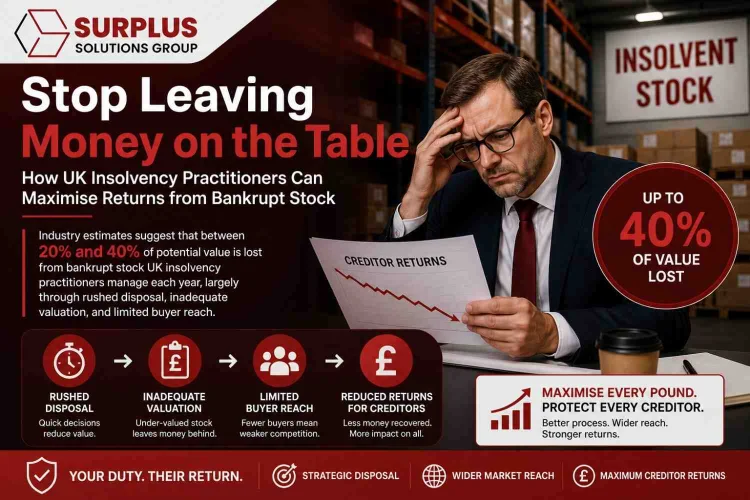
Industry estimates suggest that between 20% and 40% of potential value is lost from bankrupt stock UK insolvency practitioners manage each year, largely through rushed disposal, inadequate valuation, and limited buyer reach. If you are a licensed IP, an administrator, or a liquidator working on UK cases right now, this is the most practical guide you will read on this topic.
TL;DR Key Takeaways:
- Independent valuations before disposal prevent underselling by 20–40%
- Staged disposal across multiple channels consistently outperforms single bulk bids
- Online liquidation platforms now rival and often beat traditional auction houses for many stock categories
- The first 48 hours after the appointment are the highest-leverage window for protecting stock value
- SIP 16 compliance and a documented decision trail protect IPs from future challenge
What Actually Happens to Stock the Moment a UK Company Becomes Insolvent?
The appointment moment is everything. The second an IP is formally appointed, the clock starts on stock preservation and the legal obligations that govern what happens next.
Under the Insolvency Act 1986, appointed officeholders carry a duty to act in the interests of creditors and to realize assets for the best reasonably obtainable price. That phrase matters. Best reasonably obtainable is not the same as “fastest.” It is not the same as the most convenient. Courts have scrutinized disposal decisions that favored speed over return without adequate market testing.
Selling bankrupt stock UK requires understanding from day one which stock sits under fixed charges and which sits under floating charges. Fixed-charge assets belong to the secured creditor from the moment of appointment. Floating charge stock is pooled into the general estate. These are not just accounting distinctions. They determine who you are negotiating with, what approval you need, and how much freedom you have in choosing disposal channels.
For practical stock preservation, the immediate steps are:
- Physically secure the site and restrict access
- Commission a rapid stock count with photographic evidence
- Check storage conditions, especially for perishable, temperature-sensitive, or high-value goods
- Document anything already missing or damaged
Working with specialist “bankrupt stock buyers” early, even at the assessment stage, helps you understand live market appetite before you commit to any disposal route.
Why Do So Many IPs Undersell Bankrupt Stock? (And It Is Not Your Fault)
Let me be honest about something. Most under-realizations on bankrupt stock UK insolvency practitioners manage are not caused by incompetence. They are caused by structural pressures that push toward fast decisions.
Secured creditors want returns quickly. Costs are accruing daily. The IP’s own time is limited. And frankly, there is often a familiar buyer on the phone within 48 hours who already knows the company and offers a number that sounds reasonable.
Here is what that buyer knows, and you may not. That number reflects forced sale value, probably 30–50 pence on the pound of orderly liquidation value. They are doing their job. Your job is to test whether that offer is genuinely the best the market will produce.
The most common mistakes I have seen across insolvency practitioner stock disposal UK cases include the following:
- Accepting first-offer bulk bids without running any parallel process
- Using a single disposal channel when two or three would take only days longer
- Failing to separate high-value SKUs from bulk lots before pricing
- Providing poor-condition documentation that makes buyers discount aggressively to cover unknown risk
- Skipping the independent valuation on the grounds that there is no time
The last one is the most expensive error of all.
Surplus Solutions Group works with IPs across the UK, specifically on this challenge, offering rapid assessments and “bankrupt stock buyers” connections that help test market value quickly without sacrificing the disposal timeline. Our team at “liquidation stock clearance services” understands what different buyer categories will pay for different stock types, which removes a lot of guesswork.
How to Value Bankrupt Stock Without Getting It Wrong
There are three valuation approaches every bankrupt stock UK insolvency practitioners should understand before disposal begins.
Forced sale value is what the stock would fetch if sold immediately with no marketing time, typically to a single bulk buyer. This is the floor.
Orderly liquidation value assumes a reasonable but still time-pressured marketing period, usually four to twelve weeks, with access to multiple buyer channels. This is the realistic target.
Going concern value applies only if you are considering a trade sale of the business as an operating entity rather than a stock disposal. In that scenario, stock forms part of a broader negotiation.
For most IP stock valuation UK purposes, orderly liquidation value is the benchmark to aim for. Achieving it requires a minimum of two to three competing offers and some level of active marketing to trade buyers, online platforms, or the secondary retail market.
When should you commission an independent stock appraisal? Honestly, almost always on cases above £50,000 in estimated stock value. RICS-qualified valuers and specialist trade valuers by sector (retail, manufacturing, food and beverage) provide defensible written opinions that protect your decision-making trail if challenged later.
Here is a straightforward comparison of the three main valuation approaches:
| Valuation Method | Typical Return | Best Used When | IP Risk if Underused |
|---|---|---|---|
| Forced Sale Value | 20–40% of the cost | Emergency, perishables | High if used unnecessarily |
| Orderly Liquidation Value | 40–70% of the cost | Most standard cases | Low if properly documented |
| Going Concern Value | 70–100% of cost | Trading sale possible | N/A unless trade sale is viable |
What Are the Best Channels for Selling Bankrupt Stock in the UK?
This is where most of the value is either captured or lost. The channel you choose determines your ceiling, not just your floor.
Online liquidation platform
It remains the most underused route in UK insolvency work. Platforms like B-Stock and sector-specific B2B marketplaces allow IPs to reach hundreds of pre-qualified trade buyers simultaneously. I have seen retail fashion stock achieve 45% more through a seven-day B2B tender than through an immediate bulk trade sale. The platform fee is typically 5-15% of sale proceeds, which is almost always recovered through competitive bidding.
Trade buyers and bulk purchasers
It remains valuable, especially for niche stock categories where specialist buyers know the exact resale channel. The key is having a pre-approved buyer list before the appointment, not building one from scratch after. Surplus Solutions Group maintains active relationships with “liquidation stock buyers UK” across dozens of product categories, which gives IPs immediate buyer access on appointment day rather than day fourteen.
Auction houses
It works well for machinery, vehicles, and high-value individual items. For mixed retail stock, a general auction rarely outperforms a targeted online tender. The major UK auction houses for insolvency, including Hilco and Tiger Group, have their strengths but also significant fee structures that can erode net return significantly on lower-value lots.
Direct-to-consumer disposal
It has a limited but real role in some cases, particularly where the insolvent business had a strong local customer base and a short remaining lease time. A short-notice clearance sale can generate surprising returns on certain stock categories.
Here is how the main channels compare on the criteria that matter most to IPs:
| Channel | Speed | Typical Return | Best Stock Type | Approximate Fee | Risk Level |
|---|---|---|---|---|---|
| Online Liquidation Platform | 7–21 days | High | Retail, FMCG, electronics | 5–15% | Low to Medium |
| Trade Buyer (Pre-vetted) | 2–7 days | Medium to High | Bulk lots, mixed pallets | Nil | Low |
| Auction House | 14–30 days | Variable | Machinery, vehicles, collectibles | 15–25% | Medium |
| Direct Consumer Sale | 3–10 days | Medium | Fashion, homeware, food | Low | Medium |
| Bulk Single Buyer | 1–3 days | Low | Any, as a last resort | Nil | Low |
The surplus electronics stock disposal space is worth mentioning separately. Electronics depreciate faster than almost any other category. A week’s delay in disposal can cost 10–15% of the recoverable value. For electronics-heavy cases, Surplus Solutions Group’s “surplus electronics stock buyers” service offers same-week assessment and purchase, which can be critical to avoid significant value erosion.
How to Build a Staged Disposal Strategy That Maximises Creditor Returns
A staged disposal is exactly what it sounds like. You do not sell everything at once. You categorize stock by value, condition, and demand, then sell in tiers.
- Tier one contains your highest-value, best-condition items. These go to specialist buyers or online platforms first, at the best achievable price.
- Tier two are your mid-grade stocks. Bulk pallets, mixed lots, items with cosmetic damage but full functionality. These go to trade buyers or secondary market retailers.
- Tier three is residual. Damaged, incomplete, or end-of-life stock. This may go to recycling or waste routes or to bulk clearance at minimal return.
The mistake most IPs make is applying tier-three pricing to tier-one stock because someone offered a single bulk price for the entire inventory. Separating the categories before you receive bids almost always yields better aggregate returns.
Timing matters enormously for the bulk stock liquidation UK strategy. Christmas-themed retail stock in early January is worth roughly 20–30% of its pre-Christmas value. The same stock held until September, where legally permissible, can recover 60–70%. I am not suggesting IPs hold stock indefinitely. But a four- to six-week delay on genuinely seasonal goods, agreed upon with the floating charge holder, can make a material difference to creditor returns in UK insolvency.
For cases involving perishable, hazardous, or short-dated stock, the calculus is reversed. Speed is essential, and Surplus Solutions Group’s “food stock buyers” network can mobilize within 24 to 48 hours on perishable or near-dated inventory to prevent total value loss.
Do Stock Condition and Presentation Affect What Buyers Will Pay?
Yes. Significantly. And this is an area where a small investment of time creates disproportionate returns.
Buyers bidding remotely on liquidation lots are pricing risk. If they cannot accurately assess the condition, they discount aggressively to protect themselves. If you give them confidence through detailed condition reporting, they compete on the actual value of the goods rather than their worst-case assumptions.
The practical steps that move the needle:
Photography: Clear, well-lit images of pallets, individual items, and any damage. Not phone snapshots. Proper documentation that a remote buyer can rely on.
Grading: A/B/C stock grades, clearly applied, let buyers understand what they are getting without needing to inspect. Many professional “liquidation stock buyers UK” will not bid without grading documentation.
Manifested pallets: A manifest lists every item in a pallet by SKU, quantity, and condition. Manifested pallets consistently fetch 15–30% more than unmanifested mixed lots. The time investment is real, but the return is almost always justified.
Minor remediation, such as cleaning, repackaging, or basic repair, is worth considering on a case-by-case basis. A quick cost-benefit analysis: if remediation costs £500 and is likely to increase realization by £2,000, it passes easily. If it costs £2,000 to recover £1,500 more, it does not.
Legal Risks IPs Must Avoid When Disposing of Insolvent Stock
The Insolvency Act 1986 creates real exposure for IPs who dispose of assets at an undervalue. Section 238 allows liquidators and administrators to challenge transactions at undervalue made within two years of insolvency. More relevant for current cases: creditors and officeholders themselves can be challenged if disposal decisions appear inadequately market-tested.
What protects you is documentation. A clear decision audit trail showing:
- The valuations obtained
- The disposal channels considered
- The offers received and why you accepted or declined them
- The timeline constraints operating at the time
SIP 16, which governs pre-pack administrations, adds further compliance obligations around connected party sales and independent business reviews. Connected party transactions, where stock is sold to a director, former director, or related party, require independent sign-off and transparent disclosure.
For VAT, HMRC treats most insolvency practitioner stock disposal UK sales as taxable supplies. The IP, acting as agent, must account for VAT correctly. Where the business is VAT-registered, and the sale is structured as a transfer of going concern (TOGC), different rules apply. This area genuinely warrants specialist tax advice on larger cases.
What High-Return Case Studies Teach Us About Bankrupt Stock Disposal
Case Study 1: Fashion Retail Chain, Northwest England, 2024
An IP firm managing a regional fashion chain’s administration ran a parallel process for the first time. Instead of accepting an immediate bulk trade offer of £120,000 for the entire stock, they listed graded pallets on a B2B online tender alongside direct approaches to three specialist trade buyers. Seven days later, total realizations came to £172,000. Same stock. Same condition. A 43% uplift purely from process.
Case Study 2: Manufacturing Company, Midlands, 2023
Specialist machinery in an engineering firm’s liquidation was initially valued at £85,000 by a generalist auctioneer. An independent RICS-qualified trade valuer assessed it at £140,000 to £160,000. The IP instructed a specialist engineering auction, which realized £158,000. The valuation fee was £3,500. Net benefit to creditors: roughly £70,000.
Case Study 3: Food and Beverage Company, Yorkshire, 2024
Short-dated perishable stock was at risk of becoming worthless within five days of the appointment. The IP engaged Surplus Solutions Group’s “food stock buyers” service on day one. A buyer was on-site within 36 hours, purchasing the entire stock for £28,000. A week later, the stock would have been a waste disposal cost rather than income.
These cases are not exceptional. They represent what happens when IPs treat distressed stock resale UK as a strategic challenge rather than an administrative task.
The Biggest Myths About Selling Bankrupt Stock That Cost Creditors Money
Myth 1: Bulk sales always give the fastest return. Not true. A seven-day online tender can conclude faster than the typical negotiation cycle with a single bulk buyer who needs to arrange finance, survey stock, and get internal approval.
Myth 2: Auction houses always get the best price. For machinery and vehicles, often yes. For mixed retail stock, consumer goods, or perishables, frequently no. Online platforms and direct trade approaches consistently outperform general auctions on most FMCG and retail categories.
Myth 3: Stock condition does not affect liquidation price. This one is genuinely expensive to believe. Condition documentation directly affects buyer confidence and, therefore, bid levels.
Myth 4: You must sell everything at once. A staged disposal across two to four weeks almost always outperforms a single bulk clearance. The incremental time cost is small. The return difference can be substantial.
Myth 5: Online platforms are not suitable for B2B liquidation stock. This was partly true in 2018. It is not true now. B2B online liquidation platforms serve professional trade buyers exclusively and are fully appropriate for insolvent business asset recovery at a commercial scale.
Five Highest-Impact Strategies to Maximise Returns: A Summary
After reviewing hundreds of insolvent business asset recovery cases, the five decisions that most consistently separate high-return disposals from poor ones are:
- Obtain an independent valuation before accepting any offer, even under time pressure
- Run at least two disposal channels simultaneously rather than one sequentially
- Grade and photograph stock before listing or pricing
- Build a pre-vetted buyer network before you need it, not after the appointment
- Document every decision with methodology and market-testing evidence
The decisions made in the first 48 hours after appointment frequently define the entire return profile of a case. That window is the highest-leverage point for protecting creditor returns insolvency UK and it is where preparation, buyer relationships, and disposal strategy matter most.
Surplus Solutions Group works with bankrupt stock UK insolvency practitioners across the UK, providing rapid stock assessments, access to a national trade buyer network, and “liquidation stock clearance” support from day one of appointment through to final disposal. Our “company clearances” service handles full site clearance alongside stock realisation, which removes one of the most common logistical complications IPs face on larger cases.
If you are working on a case right now and need a fast, honest market assessment of what the stock is likely to achieve, the “bankrupt stock buyers” team at Surplus Solutions Group can typically turn around an initial view within 24 hours.
Frequently Asked Questions
Returns vary significantly by sector and disposal method. Orderly liquidation typically achieves 40–70% of the cost value. Forced bulk sales can fall to 20–35%. Multiple buyer channels and proper grading consistently push outcomes toward the higher end.
Simple bulk sales are complete in two to seven days. Online tender processes typically run seven to fourteen days. Full-stage disposal across multiple channels can take four to eight weeks but usually yields materially higher returns for creditors.
No. IPs have full discretion over disposal channels, provided they can demonstrate the outcome represents the best reasonably obtainable price. Online platforms, trade buyers, and direct sales are all legitimate and often superior routes for many stock categories.
Market value assumes an arm’s length transaction with no time pressure. Liquidation value assumes a constrained timeline. The gap between the two is where most creditor return losses occur in selling bankrupt stock UK cases.
Unsold residual stock is typically sold for scrap value, donated, or disposed of as waste. Surplus Solutions Group’s “recycling solutions” service handles the responsible disposal of residual stock in a way that meets environmental compliance obligations.
Immediate site security, access restriction, and a full stock count with photographic evidence are completed within the first 24 to 48 hours. The director’s access to the premises should be supervised from day one of the appointment.
A manifested pallet includes a full itemized list of contents, quantities, and condition grades. Buyers price unknown risk into their bids. A manifest removes that uncertainty, which drives more competitive offers and consistently higher sale prices.
Yes, selling below the cost price is legal and often unavoidable in bankrupt stock UK insolvency practitioners’ cases. The obligation is to achieve the best reasonably obtainable price, not the cost price. Proper market testing and documentation justify the outcome.