
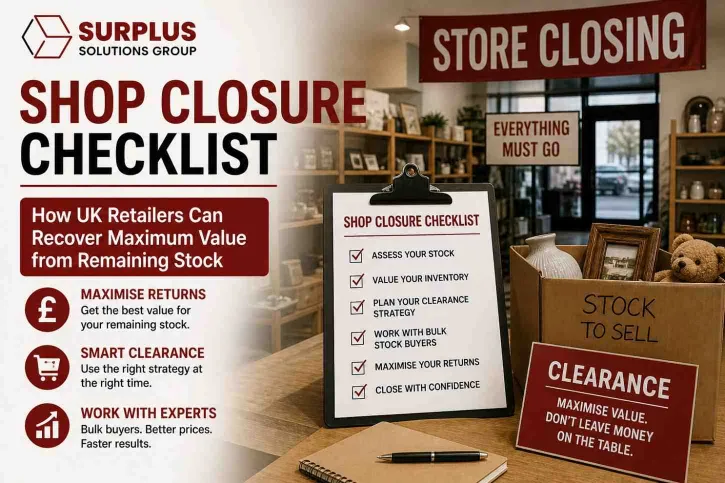
Every year, thousands of UK retailers close their doors and walk away leaving tens of thousands of pounds of stock value on the table. Some panic-discount everything in week one. Others ignore their surplus stock entirely until the landlord is chasing keys. Both approaches cost you money you genuinely did not need to lose.
I’ve seen this play out more times than I can count. A gift shop owner in Lancashire had £40,000 worth of remaining stock at closure and walked away with £9,000 because she had no plan. The same quantity, managed properly through staged clearance and bulk stock buyers UK, could have returned £22,000 or more.
This guide is built for UK retailers who are serious about shop closure stock recovery. Whether you’ve got two weeks or two months, the decisions you make right now will define what you walk away with. Let’s make sure you don’t leave a single pound behind.
TL;DR – 5 Things to Do Before Anything Else:
- Start your stock audit the moment closure is confirmed
- Always try supplier returns before you start discounting
- A staged closing-down sale beats a single deep discount event every time
- Online selling alongside your in-store sales can double your reach
- Unsold surplus stock isn’t a write-off; a donation has real tax benefits
What Should a UK Retailer Do the Moment They Decide to Close?
The first 72 hours after a closure decision are the most important. Most retailers waste them.
The moment closure is confirmed, call your accountant and your solicitor before you call anyone else. Your accountant needs to know what’s coming for your final VAT return and stock disposal tax treatment. Your solicitor needs to review your lease for break clauses and dilapidation obligations.
Then notify your landlord in writing. Check your lease carefully, because your exit timeline may affect what you can legally remove and sell before handing back the keys.
In the first 72 hours, you should:
- Freeze all new stock orders immediately
- Secure and restrict staff access to the stockroom
- Begin a preliminary stock count by category
- Review your supplier contracts for return clauses
- Notify HMRC, your business rates authority, and Companies House if you’re a limited company
The biggest mistake retailers make in this window? Telling customers before they’ve told suppliers. Once your closing-down announcement is public, your supplier’s negotiating power drops significantly. Get those conversations done first.
How Do You Carry Out a Stock Audit Before Closing a UK Shop?
Here’s something nobody tells you: your shop closure stock recovery strategy is only as good as the data underneath it. If you don’t know exactly what you have, you’ll undersell it. Guaranteed.
A proper retail store closure checklist UK starts with a full stock audit. Not a rough count. A complete, graded manifest.
Stock categories to audit separately:
- Sellable stock in good condition
- Display stock (often discounted but still valuable)
- Damaged or faulty stock
- Short-dated or seasonal stock
- Storage stock that’s never hit the shop floor
For each category, photograph items, note condition, record cost price, RRP, and a realistic stock clearance price. This document becomes your master manifest, and it’s what serious “bulk stock buyer UK” contacts will ask for before making any offer.
| Stock Category | Condition | Qty | Cost Price | RRP | Clearance Price | Route |
|---|---|---|---|---|---|---|
| Core range | A (mint) | 200 | £8 | £22 | £14 | In-store / online |
| Display items | B (minor wear) | 45 | £8 | £22 | £9 | Closing down sale |
| Damaged units | C (faulty) | 12 | £8 | £22 | £3 | Bulk trade buyer |
| Short-dated | D (date risk) | 60 | £5 | £14 | £2 | Charity/disposal |
This kind of structured manifest is exactly what the team at “our liquidation stock clearance service” uses to get retailers the best returns. When buyers can see graded, organised inventory, offers come in faster and closer to fair value.
Can You Return Unsold Stock to Suppliers When Closing Your UK Shop?
Yes, and this is the most overlooked step in every retail business closure stock process I’ve ever seen.
Most retailers assume suppliers won’t take stock back. Some won’t. But branded suppliers in particular often prefer a return over seeing their product sold at rock-bottom prices in a closing-down sale that damages brand perception.
Your leverage points with suppliers:
- You’re clearing your final invoice balance; use this as a negotiating chip
- Offer partial returns with a credit note rather than a cash refund
- Frame it as protecting their brand from distressed-sale pricing
Independent gift and homewares retailers tend to have the most success here. One gift shop owner I spoke to recovered 22% of her total stock value through supplier returns alone before her closing-down sale had even started. That was £8,800; she thought she’d lost it.
When suppliers refuse, escalate to their trade rep or national accounts team. And if that fails, keep the refused stock as your priority stock for online channels, where you control the pricing and the positioning.
For more on handling leftover stock across multiple channels, “our approach to company clearances” covers exactly this kind of multi-route disposal.
How Do You Plan a Closing Down Sale That Actually Maximizes Return?
Here’s a controversial opinion: starting your closing down sale too early is one of the most expensive mistakes a UK retailer can make.
When you announce a closing-down sale, customer behaviour changes immediately. People hold back, expecting prices to fall further. Staff morale dips. And if you’ve opened with 50% off everything on day one, you’ve left yourself nowhere to go.
The staged markdown approach works far better:
| Week | Discount Level | Target Clearance % | Key Action |
|---|---|---|---|
| Week 1–2 | 20% off | 25–30% of stock | Announce closure and start online selling simultaneously |
| Week 3–4 | 30–35% off | 50–60% of stock | Approach bulk stock buyers in the UK with a manifest |
| Week 5 | 40–50% off | 75–85% of stock | Deep discount remaining lines |
| Final week | 60%+ / all offers | 90–95% of stock | Final clearance: donate or dispose of the remainder |
On the legal side, the Advertising Standards Authority and Trading Standards are very clear: you cannot run a “closing down sale” indefinitely, and your pricing claims must be honest. Don’t claim “was £30, now £10” unless that was a genuine prior price held for a reasonable period. The risk of a trading standards complaint during an already stressful closure is not worth it.
For your closing-down sale marketing, use every channel you’ve got. Social media is free. Email your list with urgent messaging. WhatsApp your loyal regulars personally. Local Facebook community groups consistently drive footfall for independent retailers, and they cost nothing.
What Online Platforms Can UK Retailers Use to Sell Remaining Stock?
This is where most closing retailers leave the most money behind. Selling only in-store limits you to whoever walks past. Selling online opens your excess stock to the whole country.
Consumer-facing platforms:
- eBay: Best for individual listings of higher-value items. Bulk lots work too, but photograph carefully and write honest condition notes.
- Facebook Marketplace: Excellent for local buyers who can collect, which avoids shipping costs entirely.
- Gumtree: Works well for large quantities going to local trade buyers.
- Vinted / Depop: If you’re a fashion or clothing retailer, these platforms are essential for retail liquidation of apparel.
B2B and trade platforms for bulk:
Platforms like B-Stock and Hilco operate in the UK and work with businesses needing to liquidate retail stock UK at scale. These platforms use a manifested pallet system: detailed stock lists that tell buyers exactly what they’re getting. A well-prepared manifest consistently fetches 15–25% more than an unmanifested lot.
Honestly though? The time required to list, pack, and post hundreds of individual items during an already chaotic closure period is brutal. This is where working with a professional “excess stock buyers UK” partner saves both time and money. The team at “our surplus stock clearance service” can move volume quickly without you needing to become a part-time fulfillment operation on top of everything else.
Should You Sell Stock to a Trade or Bulk Buyer When Closing Your Shop?
For many closing retailers, a bulk stock buyer UK is the fastest and most practical route for shop closure stock recovery at scale. But approach it wrong, and you’ll get offers that feel like theft.
What bulk buyers are looking for:
- A clear, itemised manifest (see stock audit above)
- Minimum quantities (most serious buyers want pallets, not boxes)
- Honest condition grading
- A realistic timeline (they need to know when the stock must move)
How to protect yourself in negotiations:
Always get at least three offers before accepting anything. The spread between a low offer and a fair market offer for the same surplus stock is often 30–40%. One independent toy retailer I know accepted the first offer he received, at £4,200 for a pallet load of stock. A second opinion revealed the fair value was closer to £6,800.
Walk away from any buyer who creates artificial urgency or refuses to provide a written offer. Legitimate liquidators of retail stock in the UK will always give you something in writing.
If you’d prefer to have a professional handle the negotiation on your behalf, “our bankrupt stock buyers team” works with closing retailers regularly and can assess the value of your inventory before you speak to anyone.

What Are the Tax and VAT Implications of Selling Off Stock When Closing a UK Shop?
This section matters more than most retailers realize, and it’s the one where speaking to your accountant before you start pricing anything is genuinely essential.
VAT on closing down stock sales:
You must continue charging VAT at the correct rate on all stock sold, even if it’s below the cost price. The moment you deregister for VAT, you may need to account for VAT on any remaining business assets above a certain threshold. Get advice on the timing of your VAT deregistration relative to your final sale event.
Stock write-downs and your final accounts:
Remaining surplus stock that cannot be sold can be written down to its net realizable value in your final accounts. This reduces your taxable profit. But HMRC will expect the valuation to be independently supportable, not just your personal assessment.
Business Asset Disposal Relief may also apply if you’re closing a sole trader or partnership business, potentially reducing capital gains tax on disposal proceeds to 10%. Eligibility conditions apply.
Charitable donation of stock:
This is genuinely underused. If you donate excess stock to a registered UK charity, you can claim the cost price as a tax deduction against your final profits. For a retailer with £15,000 of unsellable surplus stock at cost, the tax saving can be £3,000–£4,500, depending on your tax position. That’s nothing.
Document every donation with a receipt from the receiving charity, note the cost price of goods donated, and keep this in your final accounts records for HMRC.
How Do You Dispose of Shop Fixtures, Fittings, and Equipment During Closure?
Your shop fittings are not worthless. They’re just harder to sell than stock, and retailers consistently undervalue them.
What you can legally sell:
Fittings are generally removable items that haven’t been permanently fixed to the building structure. Fixtures are attached to the property, and your lease will determine whether you can remove them or whether the landlord has a claim. Review this with your solicitor before selling anything.
Best routes for selling retail fixtures:
- Specialist second-hand retail equipment dealers (Google “used retail shelving UK” for UK-specific buyers)
- eBay and Facebook Marketplace for individual items like display units, rails, and EPOS systems
- Local auction houses for larger lots, including refrigeration units, industrial shelving, and tech
EPOS systems and tills: Before selling any point-of-sale technology, do a full data wipe and factory reset. This protects your customer data and your legal obligations under UK GDPR.
For fixtures that won’t sell, “our strip-out services team” handles full retail shop clearances, including responsible disposal of items that have no resale route, ensuring you avoid dilapidation penalties from your landlord.
What Are the Biggest Mistakes UK Retailers Make When Closing a Shop?
I want to be direct here because these mistakes cost people real money, and I’ve seen them repeatedly.
Mistake 1: Deep-discounting on day one. Starting at 50% off destroys your margin and your negotiating room. Stage it.
Mistake 2: Ignoring supplier returns. Even partial returns or credit notes have real value. Most retailers don’t even ask.
Mistake 3: Selling only in-store. Online channels for retail store closure stock clearance can match or exceed in-store revenue, especially for niche products.
Mistake 4: Undervaluing fixtures. A set of mid-range retail shelving units can fetch £300–£800. Don’t let them go in a skip.
Mistake 5: Not speaking to an accountant before pricing. The sequence of your stock disposal decisions affects your final tax position significantly.
Mistake 6: Accepting the first bulk offer. The first offer is almost never the best. Get three minimum.
Mistake 7: Rushing the process. Two extra weeks of structured clearance typically recovers more value than six weeks of panic discounting.
What Does a Complete Shop Closure Stock Recovery Checklist Look Like?
Pre-Closure (Weeks 1–2):
- Notify the accountant, solicitor, and landlord
- Freeze all new stock orders
- Complete full retail store closure checklist, stock audit with graded manifest
- Review supplier contracts for return rights
- Approach suppliers for stock returns before any public announcement
- Assess fixtures and fittings for resale
Disposal Phase (Weeks 2–6):
- Launch staged closing-down sale beginning at 20% off
- Simultaneously list selected stock on eBay, Facebook Marketplace, and sector-specific platforms
- Circulate the manifest to bulk stock buyers and trade contacts
- Negotiate bulk deals, a minimum of three offers before accepting
- Monitor sell-through weekly and adjust the markdown schedule accordingly
Final Phase (Final 2 Weeks):
- Deep-discount remaining excess stock to 50–60%+ off
- Sell or donate fixtures and fittings
- Document all charitable donations for HMRC with receipts
- Arrange licensed waste disposal for truly unsellable surplus stock
Post-Closure:
- Submit the final VAT return and deregister at the right time
- Notify HMRC of business cessation
- File final accounts and stock disposal records
- Close business bank accounts
- Inform Companies House (if a limited company)
If any of this closure involves insolvency, speak to a licensed insolvency practitioner under the R3 (Association of Business Recovery Professionals) framework before making any disposal decisions. The order in which you deal with creditors in an insolvency situation has legal implications.
Expert Strategies Experienced Retail Closure Specialists Recommend
The most successful shop closure stock recovery processes I’ve seen share three things in common.
First, they start planning before the closure is public. The window between decision and announcement is where the best supplier return deals and bulk buyer negotiations happen. Once the word is out, buyers know your urgency and price accordingly.
Second, they use multiple disposal channels simultaneously, not sequentially. In-store sales, online listings, trade buyers, and charitable donations all running at the same time maximize both speed and return.
Third, they get a professional stock valuation before setting any prices. An independent valuer gives you a defensible floor price for HMRC purposes and stops you from accepting offers that are significantly below fair market value.
The 80/20 rule applies hard here: in most retail closures, roughly 20% of the surplus stock generates 80% of the recovery value. Identify your highest-value lines early and manage them separately from the bulk clearance. Don’t let your best stock get swept up in a bulk lot at a fraction of its individual value.
For retailers who’d rather hand the whole process to professionals, “our full company clearance service” handles everything from stock audit and valuation through to disposal, donation, and strip-out, with one point of contact throughout. We work with independent retailers, high street chains, and corporate businesses across the whole of the UK.
Conclusion
Closing a retail shop is one of the hardest decisions any business owner makes. But it doesn’t have to mean writing off everything you’ve invested in stock.
The three highest-impact actions are simple: do a proper stock audit first, explore supplier returns before you discount anything publicly, and run your clearance across multiple channels at the same time. Those three steps alone separate the retailers who walk away with 40–60p in the pound from those who get 10p.
If you’re in the middle of a closure right now and you’re not sure where to start, our team at Surplus Solutions Group works with UK retailers at every stage of the shop closure stock recovery process. From initial stock valuation through to full clearance, donation coordination, and “responsible waste disposal,” we’ve handled it all. We’re based in Leyland, Lancashire, and work nationwide.