
Your warehouse has 6,000 units of last season’s collection. The lease renewal is in eight weeks. The new range arrives in tens. You know you need to move this stock, but you also know what happens when a fashion brand dumps inventory on public marketplaces. The discount screenshots go viral. Retailers call to renegotiate terms. Customers start waiting for the sale instead of buying at full price.
This is the real cost of getting overstock apparel clearance wrong. It’s not just about recovering pennies on the pound. It’s about whether your brand survives the method you used to do it.
Here’s what most guides won’t tell you: selling excess clothing inventory without damaging your brand is entirely possible. It just requires the right channels, the right buyers, and a clear strategy before you move a single unit.
This guide covers every angle from confidential liquidation and private wholesale to exporting to international markets. How to vet buyers. And the mistakes we’ve seen brands make when the pressure to clear stock overrides the instinct to protect it.
What Is Overstock Apparel?
Overstock apparel is clothing that exists in your supply chain beyond what your sales channels can absorb at full or expected price. It’s not defective. It’s not unwanted. It’s just more than the market wanted at this moment in this territory.
Defining Overstock Apparel
There’s a meaningful difference between overstock, deadstock, and excess inventory, and treating them the same leads to poor decisions.
Overstock is surplus from accurate demand that didn’t quite land: you ordered 10,000 units and sold 7,500. Deadstock is inventory that never reached the sales floor, still in original packaging with tags intact. Deadstock commands significantly higher recovery values because buyers can resell it as new merchandise.
Returns and seconds are a separate category entirely. They need grading, photography, and a different buyer network. Mixing them into the same lot as deadstock drives your recovery rate down.
Why Apparel Brands End Up with Overstock Inventory
We see this play out the same way year after year. The causes are almost always predictable:
- Seasonal collections that didn’t sell through at the projected rate
- Cancelled purchase orders from retailers or distributors that left stock stranded
- Overproduction driven by unit cost pressure (the bigger the run, the lower the price per piece)
- Trend changes that made a product obsolete faster than expected
- Forecasting errors in a market where fashion cycles are shorter than lead times
- Retail store closures that pushed stock back to the warehouse without a plan
- Supply chain disruptions that delivered goods after their optimal selling window
None of these are failures of product quality. They’re operational realities. The fashion inventory liquidation industry exists because this happens to every brand, every season, at every scale.
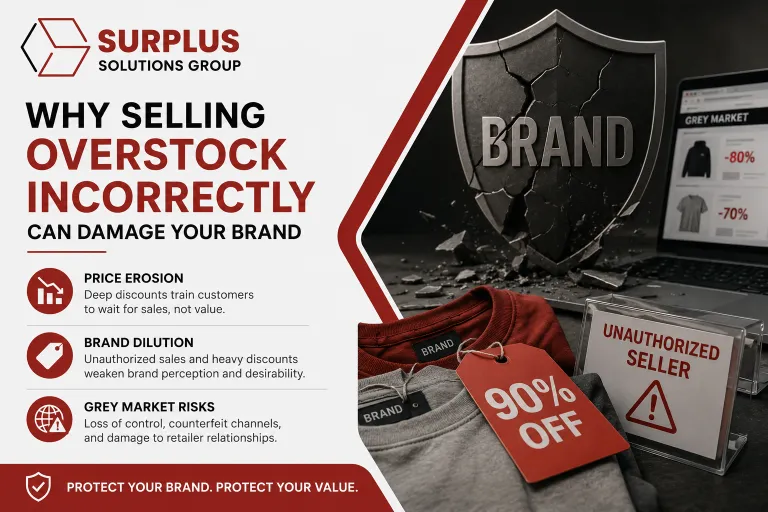
Why Selling Overstock Incorrectly Can Damage Your Brand
Price Erosion
Once your branded apparel appears publicly at 70% off, that becomes the reference price in your customer’s mind. They’ve seen it. They’ll wait for it again. Retailers who stocked you at full wholesale will notice. Some will ask for retrospective margin protection. Others will simply stop ordering.
The branded apparel liquidation market is smaller than you think. News travels quickly between buyers and trade partners. If your goods are spotted on a market stall or a third-party Amazon listing at a fraction of wholesale cost, word travels back to your trading partners faster than you’d expect.
Brand Dilution
Luxury and premium apparel brands understand this better than anyone. Burberry famously destroyed unsold stock rather than allow it to dilute brand positioning. That’s an extreme approach with its own reputational issues. But the instinct behind it is real. When surplus apparel buyers redistribute your goods through uncontrolled channels, your brand appears in contexts that contradict how you’ve positioned it.
Grey Market Risks
Goods that enter public marketplaces without territorial restrictions become grey market problems. A buyer in one region resells to another where you have active distribution. Your authorised distributor there suddenly faces competition from their own supplier’s excess. These situations take months to untangle and damage commercial relationships that took years to build.
Customer Trust Issues and Retailer Conflicts
Your direct customers feel misled if they paid full price last month. Your retail partners feel undercut if the same goods now appear at public clearance prices. Both outcomes affect repeat business, which is the metric that actually matters in fashion.
| Poor Liquidation Practices | Brand-Safe Liquidation Practices |
|---|---|
| Public discounting on marketplaces | Private wholesale to vetted buyers |
| Open sale to any bidder | Approved buyer network with restrictions |
| Uncontrolled pricing | Confidential agreements with MAP protection |
| Domestic dumping | Export to non-competing territories |
| One-time fire sale | Structured, relationship-based clearance |
What Causes Overstock Apparel? The Real Mechanics
You already know the surface causes. Here’s what’s underneath them.
- Seasonal fashion cycles are getting shorter. A product designed nine months ago for a trend cycle that has already moved on arrives in a warehouse with a shrinking window. Cancelled orders from retail partners are rising. In 2024 and 2025, mid-sized UK retailers cancelled significant volumes of forward orders as consumer confidence wavered. That stock had already been made.
- Excess manufacturing driven by MOQ pressure is something smaller brands fall into constantly. You need 5,000 units to hit a price point, but you only have firm demand for 3,000. The extra 2,000 sit in your warehouse burning cash at a holding cost that can reach 25 to 30% of the stock’s value per year, according to supply chain industry estimates.
- Slow-moving inventory compounds seasonally. A product that sells steadily in spring becomes liability by September. The longer it sits, the lower its excess clothing inventory recovery value becomes. Acting early, before the season passes entirely, consistently produces better outcomes than waiting for the lease renewal to force the decision.
The Best Ways to Sell Overstock Apparel Without Brand Damage
Here’s where the real decisions get made.
Private Wholesale Buyers
Private wholesale is the closest thing to a clean outcome. You sell directly to a buyer who operates outside your primary territory or channel. No public listing. No price visibility. No brand dilution.
The best wholesale apparel buyers operate under non-disclosure agreements as standard. They know that buying from brands requires discretion, and they protect it because their own commercial relationships depend on it. Recovery values through private wholesale typically run 20 to 50% of landed cost, depending on category, season, and volume.
The challenge is finding buyers you can actually trust, which is where a specialist intermediary earns their role.
Pros: High brand protection, controlled distribution, fair recovery value.
Cons: Takes longer to arrange than open-market channels, requires due diligence on buyers.
Confidential Inventory Liquidation
This is what we specialise in at Surplus Solutions UK. Our surplus stock clearance services are built around one principle: your brand doesn’t appear anywhere in the public domain without your explicit agreement.
Confidential liquidation means the buyer agrees in writing to territorial and channel restrictions. Your goods don’t appear on eBay UK if that creates a conflict with your retail partners. They don’t get relabelled and sold under a different identity, which is a practice that exists in the cheaper end of the liquidation market and that erodes the integrity of the goods.
We work directly with a vetted network of clothing overstock solutions buyers across Europe, the Middle East, and international markets. In our experience, moving goods geographically is one of the most effective forms of brand protection. A clearance sale in Eastern Europe does not affect your pricing in the UK or Germany.
Exporting Excess Inventory
Exporting is underused by UK brands managing fashion inventory liquidation. The logic is straightforward. Your overstock becomes someone else’s opportunity in a market where your brand either has no presence or where pricing expectations are different.
Export buyers typically purchase in bulk, move quickly, and operate in channels that are genuinely separate from your domestic retail relationships. Recovery values are not always the highest, but the brand protection value offsets that in most cases.
Post-Brexit, export documentation for non-EU markets has added a layer of complexity. Working with a buyer or intermediary who handles logistics and export compliance removes that friction entirely.
Off-Price Retail Partnerships
UK off-price retailers like TK Maxx operate formal branded supplier programmes. They purchase surplus apparel buyers’ stock under agreed terms that typically include brand presentation standards, price floors, and geographic restrictions.
This channel takes time to set up and has minimum volume requirements. But for brands with consistent overstock, it can become a reliable secondary channel that generates meaningful recovery value without public discounting.
The risk is that TK Maxx is visible to your customers and retail partners. This works fine for some brands and creates problems for others. It depends on your positioning and the relationship you have with your stockists.
B2B Apparel Liquidation Companies
Specialist apparel liquidation companies like Surplus Solutions UK offer a structured approach that removes most of the operational burden from your team. We assess the inventory, provide a fair valuation, arrange collection, handle logistics, and manage distribution through appropriate channels.
The advantage is speed and certainty. You get a decision quickly, a payment promptly, and the goods leave your warehouse on a schedule that suits your operational needs. For brands facing warehouse lease deadlines, creditor pressure, or upcoming range deliveries, certainty has real financial value.
Our branded apparel clearance process includes a full inventory review, buyer matching, and channel restriction management from day one.
Direct Sales to Approved Buyers
Some brands maintain their own approved buyer lists for overstock clothing buyers. These are pre-vetted partners who have signed brand protection agreements and who understand the rules around pricing, territory, and channel. Selling directly to approved buyers gives you the most control but requires an established relationship infrastructure that most brands don’t have in place before the problem arises.
| Sales Channel | Brand Protection | Recovery Value | Speed | Best For |
|---|---|---|---|---|
| Private wholesale | High | 20 to 50% | Medium | Branded, seasonal stock |
| Confidential liquidation | Very high | 15 to 45% | Fast | Volume with brand sensitivity |
| Export buyers | High | 10 to 35% | Fast | Non-domestic channel protection |
| Off-price retail | Medium | 25 to 55% | Slow to set up | Established brands, consistent volume |
| B2B liquidation company | High | 15 to 45% | Very fast | Urgent clearance, full-service |
| Approved buyer direct | Very high | 30 to 60% | Medium | Brands with existing buyer networks |
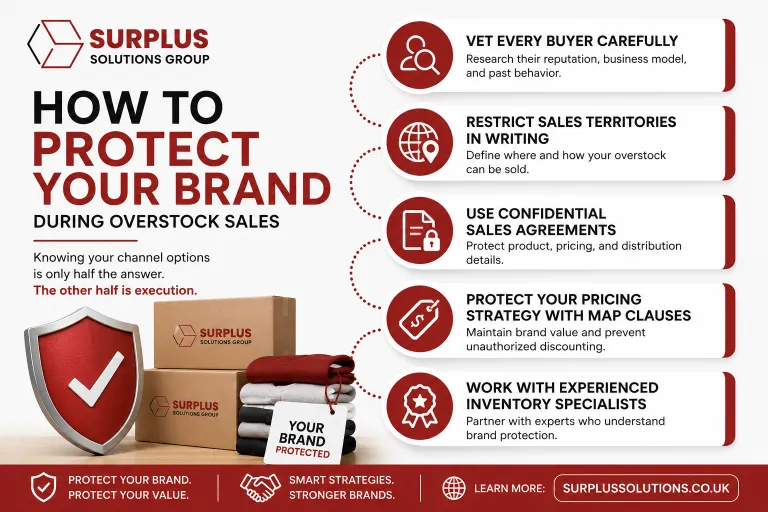
How to Protect Your Brand During Overstock Sales
Knowing your channel options is only half the answer. The other half is execution.
Vet Every Buyer Carefully
Any serious surplus apparel buyer should provide references, a track record, and evidence of how they’ve handled branded goods previously. Ask specifically where the goods will be redistributed. Ask what happens if their buyer wants to sell back into your primary territory. If those questions make a buyer uncomfortable, that tells you something important.
Restrict Sales Territories in Writing
Verbal agreements mean nothing in clearance. Every sale of branded excess clothing inventory should include a written territory restriction. Specify the countries and channels where redistribution is permitted. Include a clause about online marketplace restrictions if your brand appears on Amazon, eBay, or similar platforms.
Use confidential sales agreements.
A confidentiality agreement should cover both the terms of the transaction and the identity of the goods. You don’t want your competitors knowing what you moved, at what price, and through which channel. This is standard practice in professional inventory liquidation company arrangements and should be non-negotiable.
Protect Your Pricing Strategy with MAP Clauses
Minimum Advertised Price (MAP) clauses can be included in liquidation agreements. They prevent buyers from publicly advertising your goods below a price floor. This doesn’t always work in secondary markets, but it gives you a contractual basis for action if the clause is breached.
Work with Experienced Inventory Specialists
Honestly, this is the single most effective brand protection measure. A specialist who has done this hundreds of times knows which buyers respect brand restrictions and which ones don’t. They know which channels are genuinely confidential and which ones end up on public marketplaces despite what the buyer claimed. That institutional knowledge is worth more than any contractual clause.
At Surplus Solutions UK, our excess stock management approach for apparel clients starts with understanding your channel sensitivities before we discuss recovery value. The two aren’t in conflict. Protecting your brand and recovering meaningful value from your inventory are achievable together.
How to Choose the Right Overstock Apparel Buyer
Here’s a practical checklist for evaluating any buyer or intermediary:
- Track record with branded apparel: Can they name brands they’ve worked with and explain how they handled channel protection?
- Written confidentiality: Do they offer NDAs as standard, or only when pushed?
- Global buyer network: Do they have genuine access to export channels, or are they limited to domestic redistribution?
- Financial stability: Can they pay quickly and without conditions? A buyer who needs extended payment terms may be reselling before they’ve paid you.
- Logistics capability: Do they handle collection, or do they leave that to you?
- Transparency in valuation: Do they explain how they’ve arrived at their offer or just present a number?
- Approach to problem stock: What happens if part of your inventory doesn’t move through their primary channel?
The last point matters more than most brands realise. No buyer moves 100% of a mixed lot through a single channel at a uniform price. The question is what they do with the remainder, and whether that remainder ends up somewhere that creates a problem for your brand.
Private Liquidation vs Public Clearance Sales
The difference between these two approaches isn’t just about price. It’s about what happens to your business after the stock has moved.
| Feature | Private Liquidation | Public Clearance |
|---|---|---|
| Brand image | Protected | At risk |
| Pricing control | High | None |
| Retail relationships | Preserved | Potentially damaged |
| Confidentiality | Standard | None |
| Customer perception | Unaffected | Negative impact likely |
| Long-term value | High | Low |
| Recovery speed | Medium | Fast |
| Best for | Branded, premium apparel | Commodity, unbranded stock |
Public clearance, whether through open auctions, marketplace listings, or factory sales events, trades speed for control. If your brand is price-sensitive, relationship-dependent, or positioned above the discount end of the market, public clearance is almost always the wrong choice. The recovery rate might look attractive on day one. The downstream commercial cost rarely gets accounted for.
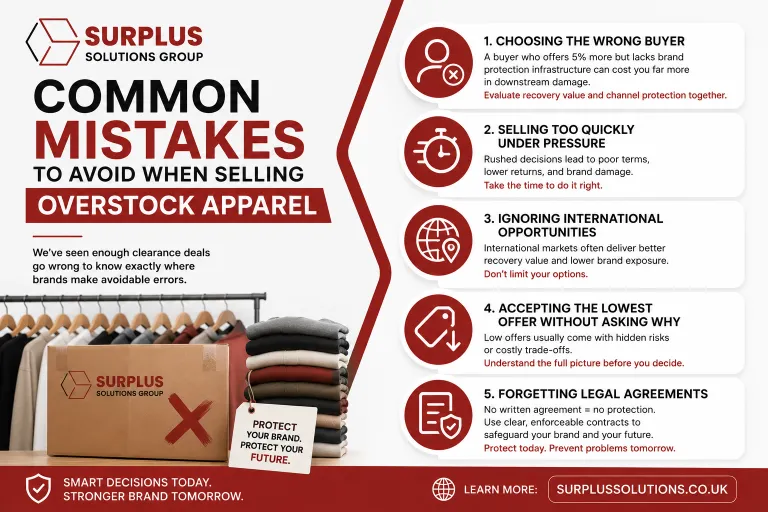
Common Mistakes to Avoid When Selling Overstock Apparel
We’ve seen enough clearance deals go wrong to know exactly where brands make avoidable errors.
Choosing the Wrong Buyer
The most common mistake. A buyer who offers 5% more than the competition but has no brand protection infrastructure will cost you more than that 5% in downstream problems. Recovery value and channel protection are not separate considerations. Evaluate them together.
Selling Too Quickly Under Pressure
Warehouse pressure, creditor pressure, and cash flow pressure are real. But panic selling produces the worst outcomes. Even a two-week delay to properly identify the right buyer for your clothing overstock solutions situation will typically produce a better result than rushing to the first offer.
Ignoring International Opportunities
UK brands consistently underuse export channels. The assumption that international buyers mean lower recovery values is often wrong. In our experience, goods moved to the right export buyer frequently recover as much as domestic private wholesale, with better brand protection.
Accepting the Lowest Offer Without Asking Why
A low offer sometimes reflects genuine market realities about your stock. But sometimes it reflects a buyer’s cost of working around problematic channel restrictions. Ask why the offer is where it is. The answer tells you a lot about how they plan to resell the goods.
Forgetting Legal Agreements
Every apparel liquidation transaction should be documented. This isn’t bureaucracy. It’s protection. If goods end up somewhere they shouldn’t, you need a contractual basis for action.
Sustainable Overstock Solutions That Protect Brand Reputation
In 2026, how you dispose of surplus stock is as visible as what you sell. Brands that destroy unsold inventory face ESG scrutiny. Brands that dump goods into uncontrolled channels face a different kind of reputational risk.
The Ellen MacArthur Foundation estimates that circular fashion could represent 23% of the global fashion market by 2030. That’s a $700 billion opportunity. UK-specific data from Soles4Souls puts the UK second-hand apparel market at £4.8 billion, driven partly by Gen Z consumers who now prefer pre-loved purchases.
Circular fashion approaches for surplus apparel buyers include the following:
- Recommerce programmes that bring stock back into controlled channels at lower price points
- Textile recycling for genuinely end-of-life garments that can’t be resold
- Charitable donation for goods below resale threshold, which has tax benefit implications
- Responsible redistribution through buyers who operate sustainably certified resale channels
Our ethical stock clearance services at Surplus Solutions UK include responsible options for every tier of inventory condition. Not everything is sellable. What matters is that non-sellable goods are handled in a way your brand can stand behind.
Why Partnering with an Experienced Overstock Specialist Matters
Here’s the thing about doing this yourself. The fashion inventory liquidation market is not transparent. Buyer reputations are not public. Channel restrictions are routinely ignored by buyers who signed agreements to respect them. Recovery values vary significantly based on who you’re negotiating with and how experienced you are in the sector.
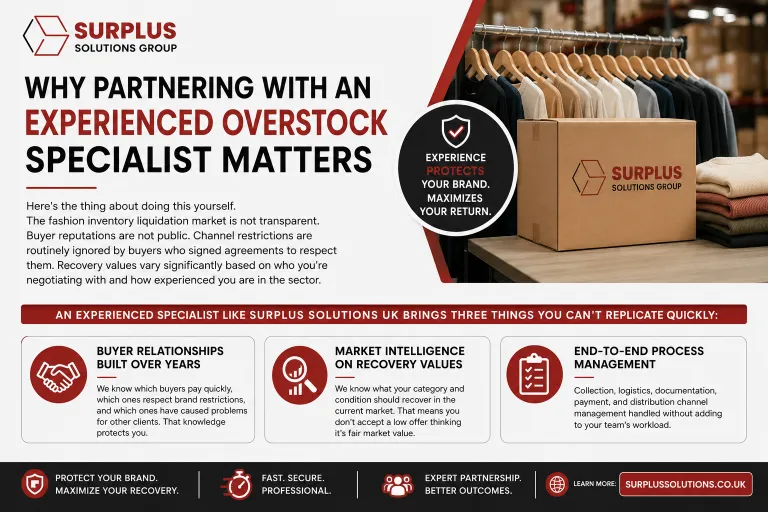
An experienced specialist like Surplus Solutions UK brings three things you can’t replicate quickly:
- Buyer relationships built over years: We know which buyers pay quickly, which ones respect brand restrictions, and which ones have caused problems for other clients. That knowledge protects you.
- Market intelligence on recovery values: We know what your category and condition should recover in the current market. That means you don’t accept a low offer thinking it’s fair market value.
- End-to-end process management: Collection, logistics, documentation, payment, and distribution channel management handled without adding to your team’s workload.
We work under strict brand protection requirements and operate with full confidentiality across all branded apparel liquidation projects. Our surplus stock buyer services cover everything from a single pallet of overstock clothing to full warehouse clearances across the UK.
Final Thoughts: Recover Value Without Sacrificing Your Brand
Overstock apparel is not a crisis. It’s an operational reality that every brand in fashion faces, every season, at every scale. The brands that handle it well are the ones that plan their clearance strategy before the pressure hits, not in the middle of it.
The channel you choose matters more than the speed you move at. A confidential sale to a vetted export buyer that takes three weeks will almost always produce a better outcome than an open marketplace listing that clears in three days.
Three months ago, we cleared a UK contemporary womenswear brand’s excess winter stock through private export channels without a single unit appearing in their domestic retail market. Recovery was 38% of landed cost. More importantly, their spring wholesale accounts had no idea it happened.
That’s what getting this right looks like. It’s not dramatic. It’s just smart inventory management.
If you’re facing a clearance challenge right now, our excess apparel stock clearance team would be happy to review your inventory and tell you honestly what the options look like. No fixed figures without seeing the stock. No pressure to make a decision before you’re ready. Just a straight conversation about what your goods are worth and how to move them without your brand paying the price.
What’s sitting in your warehouse right now that you haven’t found the right home for?