
Food businesses across the UK face the same frustrating problem: stock builds up faster than it moves. Whether it’s a cancelled order, a change in demand, or a supplier delivering more than expected, excess food inventory sits in warehouses taking up space, draining cash, and ticking toward expiry. According to WRAP, the UK generates around 9.5 million tonnes of food waste each year, and a significant share of that comes from the supply chain rather than households. Knowing how to handle excess food inventory without waste is not just good practice, it directly affects your margins, your compliance obligations, and your reputation with buyers and retailers. This guide covers the most effective methods of Food waste reduction business UK, and retailers are using right now to manage surplus food stock before it becomes a write-off.
Why Excess Food Inventory Becomes a Problem (and Fast)
Overstocked food inventory rarely stays manageable for long. Unlike other product categories, food has a hard deadline. Once the clock runs out, your options narrow quickly, and the costs stack up before most businesses notice. Storage costs are the first pressure point. Refrigerated and ambient warehouse space costs money every day the stock sits there. Beyond that, there is the cash flow impact: capital tied up in surplus food stock cannot be reinvested, paid to suppliers, or used to cover operational costs. If the stock is eventually written off, that loss runs straight through the P&L.
There is also the environmental liability side. Disposing of food incorrectly, even accidentally can breach your Duty of Care obligations under the Environmental Protection Act 1990. From March 2025, food overstock management also has to account for the Simpler Recycling regulations, which require businesses to separate food waste from general waste. Failing to comply carries fines and, in severe cases, brand damage that is far harder to recover from than the original stock loss.
The other issue is what happens when overstock appears on the market without proper controls. If short-dated product moves through unmanaged channels, grey markets, unauthorised resellers, it can undermine retailer relationships and damage brand equity in ways that outlast the stock problem itself.
Why Food Inventory Becomes Surplus in the First Place
Most excess food inventory does not happen because a business is careless. It usually builds up after one or two commercial changes that happen quickly.
Common causes include:
- A retailer cancelling or reducing an order
- Seasonal demand dropping earlier than expected
- Overproduction after a forecast was too optimistic
- Packaging changes that make old stock harder to sell
- Product delisting by a supermarket or wholesale buyer
- Supplier minimum order quantities creating more stock than needed
- Slow-moving SKUs being hidden behind faster-moving products
- Poor FIFO discipline inside the warehouse
For example, a food manufacturer may produce stock for a supermarket promotion, only for the promotion to be cancelled or reduced. The product is still safe and saleable, but the original route to market has disappeared. That is when the business needs a fast recovery plan rather than waiting until the stock becomes a write-off.
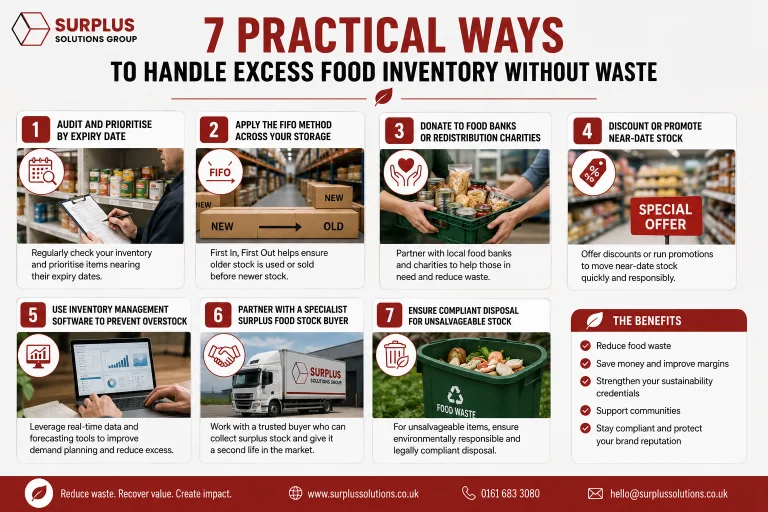
7 Practical Ways to Handle Excess Food Inventory Without Waste
Understanding how to handle excess food inventory without waste starts with knowing which option fits your situation. The right approach depends on volume, shelf life remaining, product type, and your operational capacity. Here are seven methods that consistently work across the supply chain.
1. Audit and Prioritise by Expiry Date
The first step is always visibility. Before you can act on overstocked food inventory, you need a clear picture of what you have, how much of it there is, and crucially, how much shelf life is left. Pull a full audit of your storage areas and categorise stock by best-before date and use-by date. These are not interchangeable: use-by dates govern food safety, while best-before dates relate to quality. What to do with near expired food stock should be decided immediately after the audit. Short-dated stock that sits unmanaged for even a few days can move from a recoverable situation to a write-off. Prioritising by expiry date ensures your response is targeted and timely.
2. Apply the FIFO Method Across Your Storage
The best way to reduce food waste in a warehouse over the long term is consistent rotation. FIFO, First In, First Out, is the standard for a reason. Older stock moves first, reducing the chance that newer deliveries cover product that is quietly ageing at the back. Effective FIFO relies on organised storage, clear labelling, and consistent stock rotation. In practice, many food businesses know FIFO in theory but apply it inconsistently under operational pressure. That gap is often where overstock problems begin.
3. Donate to Food Banks or Redistribution Charities
Food surplus redistribution UK options have expanded considerably in recent years. Organisations like FareShare and the Trussell Trust network accept bulk food donations from manufacturers, retailers, and distributors, redirecting them to people in need. Is donating food to a food bank tax deductible in the UK? Donations may offer tax benefits depending on your business structure, so seek professional tax advice if needed.
Redistribution works best for stock that is safe, labelled correctly, and has meaningful shelf life remaining. It is not a route for damaged goods or products with days left on the clock. But for surplus food with usable shelf life that is still in good condition, it is one of the more straightforward options, and it avoids disposal entirely.
4. Discount or Promote Near-Date Stock
What should I do with excess food inventory that still has weeks left on the shelf? Moving it at a discount is often the most financially efficient option. Customers are increasingly comfortable buying near-date products, platforms like Too Good To Go have normalised the idea for consumers, and B2B buyers in the food service and hospitality sectors are often receptive to discounted near-date products when the saving is meaningful.
The key is acting early enough. A product with three weeks left can be discounted and moved. The same product with four days left is much harder to place. Internal promotions, trade customer offers, and third-party discount platforms all have a role here, but the window to use them effectively is shorter than most businesses assume.
5. Use Inventory Management Software to Prevent Overstock
How do you reduce food waste in a food business? Prevention is always cheaper than response. Accurate demand forecasting and disciplined purchasing are the two levers that reduce overstock before it happens. Modern inventory management platforms give you visibility into stock levels, movement rates, and reorder points. Setting par levels, the minimum and maximum quantities you hold, prevents over-ordering during quieter periods. JIT ordering (just-in-time) keeps stock lean for high-turnover products, though it requires reliable supplier relationships to work consistently. Modern inventory tools can identify slow-moving stock and forecasting issues before they become costly.
6. Partner with a Specialist Surplus Food Stock Buyer
For larger volumes or time-sensitive situations, working with a food surplus buyer is often the fastest and most value-recovering option. Specialist buyers purchase surplus food stock buyers UK-wide, including overstock, time-sensitive food stock, cancelled orders, and discontinued lines at agreed prices, with collection arranged promptly. Who buys short-dated food stock in the UK? Companies like Surplus Solutions Group, based in Leyland, Lancashire, operate nationally and handle everything from ambient grocery to chilled and frozen stock. They can typically provide a valuation within 24 to 48 hours and arrange collection within days.
This route also protects brand protection interests. Reputable surplus buyers work under agreed terms that prevent stock from entering grey market channels or appearing in unauthorised retail locations. For branded manufacturers especially, that control is worth as much as the cash recovered. If you need to sell surplus food stock UK without risking brand damage or market disruption, a specialist buyer with a clear contract is the right approach. While some value loss is often unavoidable, a specialist buyer usually delivers a better outcome than disposal.
7. Ensure Compliant Disposal for Unsalvageable Stock
What is food liquidation UK? In the broadest sense, it refers to the clearance of stock that can no longer be sold or redistributed, moving it out of the business through whatever legal route remains available. For genuinely unsalvageable products, the compliant options are composting and anaerobic digestion. Both are regulated by the Environment Agency. Businesses must use a licensed waste carrier and maintain appropriate records under their Duty of Care obligations. Simply sending food waste to landfill is not compliant for most categories of food waste, and doing so without documentation creates liability.
This should be the last resort, not the default response to surplus stock. If your business regularly reaches this point, it is a signal that earlier-stage interventions (forecasting, rotation, redistribution, selling) need to be strengthened.
What to Do With Surplus Food Inventory That Is Near Expiry
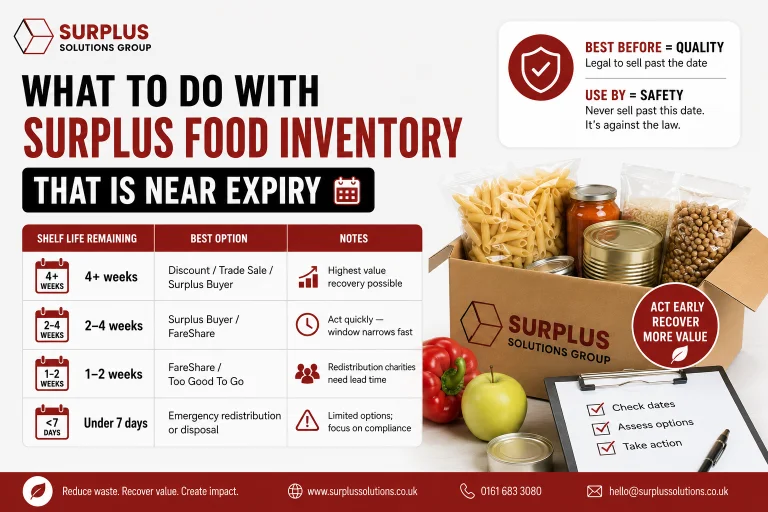
Near expiry food inventory sits in a specific legal and commercial window that many businesses do not fully understand. The rules differ depending on the date type on the label. Can you sell food past best before date UK? Yes, it is legal to sell short-dated food inventory legally UK, provided the product is safe to eat and you are transparent about its condition. The Food Standards Agency (FSA) is clear that best-before dates are about quality, not safety. Selling past this date is permitted. However, food must never be sold past its use-by date, doing so is a criminal offence under UK food safety law.
How to sell short-dated food inventory legally UK also means ensuring labelling is accurate, storage conditions have been maintained, and there is no evidence of spoilage. Buyers, whether trade or consumer, have the right to accurate product information. For short-dated food stock UK with weeks remaining, the commercial routes, discounting, trade sales, surplus buyers, are all available. For product with days remaining, redistribution charities may still accept it if they can distribute quickly. If neither is possible, compliant disposal is the only remaining option.
The Cost of Waiting Too Long
Shelf life directly affects recovery value. A product with 10 weeks remaining may attract several trade buyers. The same product with 2 weeks remaining may only be suitable for redistribution or emergency clearance. That is why early action matters. If your warehouse team can flag slow-moving stock while there is still a realistic selling window, you have more options: discounting, trade sale, export, redistribution, or sale to a specialist buyer. Once the product is too close to expiry, the conversation changes from “How much value can we recover?” to “How do we avoid a total loss?” A simple rule: if stock is not moving as expected and has less than 8–10 weeks of life remaining, treat it as urgent.
Near Expiry Options at a Glance
| Shelf Life Remaining | Best Option | Notes |
|---|---|---|
| 4+ weeks | Discount / Trade Sale / Surplus Buyer | Highest value recovery possible |
| 2–4 weeks | Surplus Buyer / FareShare | Act quickly — window narrows fast |
| 1–2 weeks | FareShare / Too Good To Go | Redistribution charities need lead time |
| Under 7 days | Emergency redistribution or disposal | Limited options; focus on compliance |
Which Solution Works Best for Different Types of Surplus Stock?
What are the options for excess food inventory? The short answer is: more than most businesses realise, but only if you act before the expiry window closes. Not every surplus stock problem needs the same solution. A few pallets of near-date retail stock need a different response from a full warehouse of cancelled promotional goods. The best route depends on shelf life, volume, product condition, storage type, and whether brand control matters.
| Surplus Stock Situation | Best Option | Why It Works |
|---|---|---|
| 20+ pallets of ambient food with 6–12 weeks shelf life | Specialist surplus food stock buyer | Fastest route to recover value and clear warehouse space |
| Short-dated chilled or frozen stock | Surplus buyer or redistribution partner | Timing is critical, so collection speed matters |
| Small volumes of edible stock | Food bank or redistribution charity | Practical for lower quantities with enough shelf life |
| Seasonal packaging or old promotional stock | Excess food stock clearance | Product is still saleable, but normal retail demand has passed |
| Cancelled supermarket or wholesale order | Surplus buyer | Helps recover value without holding dead stock |
| Product past its use-by date | Licensed disposal | Cannot legally be sold or redistributed |
| Damaged, contaminated, or unsafe stock | Compliant waste route | Protects the business from food safety and Duty of Care issues |
The key is not waiting until every option disappears. Stock with several weeks of life remaining can often be sold, redistributed, or cleared through controlled channels. Stock with only days left is much harder to place and usually returns less value.
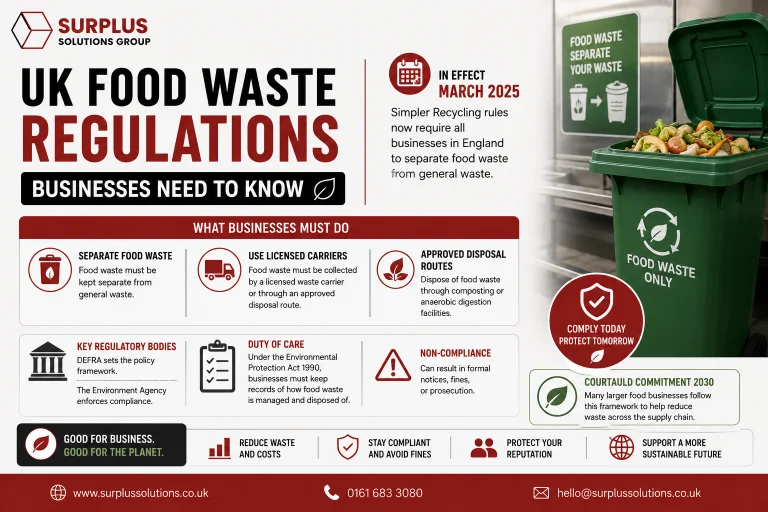
UK Food Waste Regulations Businesses Need to Know
How to avoid food inventory waste UK regulations is a question that has become more pressing since March 2025, when the Simpler Recycling rules came into effect for businesses in England.
What are the UK food waste laws for businesses in 2025?
Under the updated regulations, all businesses, regardless of size, must separate food waste from general waste. This means food waste cannot go into general refuse bins. It must be collected by a licensed waste carrier or disposed of through an approved route such as composting or anaerobic digestion.
The key regulatory bodies are DEFRA, which sets the policy framework, and the Environment Agency, which enforces compliance. The Duty of Care under the Environmental Protection Act 1990 requires businesses to keep records of how food waste is managed and disposed of. Non-compliance can result in formal notices, fines, or prosecution. Many larger food businesses also follow the Courtauld Commitment 2030 framework to help reduce waste across the supply chain.
How Selling Surplus Food Stock Protects Your Brand
How to manage excess food stock is not just an operational question, it is a brand question. How your surplus product enters the market, and through what channels, has a direct impact on consumer perception and retailer confidence. Uncontrolled excess food stock clearance, stock sold through unverified resellers or appearing in markets where your brand is not positioned, can create pricing conflicts and undermine relationships with your primary retail accounts. A major retailer who finds your product at significantly lower prices in an unauthorised channel has legitimate grounds to renegotiate terms.
For example, a manufacturer may have old packaging after a redesign, or promotional stock left after a supermarket campaign ends. If that stock appears in the wrong discount channel, it can undercut existing retail partners and create awkward pricing conversations. A controlled clearance route helps move the product without damaging the brand’s main sales relationships. Working with a reputable surplus buyer solves this. A professional buyer operates under agreed confidentiality terms, controls where product is sold, and in many cases restricts export or resale geography. Your brand equity stays intact, and the stock moves without generating market noise. This is why branded manufacturers in particular should be selective about who they work with. Before agreeing to a sale, make sure the buyer can clearly explain how your stock will be handled and where it will be sold.
Ready to Clear Your Excess Food Inventory?
If you are holding surplus food stock and need a fast, professional solution, Surplus Solutions Group can help. We buy excess food inventory nationally across the UK, including short-dated stock, overstock, cancelled orders, and discontinued lines and offer valuations within 24 to 48 hours with collection arranged to suit your timeline. Based in Leyland, Lancashire, we work with food manufacturers, distributors, and retailers from Preston and North West England through to Nationwide UK. Our approach is confidential, commercially fair, and designed to protect your brand in the process.
If you need to sell excess food stock UK, or simply want to explore your options, contact Surplus Solutions Group today. We are one of the leading food stock buyers near me Leyland Lancashire and across the country and we are ready to move quickly when the clock is ticking.