
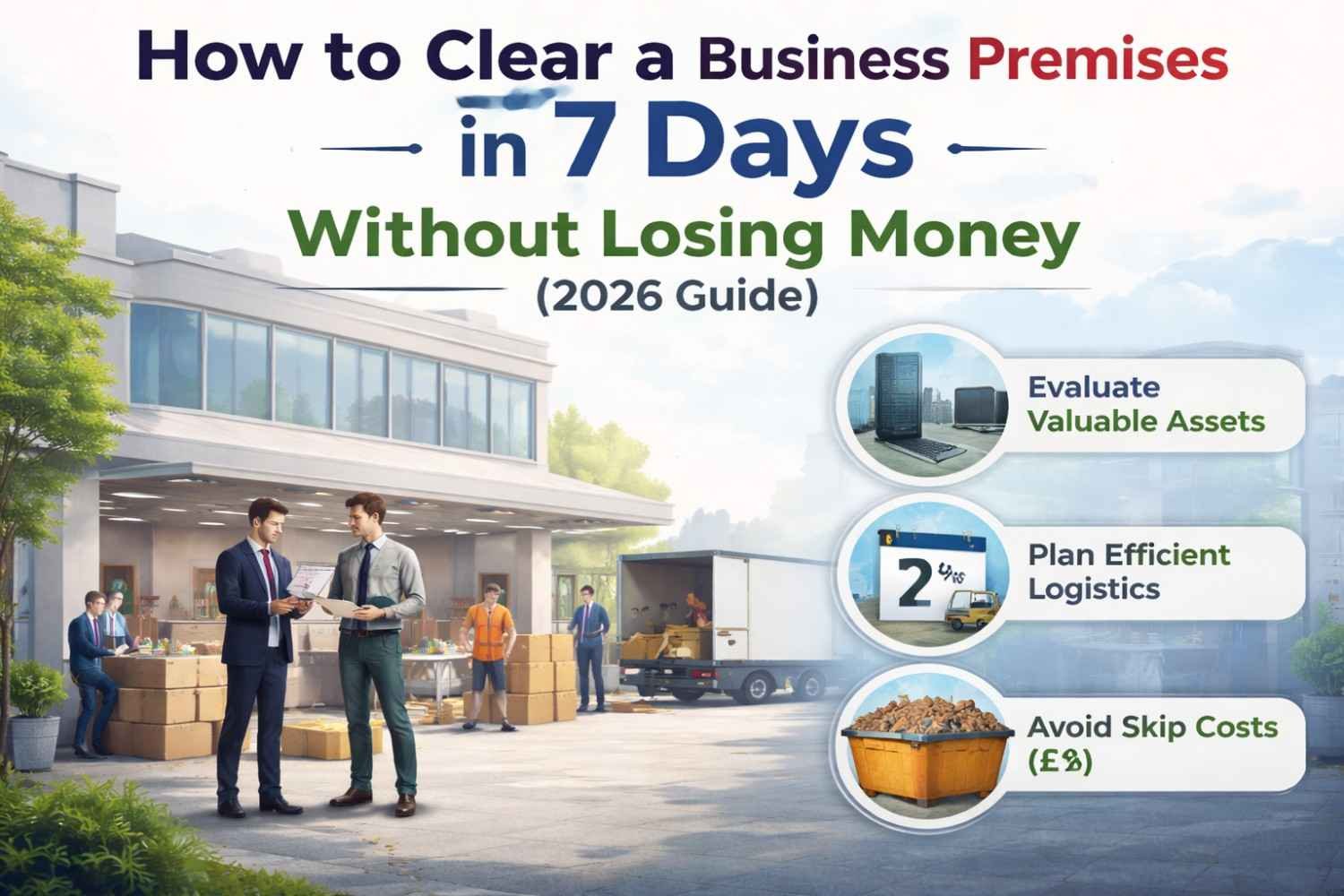
It Was a Tuesday Morning in March 2026
A distribution company in Preston had 10 days left on their commercial lease. Three floors of desks, server racks, industrial shelving, filing cabinets, and enough surplus stock to fill two lorries. The manager’s first call? A skip company.
That single decision nearly cost them £4,200.
Here is what most business owners do not realize. When you are facing a tight deadline on a business premises clearance, the skip is never your first call. It is your last. The businesses that come out ahead financially are the ones that ask one question before anything else: what inside these walls still has value?
If you are looking at a lease-end notice right now and wondering how to clear a business premises without losing money in the process, this guide is built for exactly that situation. You will get the full 7-day plan, the real cost figures for 2026, the legal obligations most businesses forget, and the recovery strategies that competitors simply do not cover.
What You Will Get From This Guide
This is not a surface-level overview. By the end of this article, you will know:
- The exact day-by-day 7-day schedule that minimises cost and maximises recovery
- How to turn a commercial property clearance from a pure expense into a partial or full recovery
- The legal obligations around GDPR, WEEE regulations, and dilapidations clauses that carry real financial risk
- Which assets hold the strongest resale value, and where can they be moved fast
- How to approach the final landlord inspection so you keep your deposit
In 2026, UK businesses undergoing unplanned business premises clearance lose an estimated £2,300 on average through rushed decisions. Most of that loss is completely avoidable.
What Should You Do First When Clearing a Business Premise?
Before you book a single van or call any contractor, spend two hours on one task: a physical inventory audit.
Walk through every room with your phone camera. Document what is there. Then sort everything into four categories:
- Sell: Items with resale value that can move within 72 hours
- Donate: Items charities will collect free, often with tax benefits attached
- Recycle: WEEE-compliant electronics, metals, paper, and cardboard
- Dispose: Genuine waste with no recovery value whatsoever
Most businesses skip this step entirely and treat everything as disposable. That is the single most expensive mistake in any business premises clearance. In our experience working with businesses across the UK, the sell category alone typically covers 30 to 50 percent of total clearance costs when handled correctly.
To value items quickly, use eBay sold listings. Search the exact model number and filter by sold items, and you get a real 72-hour market price in under five minutes. Google Lens identifies products instantly when you do not know what you are looking at. This two-hour process regularly surfaces thousands of pounds in recoverable value that would otherwise go into a skip.
If your premises hold significant assets worth recovering, businesses working with a specialist buyer before the clearance begins consistently spend less overall.
What Is the Best 7-Day Schedule for a Business Premises Clearance?
This is the schedule most competitors never share. They tell you to hire a clearance company and step back. That advice costs money.
| Day | Priority Actions |
|---|---|
| Day 1 | Contact the landlord in writing, complete a full inventory audit, and sort into four categories |
| Day 2 | List high-value assets on Facebook Marketplace, Gumtree, and BizAuctions |
| Day 3 | Book charity collections: British Heart Foundation, Emmaus UK, Furniture Re-use Network |
| Day 4 | GDPR-compliant IT asset disposal and certified data destruction |
| Day 5 | Company clearance contractor visits for the remaining items |
| Day 6 | Professional deep clean and snag check |
| Day 7 | Final landlord walkthrough with full photographic evidence |
The insight here is sequencing. Most people do these steps in reverse order. They call a clearance company on Day 1 and then wonder why the bill is high. Sell first. Donate seconds. Clear what genuinely remains. This approach consistently reduces net commercial property clearance costs by 35 to 60 percent.
The landlord conversation on Day 1 is also the highest-ROI action you can take. A short, professional email showing you have a structured clearance plan often buys goodwill, and occasionally an extension, that changes the entire financial picture.

How much does it cost to clear business premises in the UK in 2026?
The figures you find on most websites are outdated. Here are the real 2026 numbers based on current market rates across the UK.
| Premises Type | Basic Clearance | Full Managed Clearance |
| Small office (under 1,000 sq ft) | £300 to £650 | £900 to £1,600 |
| Medium office (1,000 to 3,000 sq ft) | £650 to £1,300 | £1,600 to £3,200 |
| Large warehouse or factory | £1,600 to £4,500 | £3,500 to £9,000+ |
London and the South East add roughly 35 to 55 percent to these figures. The North West, including Manchester, Preston, and Liverpool, sits at the competitive lower end. Yorkshire and the Midlands fall in the middle.
Three things drive costs up significantly:
- Hazardous materials on site: fluorescent tubes, old batteries, industrial chemicals
- Restricted access: no loading bay, upper floors with no lift, narrow stairwells
- Volume underestimation: businesses routinely misjudge by 30 to 40 percent
Please ensure you obtain three written quotes within 24 hours. Any credible business premises clearance provider will survey quickly and quote clearly. Watch out for verbal-only quotes, cash-only payment requests, and any contractor that cannot provide a valid waste carrier license from the Environment Agency.
Businesses comparing the real cost difference between a standard clearance and a hybrid approach that includes asset purchasing tend to find the gap is larger than they expected.
Can you actually make money when you clear business premises?
Yes. This is the section that most competitors leave out entirely, and it is worth reading carefully.
A business premises clearance is not just an expense. It is a recovery opportunity. The businesses that understand these principles consistently spend far less and sometimes walk away with a net positive.
At Surplus Solutions Group, before we touch a single item for any client, we ask, “What here can we buy?” We purchase surplus stock, liquidation stock, office furniture clearance items, industrial equipment, and company assets directly from businesses vacating their premises. You get paid. We arrange collection. The clearance cost drops significantly or disappears.
Here are the assets that consistently hold the strongest resale value:
- Ergonomic chairs from Herman Miller and Steelcase: 40 to 70 percent of original retail value
- Height-adjustable desks and sit-stand workstations
- Industrial shelving and pallet racking
- Server racks, networking gear, and IT hardware
- Commercial catering and kitchen equipment
- Forklift trucks and warehouse machinery
A Birmingham print company in early 2026 listed 22 workstations and a full set of industrial shelving before engaging any clearance company. That single decision returned £3,400 and reduced the remaining clearance bill to almost nothing.
For high-value equipment where competitive bidding makes a real financial difference, an on-site auction service can recover significantly more than a private sale.
What Are Your Legal Obligations When Vacating a Commercial Property?
This is where most businesses lose money without realizing it until the invoice arrives three weeks after handover.
Read your dilapidations clause before Day 1. Your commercial lease’s dilapidations clause precisely outlines the condition in which you must return the property. If items are left behind, if flooring is damaged, or if the premises are not professionally cleaned, your landlord is entitled to charge for remediation. That charge can exceed the cost of a proper clearance by a significant margin.
GDPR and data destruction are non-negotiable. Every hard drive, server, and data-bearing device must be destroyed to ICO standards before disposal. A Devon accountancy firm received an £80,000 fine in 2023 for disposing of hard drives without certified data wiping during a rushed commercial property clearance. That case is not unusual. It is a warning that applies to every business clearing premises.
WEEE regulations mean electronics cannot go into general waste. Monitors, printers, servers, and all electrical equipment must go through a registered WEEE compliance scheme or a certified IT asset disposal company.
Registered waste carrier license verification matters. Any company removing waste from your business premises must hold a valid Environment Agency-registered waste carrier license. If they fly-tip your waste, you carry shared liability. Verify the license yourself through the Environment Agency public register before signing anything.
A licensed, compliant operator handles responsible waste disposal for businesses, shielding you from liability even after returning the premises.
How Do You Choose the Right Company Clearance Partner?
Not all clearance companies operate the same way. Here is what separates a professional company clearance provider from an unlicensed operator with a cheap quote.
What to look for:
- Valid Environment Agency waste carrier license (verify independently, do not take their word)
- Public liability insurance of at least £1 million
- Verifiable reviews on Trustpilot or Checkatrade
- Written itemised quote separating labour, disposal, and VAT clearly
- Specific experience with your premises type: office, warehouse, clearance, retail, factory
Red flags to walk away from:
- Verbal quote only, with nothing in writing
- Cash-only payment structure
- No mention of recycling, sustainability, or compliant disposal
- No waste transfer notes offered on completion
A good business asset disposal partner does not just remove items. They assess value first, offer purchase options where appropriate, and provide full documentation at every stage.
The most cost-effective model in 2026 is the hybrid approach: a specialist buyer like Surplus Solutions Group purchases your saleable assets, and the remaining waste is cleared by a licensed contractor. Clients using this model regularly reduce their net clearance cost by more than half.
Companies offering full company clearance alongside direct asset purchasing represent the most financially efficient solution for most UK business closures and relocations.
What Do You Do With IT Equipment and Business Data During a Clearance?
This section gets skipped frequently. It should be the second conversation you have, right after the inventory audit.
When you are clearing a commercial property, your GDPR obligations do not pause because you are vacating the building. Data remains your legal liability until it is provably and documentably destroyed.
Your three options for IT asset disposal:
- Certified ITAD company: Issues a certificate of destruction per device. This is the gold standard for legal protection.
- Specialist electronics buyer: Working IT equipment has real resale value. Surplus Solutions Group purchases surplus electronics and can arrange certified data wiping before collection.
- Consumer trade-in schemes: Suitable for newer individual devices only. Not appropriate for bulk business hardware or servers.
Do not dispose of old servers until you have had them valued. A single server rack can return £500 to £2,000 depending on age and specification. Laptops return £50 to £400 per unit. Networking equipment frequently returns £200 to £800 per rack.
Selling surplus electronics and IT hardware from office and warehouse clearances, rather than disposing of them, is one of the quickest ways to reduce the overall cost of vacating premises.
The Most Expensive Mistakes Businesses Make During a Premises Clearance
I have watched businesses make every single one of these. Here they are in order of financial damage:
- Calling a skip company before doing an inventory. You pay to remove items that had genuine value.
- Ignoring the landlord until Day 7 means that a Day 1 conversation can change the entire negotiating position.
- Skipping data destruction. GDPR liability does not end with the lease.
- Underestimating waste volume. Budget 30 to 40 percent more than your initial estimate.
- Hiring an unlicensed clearance operator. Initially cheap, but potentially costly in terms of enforcement consequences.
- Professional cleaning should be left until the day of handover. Book it for Day 6. You need margin for error.
Businesses that handle how to clear their premises most effectively treat it as a structured project with a budget, a recovery target, and a timeline. This is not a panic response to a deadline.
A common misconception is that you can simply call a clearance company and have them manage everything. That approach works. It also leaves a significant portion of the financial recovery unclaimed. Sell first. Donate second. Clear what remains.
How to Prepare for the Final Landlord Inspection
Day 7 is not the time for surprises. Start preparing on Day 6.
Before the inspection, make sure you have:
- Photographs of every room from at least two angles
- A full video walkthrough of the empty premises
- Copies of all waste transfer notes and data destruction certificates
- Your dilapidations clause is in hand, so you know what the landlord is measuring against
During the inspection:
- Walk room by room with the landlord or their surveyor
- Note any disputed points in writing before you leave the building
- Do not sign any document that includes charges you have not agreed to
If you receive a dilapidations invoice you disagree with, you have the right to commission an independent surveyor’s report. Charges must reflect actual reinstatement costs. A commercial solicitor is worth engaging if the disputed amount exceeds £2,000.

Regional Considerations for Business Premises Clearance Across the UK in 2026
Commercial property clearance costs and timelines vary significantly by region. Here is what to factor in:
| Region | Cost Variation | Resale Market Strength | Notes |
| London and South East | +35 to 55% | Very strong for office assets | Strict WEEE enforcement |
| North West (Manchester, Preston, Liverpool) | Baseline | Strong for industrial equipment | Competitive clearance pricing |
| Midlands (Birmingham, Coventry) | Baseline to +10% | Strong for manufacturing assets | Good logistics access |
| Yorkshire (Leeds, Bradford, Sheffield) | Baseline | Strong for retail and textile stocks | Good charity networks |
| Scotland | +5 to 15% | Moderate | Allow extra lead time |
Surplus Solutions Group operates nationally. Whether you are clearing an office in London or completing a warehouse clearance in Lancashire, the team covers the full UK with the same speed and standards.
Full company clearance services across the UK, including asset purchasing and responsible disposal, are available for businesses at any stage of relocation or closure.
Can Donating Business Assets Save You Money on Taxes?
Most businesses in a clearance situation never pursue this option. That is a mistake.
If your company is VAT registered and donates assets to a registered charity, those items may qualify as zero-rated for VAT purposes. For corporation tax, donated assets recorded at market value can be treated as a deductible business expense. Speak to your accountant before clearance begins and document everything.
UK charities that collect business assets:
- British Heart Foundation: 48-hour collections in most UK cities
- Emmaus UK: nationwide furniture and equipment collections
- Furniture Re-use Network: directory of local members across the UK
Most charities accept good-condition office furniture, shelving, filing cabinets, and kitchen equipment. They will not accept damaged items, mattresses, or anything requiring repair. Confirm acceptance before booking a collection slot.
Conclusion: The 7 Days That Decide Your Financial Outcome
Most businesses treat commercial property clearance as something that happens to them under pressure. The ones that come out financially ahead treat it as a managed project with a recovery target.
That Preston distribution company from the beginning of this guide? They almost paid £4,200 to skip disposing of £6,000 worth of recoverable assets. Once they followed the inventory-first approach outlined in this guide, they recovered £4,800 from asset sales, donated a significant portion to the British Heart Foundation, and had the cleanest landlord handover of any premises the building manager had seen that year.
By 2027, the majority of UK commercial clearances will use some form of hybrid model, combining direct asset purchasing with managed clearance, because businesses are getting smarter about what their contents are actually worth.
If you are facing a clearance deadline right now, start with the two-hour inventory audit. It is the highest-value action you can take before anything else.
And if you want a partner who buys your surplus assets directly, handles the office clearance UK-wide, and ensures the whole process is compliant, cost-controlled, and completed on time, Surplus Solutions Group is ready to move fast.