
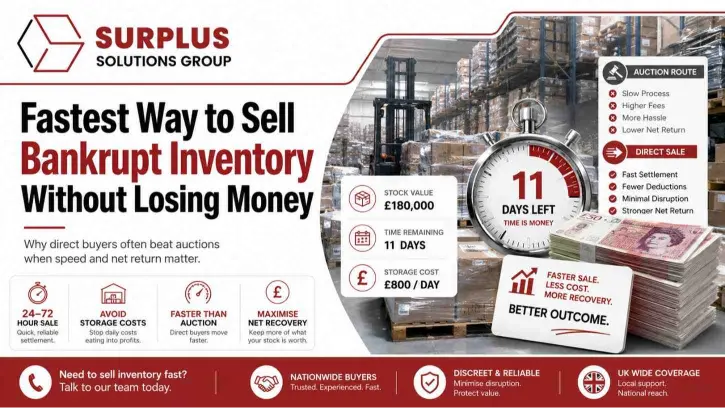
Three months ago, a manufacturing business in Leeds had a serious problem. They had over £180,000 worth of bankrupt inventory sitting in a rented warehouse. Their lease had 11 days left. The auction house they contacted told them the earliest sale date was six weeks away. Every passing day costs them £800 in storage fees alone.
It sounds familiar. If you’re dealing with distressed inventory, unsold warehouse stock, or a business closure right now, you already know the pressure is real. Cash is frozen, space costs money, and the clock is ticking fast.
What most businesses do not know is this: auctions are rarely the fastest or most profitable option for selling bankrupt stock. There is a better route, one that puts cash in your hands within 24 to 72 hours and removes every logistical headache from your plate.
This guide will show you exactly how the fastest way to sell bankrupt inventory works in the UK, what mistakes silently destroy your recovery value, and how direct buyers consistently outperform auction houses when speed and net return both matter.
What Is the Fastest Way to Sell Bankrupt Inventory?
The fastest way to sell bankrupt inventory is to work directly with a specialist liquidation company that purchases stock in bulk, handles logistics, and pays without the delays that define traditional auction timelines.
Direct inventory liquidation removes the middlemen, the bidding uncertainty, and the waiting. Instead of hoping a room full of buyers shows up on auction day, a direct buyer assesses your stock, makes an offer, and arranges collection. Simple. Predictable. Fast.
Why Businesses Need Fast Inventory Recovery
When a business closes or faces insolvency, every day of delay chips away at recovery value. Creditors expect returns. Secured lenders want repayments. And your warehouse is not a free storage unit.
I have spoken with dozens of insolvency practitioners across the UK who confirm the same thing. The businesses that act within the first 48 hours of a closure or restructuring decision consistently recover more than those that wait for a “better offer” that rarely materializes.
The longer distressed inventory sits, the more value it loses through depreciation, market changes, and the ongoing weight of storage and insurance costs.
How Inventory Loses Value Over Time
This is something most auction houses will not tell you. Unsold stock does not hold its value while you wait. Electronics become outdated. Seasonal goods lose relevance. Packaging deteriorates. Buyers lose interest.
A pallet of consumer electronics worth £5,000 today may realistically achieve £3,200 in six weeks simply because newer models have entered the market. That’s a 36% drop in recovery value before a single auction hammer falls.
Surplus stock has a shelf life. Treat it like one.
Why Delays Hurt Cash Flow
Here is a practical reality check. If your warehouse costs £1,200 per week in rent, insurance, and labor, a six-week auction process costs you £7,200 before you receive a penny from the sale. A direct liquidation completed in 72 hours costs almost nothing by comparison.
Quick cash recovery is not just convenient. It is often financially superior to waiting for a theoretically higher auction result that never arrives.
Why Are Auctions Often Slower Than Direct Inventory Buyers?
Auctions are the default assumption for business inventory liquidation. Most people assume they will get more money through competitive bidding. In practice, the opposite is frequently true.
Auction Timelines Explained
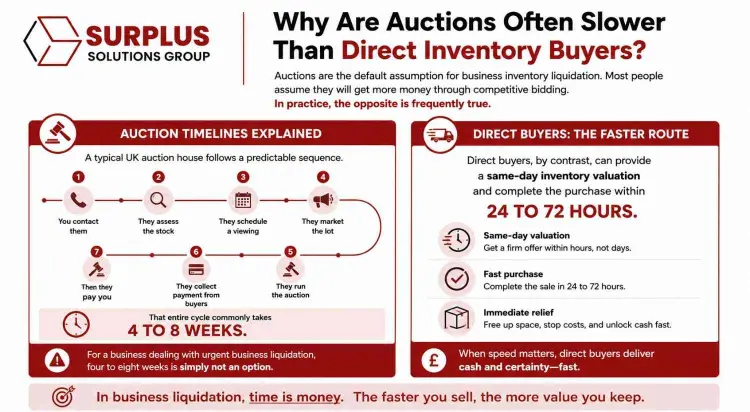
A typical UK auction house follows a predictable sequence. You contact them, they assess the stock, they schedule a viewing, they market the lot, they run the auction, they collect payment from buyers, and then they pay you. That entire cycle commonly takes four to eight weeks.
For a business dealing with urgent business liquidation, four to eight weeks is simply not an option.
Direct buyers, by contrast, can provide a same-day inventory valuation and complete the purchase within 24 to 72 hours.
Hidden Auction Costs Businesses Ignore
This is where the real damage happens. Auction houses charge seller fees, typically 10 to 20% of the sale value. Then add buyer’s premiums that reduce what buyers will bid. Then transportation to the auction site. Then insurance during the waiting period. Then storage if your lot does not sell on the first attempt.
By the time you net out all those deductions, the “higher” auction price often delivers less cash than a direct bulk sale would have provided weeks earlier.
Method | Typical Timeline | Fees | Risk of Unsold Stock |
Auction House | 4 to 8 weeks | 10 to 20% seller fee | High |
Direct Buyer | 24 to 72 hours | None | None |
Online Marketplace | 2 to 6 weeks | Listing and transaction fees | Medium |
Consignment | 4 to 12 weeks | 25 to 40% commission | High |
Delayed Payments and Unsold Lots
Here is something worth knowing. If your lot does not sell at auction, you face a choice. Relist it, often at a lower reserve, or pull it and start over. Neither option is free. Both options consume more time.
Direct inventory buyers purchase your stock outright. There is no relist. There is no failed lot. There is one transaction, one payment, and one collection.
Storage Fees During Auction Waiting Period
A common oversight businesses make is failing to calculate ongoing warehouse clearance costs during the auction waiting period. At an average of £800 to £2,000 per week, depending on the size of the stock, a six-week wait adds £4,800 to £12,000 in pure holding costs before a single bidder raises a hand.
How Do Direct Inventory Buyers Work?
Understanding the direct buyer process removes the uncertainty that makes businesses hesitant to pursue this route.
Step-by-Step Direct Liquidation Process
Working with liquidation companies like Surplus Solutions Group follows a clear and simple sequence.
- You contact the buyer and describe your stock (type, quantity, condition, location)
- The buyer provides a same-day inventory valuation
- You receive a written offer with clear terms
- If you accept, collection is arranged within 24 to 72 hours
- Payment is made promptly upon collection
That is the entire process. No auction catalogues. No waiting for bidders. No surprise fees.
Inventory Assessment and Valuation
Good surplus stock buyers in the UK assess inventory based on several factors: product condition, brand recognition, market demand, packaging integrity, and shelf life. This is not a guessing process. It is a structured evaluation that produces a realistic offer grounded in what the secondary market will actually pay.
The “quick inventory valuation” that direct buyers offer is not simply a lowball figure designed to exploit urgency. Reputable buyers rely on accurate valuation to maintain their own resale margins. They have every incentive to offer a fair price that reflects true market value.
Bulk Purchase Agreements
One significant advantage of direct buyers is their ability to purchase your entire surplus inventory in a single transaction. This matters enormously when you are trying to close a warehouse, settle with creditors, or complete a business closure cleanly.
Rather than selling product by product, which requires ongoing time and management, a bulk agreement transfers the entire inventory liability in one move.
Same-Day Valuation Process
This is where specialist buyers earn their reputation. A team from a firm like Surplus Solutions Group can attend your premises, conduct a thorough stock assessment, and provide a written offer within the same visit. For businesses facing imminent deadlines, this speed is not a luxury. It is a lifeline.
What Types of Inventory Can Be Sold Quickly?
One of the most common misconceptions about bankrupt stock liquidation services is that only certain product types qualify. In reality, experienced direct buyers handle an extraordinarily wide range of stock categories.
Retail Stock
Clothing, homeware, health and beauty, sports goods, and seasonal products. Retail inventory is among the most commonly liquidated stock in the UK and moves quickly through established wholesale and resale channels.
Industrial Equipment
Machinery, tools, production equipment, and commercial appliances. Industrial assets often hold strong resale value and attract specialist buyers through established B2B liquidation networks.
Electronics and Consumer Goods
Phones, tablets, laptops, small appliances, and accessories. Electronics are time-sensitive because technology moves fast, which makes fast inventory turnaround essential for preserving value in this category.
Obsolete and End-of-Line Inventory
Even obsolete inventory has value. Parts, components, and discontinued lines often serve specialist markets, repair networks, and international buyers who cannot easily source the same products through mainstream channels.
The key point is this: do not assume your stock is worthless before getting a professional assessment. I have seen businesses write off inventory that a specialist buyer purchased for a figure that genuinely surprised them.
What Are the Biggest Mistakes That Slow Down Bankrupt Inventory Sales?
Avoiding these errors is often the difference between recovering meaningful value and watching stocks depreciate to nothing.
Waiting Too Long to Liquidate
This is the single most expensive mistake businesses make. The instinct to wait for a better offer is understandable. But distressed assets lose value with time, and holding costs accumulate relentlessly. The businesses I have seen recover the most value are almost always the ones that acted within the first week of recognizing a liquidation need.
Poor Inventory Documentation
Buyers need accurate information to make fast decisions. Incomplete stock lists, missing product descriptions, and absent condition notes slow everything down. Before you contact any buyer, prepare a basic inventory list that includes product names, quantities, conditions, and approximate dimensions or weights.
Overpricing Distressed Inventory
There is a painful but important truth here. Distressed inventory is not worth retail value. It is not worth wholesale value, either. It is worth what the secondary market will pay for it today. Businesses that enhance their expectations of the real purchase price consistently walk away with worse outcomes than those who accept the original market valuations upfront.
Choosing the Wrong Buyer
Not all liquidation buyers operate the same way. Some specialize in certain product categories. Others have stronger logistics networks in specific UK regions. Working with stock liquidation specialists who understand your product type and have established resale channels will produce a better offer than approaching a generalist with no relevant expertise.
Does Fast Inventory Removal Save Money?
The financial case for speed is more compelling than most businesses realize.
Real Monthly Cost Breakdown Example
Consider a business holding 800 pallets of mixed warehouse overstock in a 15,000-square-foot facility.
Cost Category | Monthly Cost |
Warehouse Rent | £9,000 |
Business Insurance | £1,200 |
On-Site Labour | £3,600 |
Utilities | £800 |
Total Monthly Cost | £14,600 |
At £14,600 per month, a two-month auction process costs £29,200 in pure holding costs before the stock is even sold. A direct liquidation completed in 72 hours reduces that figure to near zero.
Speed, in this context, is not a convenience. It is a financial strategy.
Which Industries Use Fast Inventory Liquidation Services Most?
Business liquidation services serve a broader range of industries than most people expect.
Retail businesses use liquidation when closing locations, rebranding, or clearing end-of-line stock ahead of new range introductions. Manufacturing companies liquidate surplus components, raw materials, and finished goods when production lines change or contracts end. E-commerce warehouses often hold excess stock resulting from forecast errors, cancelled orders, or accumulated returns.
Construction suppliers regularly liquidate unused materials after project completions. Electronics distributors face constant pressure to move excess inventory before products become technically obsolete. Hospitality businesses liquidate furniture, equipment, and consumables during refurbishments or closures.
If your business holds physical stock and faces any kind of operational change, commercial inventory buyers have a route for you.
Are There Risks When Selling Bankrupt Inventory Quickly?
Yes. And knowing them in advance protects you.
Scam Buyers and Lowball Offers
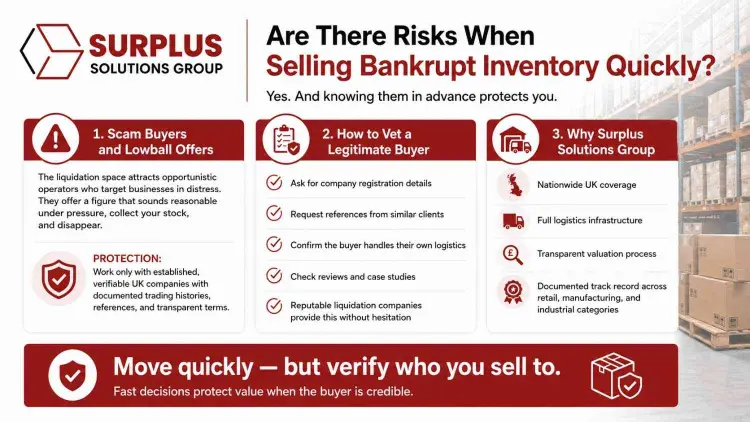
The liquidation space attracts opportunistic operators who target businesses in distress. They will offer a figure that sounds reasonable under pressure, collect your stock, and disappear. The protection against this is straightforward: work only with established, verifiable UK companies with documented trading histories, references, and transparent terms.
How to Vet a Legitimate Buyer
Ask for company registration details. Request references from previous clients in similar situations. Confirm that the buyer handles their own logistics. Check for reviews and case studies. Reputable bankrupt stock liquidation companies will provide all of this without hesitation.
Surplus Solutions Group, for example, operates nationwide across the UK with full logistics infrastructure, transparent valuation processes, and a documented track record across retail, manufacturing, and industrial categories.
Confidentiality Concerns
Business closures are sensitive. Staff may not know. Creditors may be watching. A reputable confidential liquidation service will agree to non-disclosure terms, conduct the clearance discreetly, and avoid any activity that could damage your brand reputation or reveal the situation prematurely.
What Tools Help Businesses Liquidate Inventory Faster?
Having the right systems in place before you contact a buyer speeds everything up.
| Tool | Best Use Case | Speed Impact |
| Sortly | Inventory cataloguing | High |
| inFlow Inventory | Stock valuation tracking | High |
| FinalShopify | Online channel clearance | Medium |
| Final Inventory | Warehouse stock management | Medium |
| Excel/Google Sheets | Basic stock list preparation | High |
Even a basic spreadsheet prepared before you contact a buyer can cut days off the valuation and negotiation process.
Case Study: How a Retail Chain Recovered Cash Without Auctions
The Business Problem
A mid-size clothing retailer with four UK locations announced closure in January 2025. They held approximately £240,000 in retail inventory across all sites, including seasonal stock, end-of-line garments, and warehouse overstock in their central distribution unit.
Why Auctions Failed
Their initial contact with two auction houses produced estimated timelines of five and seven weeks, respectively. Factoring in seller fees of 15%, reserve price risks, and ongoing warehouse costs of £11,000 per month, the projected net return from the auction route was significantly below their creditor obligations.
How Direct Buyers Solved the Problem
After contacting a specialist wholesale inventory clearance buyer, they received a same-day site visit and a written offer within four hours. The entire stock was purchased in a single bulk transaction. Collection was completed within 48 hours across all four sites.
Final Financial Outcome
The net recovery from the direct sale, after zero seller fees and two days of warehouse costs rather than seven weeks, exceeded the projected auction net return by approximately £31,000. The closure was completed cleanly, creditors received their payment on schedule, and the business owners avoided weeks of additional operational stress.
That £31,000 difference came entirely from choosing speed and directness over the assumption that auctions produce better outcomes.
Common Myths About Bankrupt Inventory Liquidation
Myth 1: Auctions always bring higher returns.
This ignores fees, holding costs, and the risk of unsold lots. Net returns from direct buyers regularly exceed auction net returns once all costs are factored in.
Myth 2: Only large businesses use liquidation services.
Direct bulk inventory buyers work with businesses of every size, from single-unit retailers to multinational distributors.
Myth 3: Liquidation means selling at massive losses.
Orderly liquidation with the right buyer typically recovers 40 to 70% of the cost value. That is not a massive loss. That is a realistic return on distressed assets under time pressure.
Myth 4: Direct buyers are less reliable than auction houses.
Established UK liquidation companies operate with regulated processes, transparent documentation, and clear payment terms. Reliability comes from choosing the right partner, not the right channel.
How Can You Start Selling Bankrupt Inventory Today?
If you need to move quickly, here is exactly what to do.
Fast-Action Checklist Before Contacting Buyers
- Prepare a basic inventory list with product names, quantities, and conditions
- Photograph stock clearly, including any damage or packaging issues
- Note the warehouse location and access arrangements
- Confirm whether any stock is subject to security interests or creditor claims
- Identify your minimum acceptable timeline for clearance
Once this is ready, contact a specialist inventory clearance team directly. Surplus Solutions Group provides same-day valuations across the UK and handles full logistics from collection to payment. Our “surplus stock buyers” team operates nationwide and can attend your site within 24 hours of initial contact.
Do not wait six weeks for an auction result that may not cover your holding costs. The fastest way to sell bankrupt inventory is available right now, and it starts with a single conversation.
Conclusion
Every day, bankrupt inventory sits in a warehouse; it costs money instead of making it. The businesses that understand this act decisively. The businesses that do not often find that the “better offer” they waited for never materialized, while holding costs quietly consumed what recovery value remained.
The Leeds manufacturer at the start of this guide ended up working with a direct buyer. Their entire inventory was cleared in 48 hours. They paid 11 days less in warehouse rent than they expected. And they walked away with a figure that covered their creditor obligations in full.
That outcome was not luck. It was the result of choosing the right method at the right time.
If you are facing a similar situation right now, the most important step is the first one. Contact a specialist in “bankrupt stock clearance” and get a same-day valuation. You may be surprised how much your inventory is worth and how quickly it can be turned into cash.