
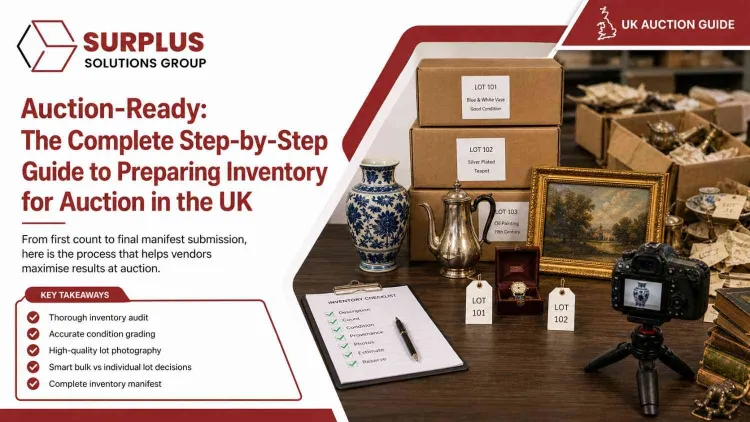
Two vendors walk into the same auction with similar inventory. One has sorted, labelled, photographed, and accurately described every lot. The other has thrown everything into boxes and handed over a rough list.
At the end of the day, the first vendor achieves 40% more per lot. The difference? Preparation.
How to prepare inventory for auction in the UK correctly is not complicated. But it requires a structured approach, and most vendors skip steps they later regret. This guide gives you the exact process, from first count to final manifest submission, so you walk into auction day with the strongest possible foundation.
TL;DR — 5 Things That Make the Biggest Difference:
- A thorough inventory audit is the non-negotiable starting point
- Condition grading must be accurate and consistent across all lots
- Photography quality is one of the highest-impact variables on final hammer price
- The bulk lot versus individual lot decision can make or break your total return
- A complete and accurate inventory manifest protects you legally and commercially
Why Inventory Preparation Matters So Much for Auction Returns
Let me be direct about something most auction content glosses over: auction inventory preparation UK is not admin. It is revenue generation.
Bidders pay more when they know exactly what they are bidding on. When a lot has clear photography, an honest condition report, and a detailed description, the risk perception drops. And when risk drops, bids go up. That is the psychology driving every well-run auction.
The opposite is equally true. A poorly labelled, vaguely described, low-resolution listing creates doubt. Doubt suppresses bids. And suppressed bids mean a lower hammer price or, worse, an unsold lot.
The cost of under-preparation that vendors never calculate:
| Preparation Level | Bidder Confidence | Unsold Rate | Return vs. Market Value | Post-Auction Dispute Risk |
| Fully prepared (audit, graded, photographed, described) | High | 5–10% | 40–65% | Very low |
| Partially prepared (basic descriptions, limited photos) | Medium | 20–30% | 20–35% | Medium |
| Unprepared (rough list, no photos, no grading) | Low | 40–60%+ | 5–15% | High |
Three days of proper asset preparation for business auction UK can add 25–40% to your total hammer price realisation. That is not an estimate. It is what professional auctioneers see repeatedly.
For vendors working through “our auctions management service,” we start every consignment with a preparation assessment before a single lot is numbered or photographed. The data is consistent: preparation time invested upfront compounds into higher returns on the day.
Step 1: Conduct a Full Inventory Audit
You cannot catalogue, value, or describe what you have not counted. The inventory audit is the foundation of everything that follows in how to prepare inventory for auction in the UK.
Before you begin, freeze all stock movements. Nothing in, nothing out. If items are moving during your audit, your count will never reconcile.
Step-by-step inventory audit process:
- Physically count every item by location, whether that is room, aisle, shelf, or bay
- Record make, model, serial number, and quantity for every asset
- Note condition at point of counting: working, incomplete, damaged, or unknown
- Photograph every item or batch at the counting stage
- Enter all data into a master inventory spreadsheet
- Cross-reference against any existing asset register or stock management system
- Flag discrepancies for investigation before proceeding to the next phase
Tools that speed up the audit process:
- Barcode scanning apps such as Sortly or inFlow for serialised assets
- QR code labelling systems for large warehouse environments
- Simple spreadsheet templates set up before counting begins
If inventory has no documentation, labels, or asset records at all, which happens frequently in liquidation stock situations, photograph everything and record physical descriptions. Even partial information is better than nothing and will still inform your lot of descriptions later.
Step 2: Sort and Segregate Inventory Into Auction Categories
Once your audit is complete, the next step in auction inventory preparation in the UK is physical segregation. This is the step that unlocks the most value from mixed inventory, yet it is consistently underestimated.
Why segregation matters so much:
Like-with-like grouping attracts specialist buyers who are willing to pay sector-appropriate prices. When a specialist IT buyer sees a well-organized lot of servers and workstations, they bid with confidence. When the same equipment is buried in a mixed general lot, the buyer either misses it or bids conservatively.
The main commercial auction categories:
- Plant and machinery (sorted by type and application)
- Commercial vehicles and transport assets
- IT equipment, servers, and technology
- Office furniture and fixtures
- Retail stock (by product category and condition)
- Industrial tooling and specialist equipment
- Food and beverage stock (which has specific handling requirements)
- Specialist and high-value items requiring individual assessment
Within each category zone, further sort by condition: good, fair, poor, and spares or repair. This within-category sorting is what makes your stock condition reporting for auction accurate and fast in the next phase.
For preparing stock for commercial auction situations involving warehouse inventory across multiple sites, “our company clearance and strip-out service” can assist with the physical segregation stage before auction consignment.
Step 3: Identify High-Value Individual Lots
This is the step most vendors get wrong. And it is often the most expensive mistake they make.
Hidden high-value items incorrectly grouped into bulk lots are one of the biggest missed opportunities in auction lot preparation. A single misidentified asset can represent 20% of your total auction value, sitting unrecognized in a £200 job lot.
How to identify high-value lots within mixed inventory:
- Research make and model against live auction comparables and manufacturer RRP
- Look for serial numbers, original documentation, and warranties, all of which add measurable value
- Check current second-hand market prices for equipment you do not recognise
- Consult a specialist appraiser for items outside your area of expertise
- Pay close attention to IT equipment, precision instruments, and specialist trade machinery
Categories where hidden high-value items appear most often:
- IT equipment: CAD workstations, specialist servers, and test equipment
- Industrial tooling: precision measurement instruments and specialist jigs
- Retail stock: limited edition, branded, or discontinued product lines
- Medical and laboratory equipment
- Catering equipment: commercial-grade specialist machinery
When in doubt, commission an independent valuation for any item you suspect might be significantly more valuable than its surroundings. The cost of a RICS-qualified appraiser for one afternoon is almost always recovered through the uplift in hammer price on correctly identified individual lots.
“Our bankrupt stock buyers team” regularly identifies high-value items within mixed inventory consignments that vendors had initially grouped for bulk clearance. In one recent case, £18,000 worth of individually valuable IT assets had been earmarked for a £400 job lot. The difference matters.
Step 4: Make the Bulk Lot vs. Individual Lot Decision
This is the single most important strategic decision in how to prepare inventory for auction in the UK. Getting it right is worth more than any other preparation step.
The case for individual lots:
- Maximum price per unit through competitive bidding
- Attracts specialist buyers willing to pay sector-appropriate prices
- Full transparency for bidders drives confidence and higher hammer prices
- Best for high-value, identifiable, and desirable assets
The case for bulk and job lots:
- Appropriate when time pressure makes individual preparation impossible
- Right for low-value, unidentifiable, or heavily damaged items
- Useful for clearing residual inventory after individual lots are exhausted
The hybrid approach: what works best for most inventories?
| Tier | Inventory Profile | Strategy | Expected Return |
| Top 20% | High-value, identifiable, desirable | Individual or small group lots | 45–65% of market value |
| Middle 50% | Mid-value, category-sortable | Curated category lots | 25–45% of market value |
| Bottom 30% | Low-value, mixed, or damaged | Bulk lot clearance | 5–20% of market value |
Sell your top 20% as individual or small group lots. Create curated category lots for the middle tier. Bundle the bottom tier for clearance. This hybrid structure is what professional asset preparation for a business auction looks like in practice.
Step 5: Tag, Label, and Number Every Lot
Lot tagging is more than an admin task. Under the Misrepresentation Act 1967, the auctioneer relies on vendor-supplied lot information to represent assets accurately to bidders. Mislabelled lots create legal liability.
Step-by-step lot tagging process:
- Assign a unique lot number to every individual item or group
- Create a physical lot label, weatherproof for warehouse environments
- Include lot number, brief description, and condition grade on every label
- Attach the label securely to the asset, not loosely place it on top of it
- Mirror lot numbers in your master inventory manifest
- Cross-check: every physical lot must have a matching manifest entry
Labelling by asset type:
- Large plant and machinery: spray-painted or bolted number plates
- IT equipment: adhesive labels on the rear panel or asset tag position
- Retail stock: tagged or boxed with the label on the exterior
- Vehicles: label on the dashboard and in the windscreen
- Small items and tooling: individually bagged and tagged
If an asset cannot be physically labelled because it is fragile, sealed, or specialized, note this in the manifest and ensure the location is clearly marked on your site map for preview day.
Step 6: Photograph Inventory to Professional Standards
Photography is the highest-impact preparation variable for online commercial auction results. Bidders cannot touch, test, or inspect assets online. Photography is their only reality.
Poor images suppress bids even on high-value items. Strong images build bidder confidence and consistently deliver higher hammer prices. This is not an opinion. It is what every serious auction house sees in its data.
Minimum photography standards:
- At least one strong cover shot per lot, plus three or more detail shots
- Resolution of 1,500 pixels minimum for online platforms
- Plain, uncluttered backgrounds with appropriate contrast
- Natural light where possible, avoiding harsh shadows
- Scale references for machinery and large assets
Key shots by asset category:
For plants and machinery: front-facing overall shot, left and right profiles, rear view, control panel, serial number plate, and any damage areas clearly shown.
For IT equipment: front face-on, rear ports and connections, serial number or asset tag, any physical damage, and screen-on, where applicable.
For retail stock: product shot on plain background, packaging condition, label or barcode close-up, and damage or defect close-up if applicable.
For vehicles: front and rear three-quarter shots, driver interior, load area, dashboard and odometer, engine bay, tyre condition, and any damage.
Editing for brightness and contrast correction is acceptable and expected. Editing that conceals damage or misrepresents a condition is a legal risk under the Consumer Protection from Unfair Trading Regulations 2008 and should never be done.
Step 7: Write Lot Descriptions That Drive Bidder Confidence
Lot description quality directly affects the hammer price. Vague descriptions create doubt. Doubt suppresses bids. Honest, detailed descriptions do the opposite.
Here is what every strong lot description must include:
- Lot number and a clear, specific, searchable title
- Make, model, and year for machinery, vehicles, and equipment
- Exact quantity for stock lots
- Condition grade using your standardised grading system
- Key specifications: dimensions, capacity, power requirements, compatibility
- Known defects and damage, fully disclosed
- Provenance and documentation available
- Collection requirements, including size, weight, and access needs
- VAT status: standard rated, margin scheme, or VAT exempt
Strong vs. weak example:
Weak: “Industrial machine, used condition, collection required.”
Strong: “Trumpf TruLaser 3030 Fibre Laser Cutting Machine (2018), 4kW, approximately 2,300 hours. Condition Grade B — fully operational at time of consignment, minor surface wear to cutting bed. Full service records available. Specialist removal required, forklift access essential. VAT applicable.”
Disclosing damage actually increases buyer confidence. Bidders who trust your description bid higher than bidders who suspect you are hiding something. This is the most counterintuitive truth in how to catalogue assets for auction in the UK, and it is completely consistent.
For auction lot preparation in insolvency cases, condition grading consistency is also important for the insolvency practitioner’s duty to demonstrate that assets were fairly valued and honestly represented to bidders.
Step 8: Compile a Complete Inventory Manifest
The inventory manifest is your master document. It links every physical lot to its auction catalogue entry. It is what the auctioneer’s marketing team, administration team, and legal team all work from.
What a complete auction inventory manifest must include:
- Lot number
- Asset description: make, model, serial number
- Quantity
- Condition grade
- Location on site (bay, aisle, shelf reference)
- Estimated value: low and high
- Reserve price if agreed
- VAT status
- Photography reference (image file names)
- Any special handling or collection requirements
- Provenance or documentation available
The manifest cross-check is non-negotiable. Before submission, physically walk every lot on site and verify that each one has a matching manifest entry. Discrepancies found after submission create delays, confusion, and, in some cases, post-auction disputes.
For how to prepare inventory for auction UK in time-pressured liquidation situations, “our liquidation stock clearance service” includes manifest preparation support as part of our end-to-end auction consignment process.
Submit your manifest to the auctioneer in the format they require: Excel or CSV for most commercial auction houses, or direct platform upload for timed online auction systems.
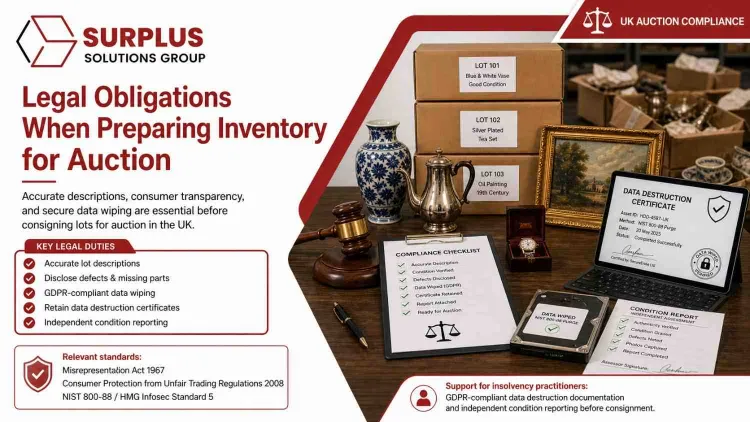
Legal Obligations When Preparing Inventory for Auction
The Misrepresentation Act 1967 makes vendors legally responsible for the accuracy of their lot descriptions. Inaccurate descriptions that induce a buyer to bid can result in the sale being voided and compensation claims. This is not a theoretical risk. It happens.
The Consumer Protection from Unfair Trading Regulations 2008 apply where consumers participate in auction sales. Prohibited practices include omitting material information that affects a buyer’s decision, including known defects, missing components, or inaccurate specifications.
GDPR and data wiping: Before consigning any IT equipment or data-bearing assets to auction, all data must be fully wiped to an acceptable standard. NIST 800-88 and HMG Infosec Standard 5 are the recognized benchmarks. Obtain and retain a data destruction certificate for every device. This certificate should be disclosed in the lot description, as it adds buyer confidence and removes liability.
If you are an insolvency practitioner preparing inventory for auction, “our bankrupt stock buyers team” can assist with both GDPR-compliant data destruction documentation and independent condition reporting before consignment.
The Most Common Inventory Preparation Mistakes
For the auction lot preparation guide accuracy, here are the mistakes I see most frequently:
Mistake 1: Starting preparation too late and rushing every subsequent phase. This is the most expensive single decision a vendor makes.
Mistake 2: Grouping high-value items into bulk lots unnecessarily. Identify first, then group.
Mistake 3: Inconsistent condition grading across lots. If Grade B means different things on different lots, buyers cannot trust the system and will bid lower across everything.
Mistake 4: Poor photography. Low resolution, cluttered backgrounds, and missing damage shots consistently suppress bids on otherwise desirable lots.
Mistake 5: Vague or incomplete lot descriptions that create buyer distrust and post-auction disputes.
Mistake 6: Failing to gather documentation before consignment. Service records, manuals, and certificates add measurable value and should be collected before the auction catalogue is finalized.
Mistake 7: Submitting an incomplete or inaccurate inventory manifest. Discrepancies found on auction day damage your relationship with the auction house and delay your settlement.
Pre-Auction Inventory Preparation Checklist
Phase 1: Inventory Audit
- All stock movements are frozen
- Full physical count completed by location
- All items recorded with make, model, serial number, and quantity
- Condition noted at point of count
- Master inventory spreadsheet created and verified
Phase 2: Sorting and Segregation
- All inventory is physically sorted into category zones
- Within each category, further sorted by condition
- High-value individual lots identified and separated
- Bulk lots and job lots are defined and physically grouped
- Site map created showing all lot locations
Phase 3: Valuation and Reserve Setting
- All high-value lots independently appraised where warranted
- Market comparables researched for key lots
- Reserve prices agreed with the auctioneer
- Guide prices set for auction catalogue
Phase 4: Tagging and Labelling
- Unique lot number assigned to every lot
- Physical labels attached to every lot
- Lot numbers cross-referenced against the manifest
Phase 5: Photography
- Cover shot taken for every lot
- Detail shots taken (minimum three per lot)
- Damage and defect shots taken and clearly noted in descriptions
- All images uploaded and linked to manifest records
Phase 6: Lot Descriptions
- All lots described using the standard template
- Condition grades applied consistently
- All known defects disclosed
- VAT status confirmed for each lot
- Collection and access requirements noted
Phase 7: Documentation
- All available documentation gathered per lot
- IT equipment data wiped and certificates obtained
- Missing documentation disclosed in lot descriptions
Phase 8: Manifest and Site
- Complete inventory manifest submitted to the auctioneer
- Manifest cross-checked against physical lots
- Site access routes cleared for preview
- Health and safety assessment completed
- Collection logistics agreed with the auctioneer
Conclusion
Every hour invested in how to prepare inventory for auction properly delivers a measurable return on auction day. The preparation is not the cost. It is the investment.
The five steps that have the greatest impact on your final result are a thorough inventory audit, accurate identification of individual high-value lots, professional photography, honest and detailed descriptions of the lot, and a complete and verified inventory manifest.
Vendors who follow this process consistently achieve higher hammer prices, lower unsold rates, and fewer post-auction disputes, regardless of what they are selling.At Surplus Solutions Group, “our auctions management service” provides end-to-end support for vendors preparing inventory under time pressure, from initial audit and condition grading through to manifest submission and post-auction collection management. We also work closely