
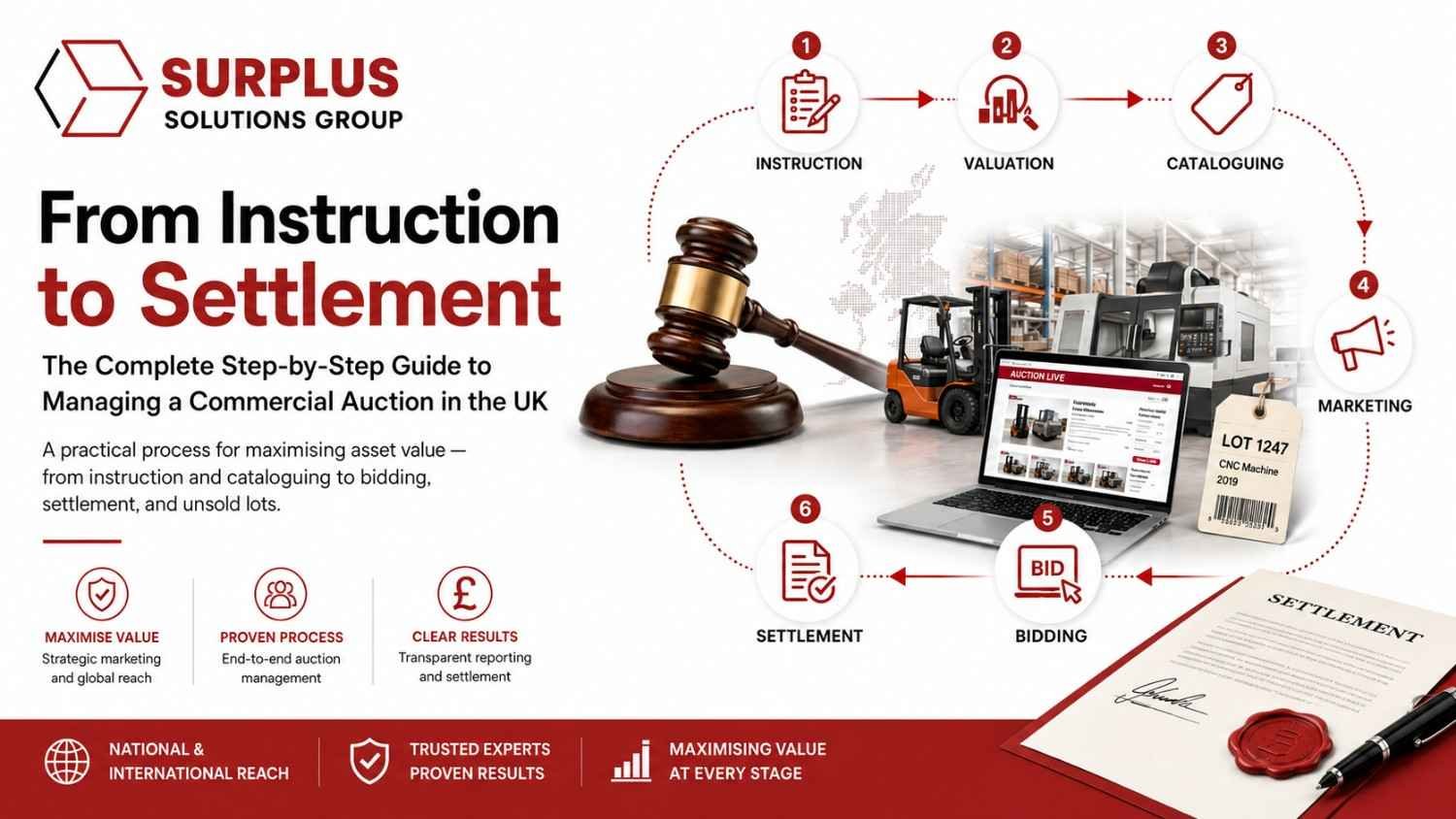
A commercial auction done well can recover significantly more value from business assets than any private sale. Done poorly, it can undersell those same assets and leave vendors, creditors, and stakeholders wondering where the money went.
I’ve seen both outcomes. And the difference almost always comes down to one thing: process.
This guide covers the complete commercial auction process that UK businesses and insolvency practitioners rely on, from the moment you receive the instruction through to final settlement and the handling of unsold lots. Whether you’re managing your first auction or your fiftieth, the framework here works.
5 Things That Drive Commercial Auction Results:
- Pre-auction preparation determines at least 80% of the outcome
- Auction catalogue quality and lot sequencing directly affect hammer prices
- Marketing reach is the single biggest driver of bidder competition
- Post-auction settlement and collection must be managed tightly
- Unsold lots need a clear re-marketing strategy from day one
What Is a Commercial Auction and When Is It the Right Choice?
A commercial auction is a competitive, transparent disposal method where business assets are sold to the highest bidder. The competitive bidding environment is what separates it from private sales. When multiple qualified buyers compete for the same asset, prices rise. That’s the mechanism.
The main types of commercial auctions in the UK:
| Auction Type | Best Asset Category | Speed | Return Potential | Vendor Control |
| Live in-room | High-value plant, machinery | Medium | High | High |
| Timed online auction | Most categories | Fast | Medium to high | Medium |
| Hybrid (live + online) | Mixed asset sales | Medium | Very high | High |
| Webcast auction | Trade specialist assets | Medium | High | High |
| Sealed bid/tender | Property, large plant | Slow | Variable | High |
Timed online auctions have genuinely changed the landscape for running a business asset auction in the UK. In my experience, they consistently outperform live-only events for industrial stock and trade equipment, simply because they remove the geographic barrier for bidders. More bidders always means more competition.
The commercial auction process is used by insolvency practitioners in liquidation and administration, business owners disposing of surplus assets, corporate fleet managers, commercial property managers, and local authorities. The common thread is a need for transparent, competitive, and well-documented disposal.
For businesses needing professional support with “auction management for commercial assets,” the approach you take at the very start of the process shapes everything that follows.
Stage 1: Instruction, Scoping, and the Vendor Agreement
The first stage of any commercial auction process is the instruction meeting. This is where the auctioneer needs to understand everything about the assets, the client’s objectives, and the timeline.
What the auctioneer needs to establish at the instruction:
- Asset type, quantity, location, and condition overview
- Client objectives: Is the priority speed, maximum return, or compliance?
- Timeline constraints such as lease end dates, insolvency deadlines, or creditor pressure
- Vendor identity, including Anti-Money Laundering (AML) and Know Your Customer (KYC) verification
Once the scope is agreed upon, the vendor agreement is signed. This document is more important than most vendors realize.
What to look for in a vendor agreement:
- Commission structure and how the buyer’s premium works
- Reserve price policy and who has the authority to adjust it on auction day
- Marketing budget and strategy outline
- What happens to unsold lots
- Collection and removal responsibilities
Don’t sign anything until you understand how unsold lots are handled. This clause has real financial consequences, and many vendors only notice it after the fact.
Stage 2: Pre-Auction Valuation of Commercial Assets
Here’s something most people underestimate: the pre-auction valuation is the most important step in the entire commercial auction process. Get this wrong, and everything downstream suffers.
There are three valuation approaches used by professional auctioneers:
- Forced sale value: the minimum achievable in urgent, time-pressured disposal
- Orderly liquidation value: the realistic auction estimate in a properly managed sale
- Market value: the aspirational benchmark, usually higher than the auction achieves
For liquidation auction management in the UK, the orderly liquidation value is the most relevant starting point. It gives you the evidence base for setting a defensible reserve price and for managing vendor expectations.
Who should conduct the valuation?
For most categories, in-house auction house appraisers are sufficient. For high-value plant, machinery, or specialist equipment, an independent RICS-qualified valuer adds credibility, particularly in insolvency cases where the insolvency practitioner needs to demonstrate to creditors that assets were fairly valued.
“Our auctions management service” always recommends independent valuations for estates where the total asset value exceeds £100,000. It protects the IP, satisfies creditor committees, and sets the reserve price on solid ground.
Stage 3: Preparing the Auction Catalogue
The auction catalogue is your most powerful marketing tool. Full stop. A well-prepared catalogue with strong photography, detailed lot descriptions, and accurate condition grading builds bidder confidence before a single bid is placed.
A weak catalogue, or one with vague descriptions and poor images, suppresses interest. Bidders who can’t assess an asset accurately from a listing will either not bid or bid conservatively to cover the risk. Both outcomes hurt the price of the hammer.
Step-by-step catalogue preparation:
- Professional photography for every lot (multiple angles, close-ups of condition issues)
- Lot descriptions including make, model, year, serial number, key specifications, and condition
- Condition grading using a consistent system (A, B, C or 1 to 5)
- Lot number assignment and sequencing
- Guide price ranges (high and low estimates)
- Collection, viewing, and terms information
- Full quality check and proofing before publication
Lot sequencing is something competitors rarely discuss in depth, but it genuinely matters. The order of your lots affects the final hammer price on individual items. Starting with strong, desirable lots builds momentum and bidder confidence early. High-value lots perform best in what auctioneers call the “golden hour” of a sale, when attention and bidder energy are at their peak. Placing weak lots at the beginning kills momentum before it starts.
For online commercial auction platform UK listings, lot description quality also determines how well the lots rank in platform search results. Keyword-rich, specific descriptions consistently attract more registered bidders.
Stage 4: Setting the Reserve Price
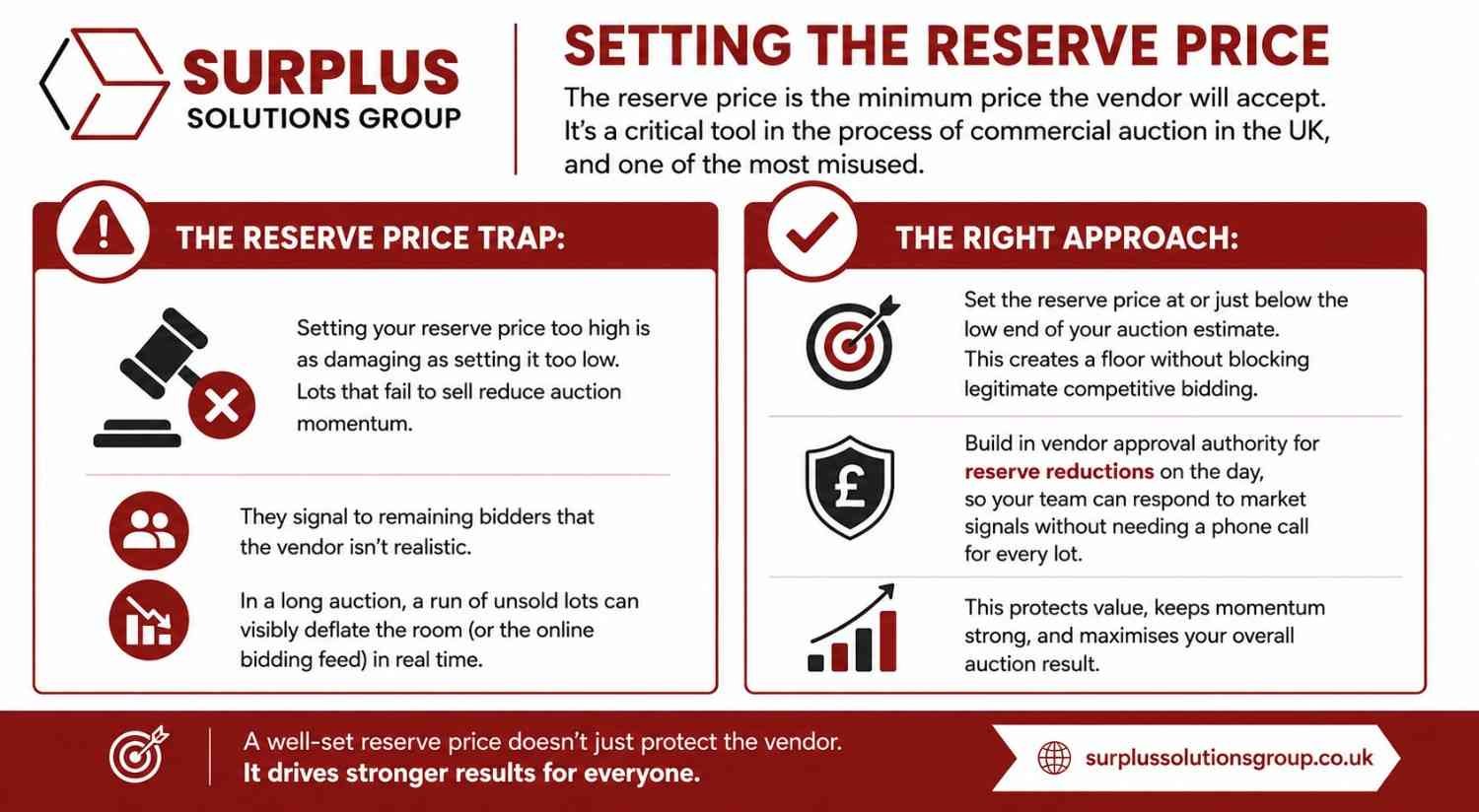
The reserve price is the minimum price the vendor will accept. It’s a critical tool in the process of commercial auction in the UK, and one of the most misused.
The reserve price trap:
Setting your reserve price too high is as damaging as setting it too low. Lots that fail to sell reduce auction momentum. They signal to remaining bidders that the vendor isn’t realistic. In a long auction, a run of unsold lots can visibly deflate the room (or the online bidding feed) in real time.
The right approach:
Set the reserve price at or just below the low end of your auction estimate. This creates a floor without blocking legitimate competitive bidding. Build in vendor approval authority for reserve reductions on the day, so your team can respond to market signals without needing a phone call for every lot.
Reserve price guidelines by asset category:
| Type | Typical Reserve as % of Market Value | Key Consideration |
| Machinery and plant | 20–40% | Age, condition, specialist demand, asset |
| Commercial vehicles and fleet | 40–60% | Mileage, service history, market demand |
| Retail stock and inventory | 10–25% | Condition, brand, sellability |
| IT equipment and office assets | 15–35% | Obsolescence risk |
| Commercial property | 70–85% | Market conditions, planning status |
For business asset disposal auction situations involving insolvency, the reserve price should always be supported by a written valuation. This protects the insolvency practitioner from creditor challenge.
Stage 5: Marketing the Commercial Auction
More bidders means more competition. More competition means higher hammer prices. This logic is simple, but the execution of auction marketing is where most of the process of the commercial auction actually fails.
A poorly marketed auction with great assets will always underperform a well-marketed auction with average assets. I believe this strongly, and the evidence from hundreds of sales supports it.
The marketing channels that drive bidder registrations:
- Dedicated auction house email list, segmented by asset category
- Industry trade publications and sector-specific advertising
- Online commercial auction platform aggregators such as BidSpotter, i-bidder.com, and the-saleroom.com
- Social media: LinkedIn for B2B assets, Facebook for general trade and consumer goods
- Direct outreach to known trade buyers and sector specialists
- Press releases for high-value or notable sales
The marketing timeline that works:
| Week | Action | Goal |
| Week 1 | Catalogue published, email campaign launched | Initial bidder registrations |
| Week 2 | Social media campaign live, trade ads placed | Expanding bidder audience |
| Week 3 | Preview day promoted, reminder campaign sent | Converting interest to registrations |
| Final week | Urgency messaging, last-chance registration push | Maximising active bidder numbers |
| Auction day | Live updates, countdown posts | Maintaining engagement and momentum |
“Our auction marketing approach” at Surplus Solutions Group uses all of these channels simultaneously, not sequentially. The compounding effect of running email, social, and aggregator campaigns in parallel consistently delivers higher bidder registration numbers than running them one at a time.
Stage 6: Bidder Registration and AML Compliance
Bidder registration is not just an admin task. In the UK, auction house services for businesses are subject to Anti-Money Laundering (AML) regulations under the Money Laundering Regulations 2017. Failing to comply isn’t just a legal risk. It puts your entire auction at risk of a post-sale challenge.
Step-by-step bidder registration process:
- Online registration form capturing name, contact details, and company information
- ID verification: passport or driver’s license for AML compliance
- Proof of funds or credit check for high-value lots
- Terms and conditions acceptance, which is legally binding
- Bidder number or paddle assignment
- Catalogue access and viewing confirmation
For timed online auctions and hybrid formats, registration happens through the online commercial auction platform itself. Make sure your chosen platform captures all required AML data and stores it securely in line with GDPR obligations.
For international bidders, the AML requirements are stricter. Additional due diligence, including proof of source of funds, may be required for transactions above certain thresholds.
Stage 7: The Preview Day
The preview day is a sales opportunity that most people treat as a viewing session. That’s a mistake.
When bidders attend a preview, they’re forming their confidence level and their maximum bid in their heads. Your job is to address every concern before the auction starts.
Running an effective preview day:
- Set clear viewing hours and manage access flow to avoid congestion
- Staff the preview with team members who know the assets
- Have condition reports and additional documentation available on request
- Capture the contact details of every interested party for last-minute marketing follow-up
- Address objections about the condition honestly, because a bidder who trusts your assessment bids higher
Health, safety, and site management during previews are non-negotiable. A risk assessment must be completed, public liability insurance must be in place, and hazardous or heavy equipment must be safely accessible.
Stage 8: Managing the Auction Day
Here’s the truth about auction day: it’s the shortest phase of the entire commercial auction process in the UK, and it depends almost entirely on the quality of the seven stages that preceded it.
That said, the operational management of auction day still matters.
The final 24-hour checklist:
- Platform and technology testing for online and hybrid formats
- Auctioneer briefing and lot order confirmation
- Staff role assignments for floor, administration, and vendor liaison
- Bidder access and paddle confirmation
- Final reserve price approval from the vendor or insolvency practitioner
Managing a timed online auction on the day:
- Monitor bid activity in real time across all lots
- Apply anti-sniping extensions when bids land in the final 60 seconds (this protects vendors and is standard practice on reputable online commercial auction platforms)
- Have technical support on standby for bidder access issues
- Communicate with active bidders promptly if any lot details need clarifying
For hybrid auctions, synchronizing floor bids with online bids in real time is the biggest operational challenge. Latency between the room and the platform must be managed so that neither bidder type has an unfair advantage.
Stage 9: Post-Auction Settlement and Collection
Once the hammer price is recorded, the post-auction process begins immediately.
Post-hammer process:
- Buyer confirmation and invoice generation (hammer price + buyer’s premium + VAT)
- Payment terms communicated clearly: typically 24 to 48 hours for assets, 28 days for property
- Signed a memorandum of sale for commercial property lots
- Collection window confirmed: usually 3 to 10 working days
Buyer defaults happen. When they do, the legal position is clear: the vendor can relist the lot, pursue the buyer for the price difference and associated costs, and permanently blacklist that buyer from future registrations.
Manage collection scheduling tightly. Every day a buyer has access to a site beyond the agreed window, it costs money in supervision, storage, and lease exposure. “Our company clearance and strip-out services” support post-auction collection management for clients who need the site cleared and handed back on a fixed deadline.
For VAT, commercial auction sales are generally standard-rated where the vendor is VAT-registered. Buyers should be made aware of the VAT position for each lot in the catalogue before they bid.
Stage 10: Handling Unsold Lots
Unsold lots are not the end of the process. They’re a signal that either the reserve price was set too high, the marketing didn’t reach the right buyers, or the asset category simply didn’t fit this particular auction.
Post-auction options for unsold lots:
- Post-auction private sale at or above reserve price within an agreed window (typically 7 to 14 days)
- Direct approach to under-bidders from the original sale
- Reserve price reduction and re-listing in the next available sale
- Bulk sale of all unsold lots to a single trade buyer
- Charitable donation where appropriate
- Licensed disposal as an absolute last resort
The under-bidder route is underused. The highest unsuccessful bidder in any lot is, by definition, the next most motivated buyer in the room. A direct approach within 48 hours of the auction, with a clear deadline for a decision, converts more often than people expect.
Our surplus stock disposal service regularly handles the re-marketing of unsold commercial auction lots for both auction houses and insolvency practitioners. The key is treating unsold stock as a separate disposal challenge with its own strategy, not as a failure to be quietly written off.
Common Mistakes in Commercial Auction Management
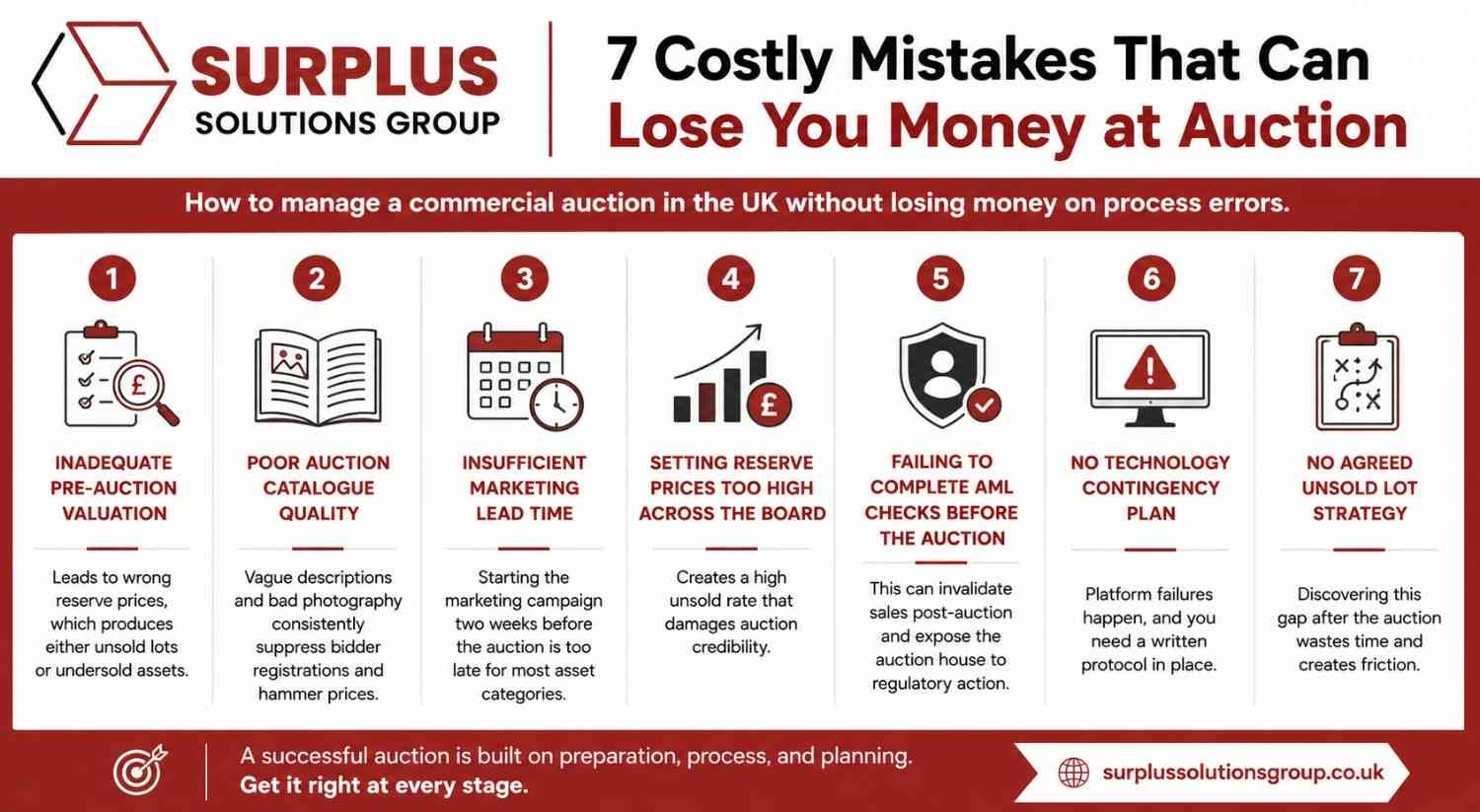
For how to manage a commercial auction in the UK without losing money on process errors, these are the mistakes I see most often:
Mistake 1: Inadequate pre-auction valuation leading to wrong reserve prices, which produces either unsold lots or undersold assets.
Mistake 2: Poor auction catalogue quality. Vague descriptions and bad photography consistently suppress bidder registrations and hammer prices.
Mistake 3: Insufficient marketing lead time. Starting the marketing campaign two weeks before the auction is too late for most asset categories.
Mistake 4: Setting reserve prices too high across the board, creating a high unsold rate that damages auction credibility.
Mistake 5: Failing to complete AML checks before the auction. This can invalidate sales post-auction and expose the auction house to regulatory action.
Mistake 6: No technology contingency plan for timed online auction or hybrid formats. Platform failures happen, and you need a written protocol in place.
Mistake 7: No agreed unsold lot strategy with the vendor. Discovering this gap after the auction wastes time and creates friction.
Conclusion
A commercial auction that is well-prepared, well-marketed, and professionally managed will consistently outperform one that treats the sale day as the main event. Because the preparation is the main event.
The five stages that have the greatest impact on final results are valuation accuracy, auction catalogue quality, marketing reach, lot sequencing strategy, and reserve price discipline. Get those five right, and auction day largely takes care of itself.
Whether you’re an insolvency practitioner managing a complex asset realization, a business owner disposing of surplus equipment, or an asset manager handling a corporate fleet, the commercial auction process UK framework in this guide gives you the foundation to deliver strong results every time.
At Surplus Solutions Group, “our auction management service” covers every stage of this process, from instruction and pre-auction valuation through to post-auction settlement and our unsold stock disposal service. “We work with insolvency practitioners, business owners, and asset managers across the UK and bring a transparent, documented approach to every sale.
If you’re facing a business asset disposal auction in the UK and want a partner who understands both the auction process and the commercial reality of getting assets moved quickly and at fair value, “our team at Surplus Solutions Group” is the right conversation to have.