
Your warehouse has 15,000 units of skincare that missed the launch window. The formulation is fine. The packaging is sealed. But the collection it belonged to has been discontinued, the rebranding is done, and your retailer has cancelled the order. Every week those products sit there; they’re losing value, eating storage costs, and sitting in regulatory limbo you haven’t fully thought through yet.
Selling surplus beauty products is not as simple as listing a pallet on a wholesale platform and waiting for the money. There are labelling laws, shelf-life rules, distributor obligations under UK cosmetics regulation, and brand protection risks that can turn a straightforward clearance into a legal or commercial headache.
Here’s the thing, though. None of this is unsurmountable. Done correctly, surplus beauty product clearance protects your brand, stays fully inside UK law, and recovers meaningful value from inventory that would otherwise die in storage.
This guide covers everything: the legal requirements, the channels that protect your pricing, the products you should never move without careful review, and how to choose a buyer who won’t create problems downstream.
What Are Surplus Beauty Products?
Surplus beauty products are cosmetics, skincare, haircare, fragrance, and personal care items held in excess of what your current sales channels can absorb. They’re not defective. They’re not recalled. They’re just more than the market wants right now, in your territory, through your existing routes to market.
Definition of Surplus Beauty Products
It’s worth distinguishing the key categories, because they carry different compliance implications and different recovery values.
Overstock is inventory that partially sold through but left a remainder. You ordered 20,000 units and sold 14,000. The remaining 6,000 are overstock. Deadstock is product that never reached the sales floor, still in original sealed packaging, often with full shelf life remaining. Deadstock commands the highest beauty product liquidation recovery values because buyers can redistribute it as new.
Slow-moving inventory is stock that’s technically still on your active list but not shifting. Left long enough, it becomes overstocked. Excess cosmetics inventory from packaging changes or rebranding is a common category we deal with regularly. The formula is identical. The brand and packaging change means the old units can’t go through your primary channel anymore.
Common Types of Beauty Products Sold as Surplus
Every major beauty category generates surplus at some point:
- Skincare: serums, moisturisers, SPF, eye creams, cleansers
- Cosmetics: foundations, lipsticks, eyeshadow palettes, mascaras
- Haircare: shampoos, conditioners, treatments, styling products
- Fragrance: EDT, EDP, body sprays, gift sets
- Personal care: shower gels, body lotions, deodorants, soap
- Salon products: professional-grade treatments and styling lines
- Beauty accessories: tools, applicators, and device accessories
Each category has different shelf-life considerations, different buyer demand patterns, and different compliance exposures. Fragrance, for example, has a long PAO (period after opening) and holds value well. Skincare with active ingredients like vitamin C or retinol oxidises faster and needs careful review before redistribution.
Why Businesses End Up with Surplus Beauty Inventory
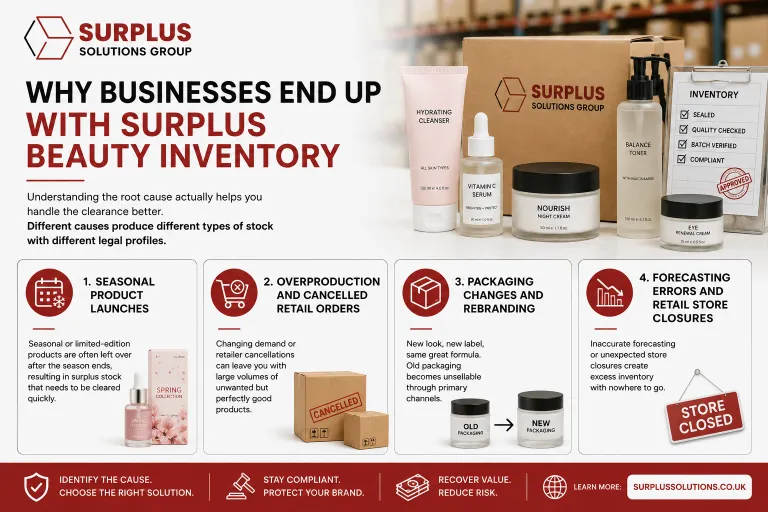
Understanding the root cause actually helps you handle the clearance better. Different causes produce different types of stock with different legal profiles.
Seasonal Product Launches
Beauty brands launch by season. When a product doesn’t sell through in its seasonal window, it doesn’t automatically lose value. But it does need a route out. Holding it for the next season rarely works because your channel will be receiving the new range.
Overproduction and Cancelled Retail Orders
These two causes generate the cleanest surplus. Overproduced goods are typically sealed, have a full shelf life, and are fully compliant. Cancelled retail orders, particularly from department stores or supermarket chains that pull back orders mid-season leave brands with large quantities of finished goods that were ready to ship but never did.
We had a situation last year where a premium haircare brand was left with 8,000 units of a salon treatment after a major retail partner cancelled their forward order three weeks before delivery. Full shelf life, boxed, perfectly compliant. That’s exactly the kind of stock where confidential wholesale recovery makes sense.
Packaging Changes and Rebranding
A packaging update means the old version has to go. The formula is unchanged. The product is safe, legal, and fully within its shelf life. But it can’t go through your primary channel because it doesn’t match current branding standards.
Forecasting Errors and Retail Store Closures
Excess beauty inventory from forecasting errors is one of the most common things we see. Fashion and beauty trends move faster than the ordering cycle. What looked right at the forecast stage doesn’t always land. Store closures, especially among mid-market UK retail chains since 2020, have pushed significant volumes of beauty surplus stock back into the supply chain without a plan.
Is It Legal to Sell Surplus Beauty Products?
Yes, with conditions. This is the question I get asked most often, and the honest answer is more nuanced than a simple yes.
Understanding Product Ownership
If you own the stock outright, you have the right to sell it. That ownership question becomes more complex if the goods were manufactured under a third-party licence, if there are outstanding distribution agreements, or if the goods are subject to creditor claims in an insolvency scenario.
Intellectual Property and Trademark Considerations
Selling branded surplus cosmetics doesn’t give a buyer the right to relabel, repackage, or rebrand. If you sell 5,000 units of a branded moisturiser to a wholesale buyer, those goods must remain in their original packaging. The moment a buyer removes your brand from the packaging and substitutes their own, that’s a trademark infringement. It happens in the lower end of the liquidation market. It’s one of the reasons vetting buyers properly is not optional.
Product Authenticity Requirements
Under the UK Cosmetics Regulation, any person in the supply chain who makes a cosmetic product available on the market is a distributor with legal obligations. That includes you when you’re selling excess cosmetics inventory through wholesale channels. The product must be what it says it is.
Expiration Dates and Shelf Life
This is where most compliance problems originate. Cosmetic products in the UK must display a “best before” date if the product has a shelf life of 30 months or less. Products with a longer shelf life must display a PAO symbol (the open jar icon showing how long the product is safe after opening).
Selling expired beauty products is not just commercially damaging. It can expose you to trading standards enforcement under the UK Cosmetics Regulation and the Consumer Protection Act 2015. Products past their stated date should never move through any sale or redistribution channel unless you have verified safety data and legal advice supporting the decision.
Batch Numbers and Product Traceability
Every cosmetic product sold in the UK requires a batch number. This isn’t bureaucracy. It’s the mechanism through which a product recall works. If a safety issue is identified in a batch after redistribution, the batch number is how it gets traced and withdrawn from the market. Any surplus stock without batch number identification is a legal liability, not just a practical problem.
Labelling, Packaging Compliance and Consumer Protection
Under the UK Cosmetics Regulation, cosmetic product labels must include the name and address of the responsible person, nominal content, precautions, function, INCI ingredient list, batch number, and date of minimum durability. If packaging is damaged and these elements are no longer visible, the product cannot legally be placed on the GB market.
Selling domestically versus internationally adds another layer. Goods sold into EU markets must comply with EU cosmetics regulations rather than UK cosmetics regulations. Northern Ireland has its own separate requirements aligned with EU rules. If you’re exporting, you need to understand the destination market’s requirements, not just assume UK compliance transfers automatically.
Legal Requirements Before Selling Surplus Beauty Products
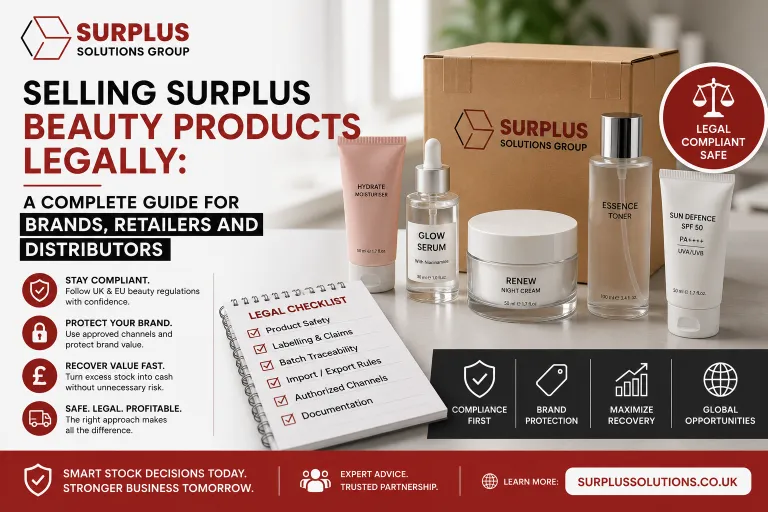
Here’s a practical compliance checklist before you move a single unit.
Verify Product Authenticity and Safety Status
Confirm that no recall or safety alert has been issued for the batch. Check with the Office for Product Safety and Standards (OPSS) and review the original CPSR (Cosmetic Product Safety Report) to confirm the product was properly assessed.
Ensure Products Are Safe and Within Shelf Life
Check batch numbers against your production records. Verify the best-before date or PAO. If shelf life is under six months, recovery value drops significantly, and some buyers won’t touch it. If it’s already expired, it cannot legally be sold in the UK.
Review Supplier and Distribution Agreements
Before liquidating, check whether your original supplier or distribution agreement contains any restrictions on secondary sales, territory limitations, or minimum price obligations. Some brand license agreements explicitly restrict surplus sales to certain channels.
Check Local and International Regulations
For UK domestic sales, the key framework is the UK Cosmetics Regulation under Schedule 34 of the Product Safety and Metrology SI. For EU exports, Regulation EC 1223/2009 applies. For the US, the FDA has its own cosmetics framework under MoCRA, introduced in 2023. Each market has different requirements.
Maintain Proper Storage Conditions
Cosmetic products can degrade if stored incorrectly. Temperature, humidity, and light exposure all affect product integrity. If your warehouse has not maintained appropriate conditions, there is a due diligence question around whether the product is still safe regardless of the stated shelf life.
Keep Product Documentation Ready
Before any buyer takes possession, you should have available the CPSR reference, batch documentation, original product specification, and shelf life evidence. A serious surplus cosmetics buyer will ask for this. If one doesn’t, that tells you something about how they operate.
Quick Compliance Checklist Before Selling:
- No active recall or safety alert on the batch
- Product within stated shelf life
- Labelling fully intact and readable
- Batch number traceable
- Distribution agreements reviewed
- Storage conditions documented
- Destination market regulations confirmed
Best Ways to Sell Surplus Beauty Products Legally
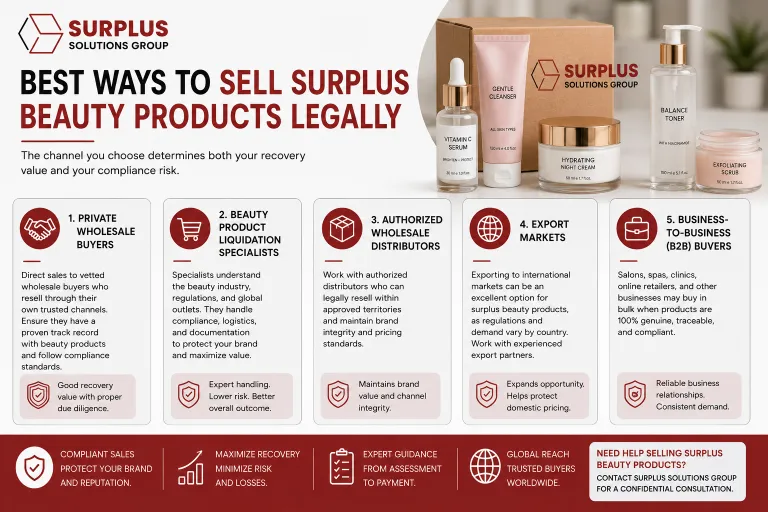
The channel you choose determines both your recovery value and your compliance risk.
Private Wholesale Buyers
Private wholesale is the cleanest route for branded surplus beauty products. You sell directly to a vetted buyer who operates in a channel that doesn’t conflict with your existing retail relationships. No public listing. No price visibility. No brand dilution.
The best private wholesale beauty product buyers will operate under written non-disclosure agreements and accept channel restrictions as standard. Recovery values through this route typically run between 20 and 50 percent of cost price depending on category, shelf life, and volume.
Beauty Product Liquidation Specialists
A specialist in beauty product liquidation brings a buyer network and compliance knowledge that a general marketplace simply can’t replicate. They understand the shelf-life restrictions, they know which buyers can take short-dated product, and they handle distribution through channels that are appropriate for your brand positioning.
At Surplus Solutions UK, our health and beauty stock clearance services specifically cover skincare, cosmetics, haircare, and personal care. We’ve handled everything from premium-branded skincare to private-label haircare runs, all under confidential terms.
Authorized Wholesale Distributors
For brands with existing wholesale networks, redirecting surplus through authorised distributors to specific territories can preserve both pricing integrity and channel relationships. This works best when you have the infrastructure already in place and the surplus volumes are manageable.
Export Markets
Exporting excess beauty inventory is underused by UK brands. It removes goods from the domestic market entirely, protecting pricing in your primary territory. European buyers, Middle Eastern distributors and export traders covering sub-Saharan Africa all actively source surplus skincare products and cosmetics from UK brands.
The compliance question for exports is the destination market’s cosmetic regulation framework. A reputable buyer handles this as part of their operation. Our surplus stock export solutions cover documentation, logistics, and channel management for international redistribution.
Business-to-Business (B2B) Buyers
B2B channels let you move volume quickly without public exposure. The key is ensuring B2B buyers are operating within their own commercial channels and not redirecting your branded goods into consumer-facing marketplaces where pricing becomes visible.
Confidential Inventory Sales
For premium or luxury beauty surplus stock, confidentiality isn’t just nice to have. It’s essential. A written confidential sales agreement should specify the buyer, permitted redistribution channels, geographic territory, pricing floor if relevant, and what happens to goods that aren’t redistributed within a defined period.
| Sales Channel | Legal Compliance | Brand Protection | Recovery Value | Best For |
| Private wholesale | High | High | 20 to 50% | Branded, premium SKUs |
| Liquidation specialist | Very high | Very high | 15 to 45% | Volume, mixed categories |
| Authorized distributor | Very high | Very high | 25 to 55% | Structured brands |
| Export buyers | High | High | 10 to 40% | Territory protection |
| B2B buyers | Medium | Medium | 15 to 40% | Fast volume clearance |
| Confidential sale | Very high | Very high | 20 to 50% | Luxury and premium brands |
Products You Should Never Sell Without Careful Review
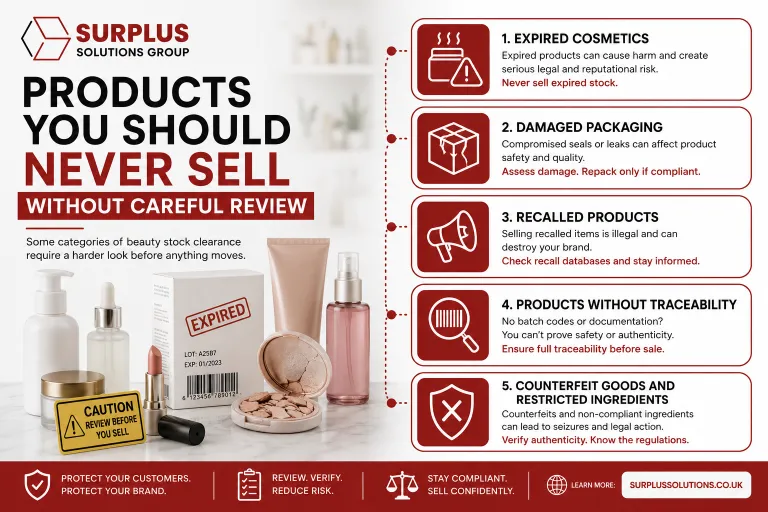
Some categories of beauty stock clearance require a harder look before anything moves.
Expired Cosmetics
Do not sell them in the UK. Products past their stated best-before date or outside their PAO period cannot legally be placed on the GB market. Some export markets allow short-dated products under specific conditions. Get legal advice before you attempt this.
Damaged Packaging
If the INCI list, batch number, best-before date, or responsible person details are no longer readable, the product is non-compliant for UK sale. Some goods with minor cosmetic packaging damage can still be redistributed in certain markets. A specialist can help you assess this honestly.
Recalled Products
If a batch has been subject to a safety recall, it cannot be sold through any channel. It needs to be formally withdrawn and disposed of. Attempting to liquidate recalled goods is a serious regulatory offence and a brand catastrophe.
Products Without Traceability
If you cannot trace a product back to a specific batch and production record, you cannot verify its compliance history. Without that, no responsible buyer should touch it, and you shouldn’t be trying to move it.
Counterfeit Goods and Restricted Ingredients
Obvious, but worth stating: counterfeit goods cannot be liquidated through any legal channel. Products containing ingredients now banned under the UK Cosmetics Regulation (the prohibited substances list runs to Annex II of the UK regulation) must be withdrawn, not redistributed.
How to Protect Your Brand While Selling Surplus Inventory
The goal is to recover value without your brand appearing in contexts that undermine what you’ve spent years building.
Vet Every Buyer Carefully
Ask where the goods will go. Ask for references from other brands they’ve worked with. Ask specifically whether the goods will appear on UK consumer-facing marketplaces. A buyer who can’t answer these questions clearly, or who resists the conversation, is not a buyer you want handling your branded stock.
Maintain Pricing Integrity
Cosmetic inventory liquidation through channels that undercut your RRP creates reference price problems. Customers notice. Retailers notice. Your MAP pricing (Minimum Advertised Price) can be included in a liquidation agreement as a contractual floor.
Use Confidential Agreements
Every sale of branded beauty surplus stock should be documented. Territory restrictions, channel restrictions, confidentiality obligations, and brand presentation standards should all be in writing. Our brand-protected surplus stock agreements at Surplus Solutions UK cover this as standard.
Preserve Customer Trust and Retailer Relationships
The test we use internally is straightforward. If the goods ended up in a channel that your existing retail partners discovered, would it damage that relationship? If the answer is yes, the channel is wrong. Work backward from that question.
Common Legal Mistakes Businesses Make
We’ve seen the same errors repeated across the industry. Here’s what to watch for.
Selling Expired Products Without Verification
This is the most common mistake. Teams move fast under storage or cash pressure and don’t properly audit shelf life before the clearance goes ahead. One Trading Standards action can cost more than the inventory was worth.
Ignoring Cosmetic Regulations on Labelling
Goods with damaged or incomplete labelling are non-compliant for UK sale. Brands sometimes assume that because the product was compliant when it was manufactured, it remains compliant through secondary distribution regardless of condition. That assumption is wrong.
Working with unauthorised buyers
An unauthorised buyer is one who can’t demonstrate how they’ll manage redistribution in a compliant and brand-safe way. The lack of documentation, the missing NDA, and the vague answer about channels: these are all red flags that your goods may end up somewhere problematic.
Missing Documentation and Cross-Border Compliance Issues
Cosmetic stock buyers handling export sales need to understand the destination market’s regulatory framework. Missing documentation at customs doesn’t just cause delays. It can result in goods being seized or destroyed.
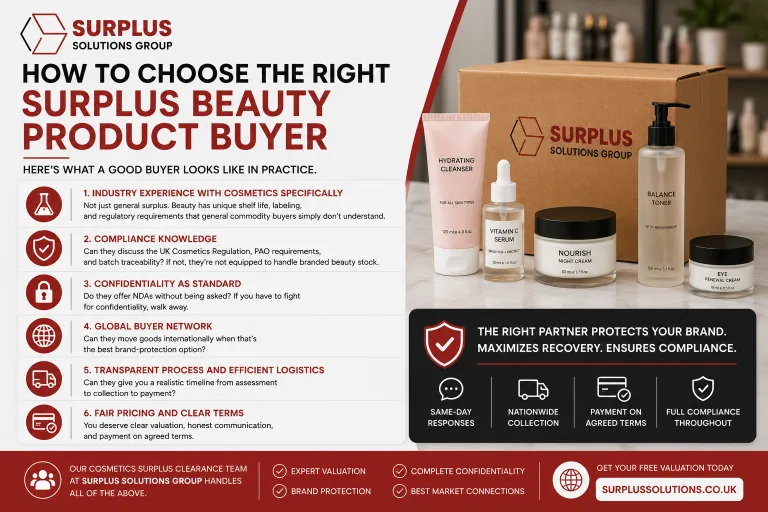
How to Choose the Right Surplus Beauty Product Buyer
Here’s what a good buyer looks like in practice.
- Industry experience with cosmetics specifically: Not just general surplus. Beauty has unique shelf life, labeling, and regulatory requirements that general commodity buyers simply don’t understand.
- Compliance knowledge: Can they discuss the UK Cosmetics Regulation, PAO requirements, and batch traceability? If not, they’re not equipped to handle branded beauty stock.
- Confidentiality as standard: Do they offer NDAs without being asked? If you have to fight for confidentiality, walk away.
- Global buyer network: Can they move goods internationally when that’s the best brand-protection option?
- Transparent process and efficient logistics: Can they give you a realistic timeline from assessment to collection to payment?
Our cosmetics surplus clearance team at Surplus Solutions Group handles all of the above. Same-day responses, nationwide collection, payment on agreed terms, and full compliance throughout.
Sustainable Beauty Inventory Management
This matters more than it used to. ESG scrutiny on beauty brands has intensified. The Cosmetic, Toiletry, and Perfumery Association (CTPA) and British Beauty Council both publish guidance on responsible inventory management. Destroying surplus stock generates waste and increasingly attracts negative press. Redistributing it responsibly is genuinely the better outcome environmentally.
Circular economy approaches for beauty inventory solutions include recommerce channels for near-end-of-life stock, textile and packaging recycling for goods that genuinely can’t be resold, and charitable donation programmes for products within shelf life that have limited commercial value.
Our responsible beauty stock disposal services cover the full spectrum. We look at every pallet and assess whether it can be redistributed commercially, donated, or recycled. Nothing goes to landfill unless there’s genuinely no alternative.
Why Working with a Professional Surplus Inventory Partner Matters
Here’s the honest version of this, rather than the polished pitch version. The beauty product liquidation market is opaque. Recovery values aren’t published anywhere. Buyer reputations are not transparent. Channel promises made verbally don’t hold up when goods appear on Amazon two weeks after collection.
Working with a specialist doesn’t just mean you get a better price. It means you get an accurate assessment of what your stock is actually worth in the current market. It means you get buyers who have been assessed for their ability to handle brand restrictions. It means the liability sits with someone who understands it.
At Surplus Solutions Group, we work directly with brands, retailers, insolvency practitioners, and distributors on surplus cosmetics clearance. We handle goods under written confidentiality, within the UK regulatory framework, and with export options for goods where domestic redistribution creates brand conflicts.
If you’re sitting on excess beauty inventory that doesn’t have a plan yet, our surplus beauty product buyer team can assess it quickly. No fixed quotes without seeing the stock. No pressure to make a decision before you’re ready.
Final Thoughts: Sell Surplus Beauty Products with Confidence
Back to those 15,000 units of skincare sitting in the warehouse. The product is safe. The documentation exists. The shelf life is good. The problem isn’t the stock. It’s not having a compliant, brand-safe plan to move it.
Selling surplus beauty products legally in the UK isn’t complicated when you know the compliance requirements, choose the right channel, and work with buyers who understand both the regulatory framework and the commercial sensitivities involved. The brands that handle this well don’t treat it as a fire sale. They treat it as inventory management, and the results reflect that.
The beauty inventory solutions market in 2026 is more sophisticated than it was five years ago. Buyers exist who can take volume quickly, under confidential terms, with full regulatory compliance, and distribute through channels that genuinely protect your brand positioning.
If you’re ready to talk through what your specific inventory is worth and what the options look like, our surplus beauty product clearance team at Surplus Solutions UK is here. No generic quote without seeing the stock. No pressure. Just a straight conversation.
What’s sitting in your warehouse right now that you’re not sure how to move?