
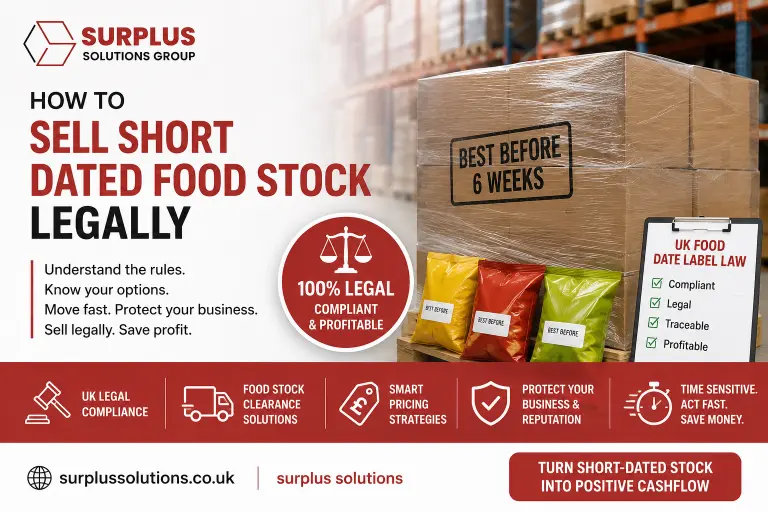
Your warehouse has 4,000 units of packaged snacks sitting on pallets. The best-before date is six weeks away. Your regular retail buyer just cancelled the order. Every day that passes is money leaving your business, and the clock is ticking.
This is a situation I hear from food manufacturers, wholesalers, and FMCG distributors all the time. Short dated food stock is one of the most common and costly inventory problems in the UK food industry. And yet most businesses either panic and take a terrible price, or worse, bin stock that could have been sold legally and profitably.
The good news is that selling short-dated food legally is entirely possible in the UK. You just need to understand the rules, know your options, and move fast enough to make it work.
This guide covers everything: UK food date label law, compliance requirements, the best channels for food stock clearance, pricing strategies, and how to protect your business throughout the process.
What Is Short Dated Food Stock?
“Short dated food stock” refers to products that are approaching their best before or use by date but have not yet expired. These products are still safe and legal to sell. The challenge is finding the right buyer quickly enough to recover meaningful value before the window closes.
Definition of Short-Dated Inventory
In the UK food trade, “short dated” typically means stock with less than 30 to 90 days of shelf life remaining, depending on the product category. For ambient goods like crisps or cereals, 30 days is considered short-dated. For frozen products, even 60 days can trigger a clearance conversation with buyers.
Common Examples of Short Dated Products
- Packaged snacks and confectionery
- Ambient beverages and soft drinks
- Dry goods including pasta, rice, and cereals
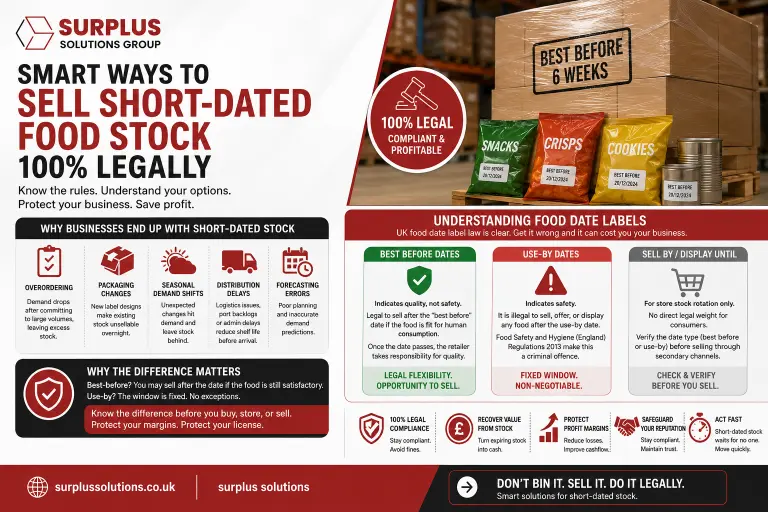
Why Businesses End Up With Short-Dated Stock
Overordering is the most common cause. A buyer commits to a large volume, demand drops, and suddenly you’re sitting on hundreds of pallets with a tightening shelf life. Packaging changes are another major trigger. When a brand refreshes its label design, all existing stock with the old packaging becomes unsellable through normal channels overnight.
Seasonal demand shifts hit food businesses particularly hard. A heatwave that didn’t materialize leaves a drinks distributor with thousands of cases they can’t shift at full price. Distribution delays caused by logistics disruptions, port backlogs, or administrative hold-ups can eat weeks off a product’s shelf life before it even reaches a UK warehouse.
Understanding Food Date Labels
This is where a lot of businesses make expensive mistakes. The legal rules around food date labels in the UK are clear, but they’re frequently misunderstood. Getting this wrong doesn’t just cost you money. It can cost you your food business license.
Best Before Dates
A best before date indicates quality, not safety. Under UK food law, it is completely legal to sell food after its “best before” date has passed, provided the product remains fit for human consumption. The Food Standards Agency confirms this. Once the best-before date passes, the retailer takes on responsibility for product quality.
This means a significant portion of what people call short-dated food stock can still be sold legally after the printed date. That’s a valuable commercial opportunity that many businesses don’t realize they have.
Use-By Dates
A use by date is an entirely different matter. It is a criminal offense under UK food law to sell, offer for sale, or display for sale any food product after its use-by date has passed. This applies even if the food looks and smells perfectly fine.
The Food Safety and Hygiene (England) Regulations 2013 make this explicit. A Leeds retailer was prosecuted in 2016 and fined £2,200 plus costs for selling cooked meats past their use-by date. date. The fines were relatively modest in that case. For larger operators, the penalties and reputational damage can be far worse.
Sell By and Display Until Dates
These exist primarily for the benefit of store staff managing stock rotation. They carry no direct legal weight for consumers. However, products displaying “sell by” labels that were intended for UK retail must be verified against whether that date corresponds to a best before or use by classification before you attempt to sell through secondary channels.
Why the Difference Matters for Your Business
If your surplus food stock carries best-before dates, you have legal flexibility to sell it even after the date. If it carries a use-by date, your window is fixed and non-negotiable. Knowing this distinction before you accept stock into your warehouse or commit to a purchase is fundamental to protecting your margins and your legal standing.
Is It Legal to Buy Before-Hort-Dated Food Stock?
Yes, in most cases. But the answer depends on what type of date label the product carries and what condition the stock is in at the point of sale.
General Legal Principles
Products with best before dates can be sold before and after the printed date. Products with use by dates must be sold and consumed before the date expires. There are no exceptions to the use-by rule in UK law.
Food buffet requirements, offense
Even when selling legally, food businesses must ensure products are stored correctly throughout the supply chain. A product that has been stored out of temperature range may be unsafe even if it hasn’t technically expired. Under the Food Safety Act 1990 and retained EU Regulation 178/2002, placing unsafe food on the market is an offense regardless of date labeling.
Consumer Protection Laws
When selling short dated products through retail channels, consumers must be informed that dates are approaching or have passed. This requirement sits under the Consumer Protection from Unfair Trading Regulations 2008. Failing to disclose the short-dated nature of goods at the point of sale can constitute a misleading omission.
Labelling Compliance Checklist
- Confirm whether dates are “best before” or “use by”
- Verify original date labels are intact and legible
- Do not alter, obscure, or remove any date markings
- Ensure storage and temperature conditions have been maintained throughout
- Disclose short-dated status to buyers and end consumers
- Retain purchase and sale documentation for all transactions
Key Regulations Businesses Must Understand
Short dated food stock clearance in the UK sits within a clear regulatory framework. Understanding these rules protects your business from enforcement action and product liability claims.
Food Safety Standards
The Food Safety Act 1990 is the primary legislation governing food businesses in England, Wales, and Scotland. It requires that food offered for sale be safe, of the nature and substance demanded, and not falsely described. Selling expiring food inventory that fails any of these tests carries criminal liability.
Traceability Requirements
Under retained EU Regulation 178/2002, food businesses must be able to trace products one step back through the supply chain and one step forward. When selling discount food inventory, you must be able to identify your supplier and your buyer for each batch. Keep records for a minimum of five years.
Storage and Handling Rules
Correct storage isn’t just good practice. It’s a legal requirement. Products sold through food stock clearance channels must have been stored within the manufacturer’s specified conditions throughout. This means maintaining cold chain integrity for chilled stock, keeping ambient products dry and within stated temperature ranges, and inspecting stock before it changes hands.
Risks of Selling Short Dated Food Incorrectly
I want to be direct here because I’ve seen businesses damage themselves badly through avoidable mistakes in this area.
Regulatory Penalties
Selling food past its use-by date is a criminal offense. Trading Standards and local authority Environmental health officers actively enforce this. Penalties include unlimited fines, improvement notices, prohibition orders, and in serious cases, prosecution of individual directors or managers.
Product Liability Risks
If a consumer becomes ill after consuming a product you sold through food inventory liquidation, your business can face civil claims. Ensure your public liability insurance covers your food-trading activities and that you hold all documentation proving products were within date and properly stored at the point of sale.
Brand Reputation Damage
For manufacturers and brand owners, surplus food stock appearing through the wrong channels can damage brand equity. A premium food brand found on a discount pallet market at half price sends a signal to consumers that undermines years of brand investment. Our “brand protection services” exist precisely to prevent this from happening.
Delaying Clearance Efforts
This is the mistake I see most often. A business holds onto short-dated stock, hoping the situation resolves itself. It never does. Every week you delay, the remaining shelf life shortens, the pool of potential buyers shrinks, and the recoverable price drops. If you have near expiry food products sitting in your warehouse today, the best time to act is right now.
Legal Ways to Sell Short Dated Food Stock
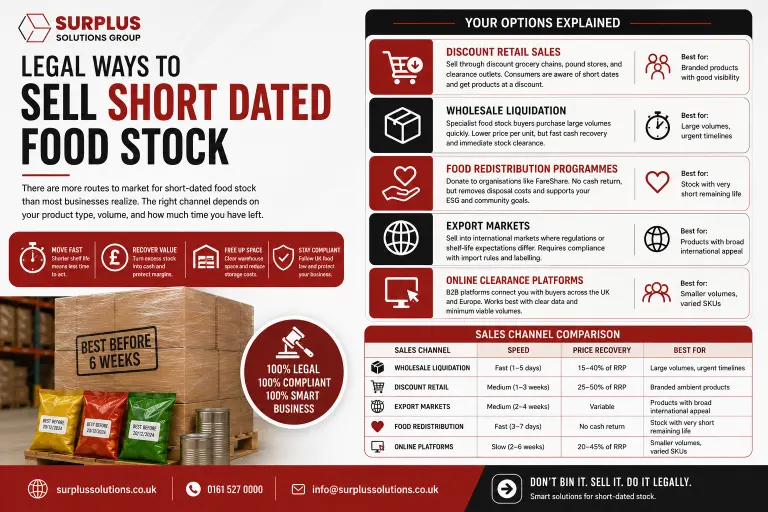
There are more routes to market for short-dated food stock than most businesses realize. The right channel depends on your product type, volume, and how much time you have left.
Discount Retail Sales
Selling directly through discount retail channels is one of the most straightforward options. Retailers like discount grocery chains, pound stores, and clearance outlets actively source near-expiry food products at reduced prices. They pass the discount on to consumers, who are fully aware of the short-dated nature of what they’re buying.
Wholesale Liquidation
This is typically the fastest route to converting short-dated food stock into cash. Specialist “food stock buyers” purchase large volumes in a single transaction. You get a lower price per unit than retail, but you recover value quickly, clear warehouse space, and eliminate the ongoing cost of storing stock that’s losing value daily.
Our team at Surplus Solutions regularly works with food manufacturers and distributors to structure “food stock clearance” transactions that recover the best possible value given the available shelf life.
Food Redistribution Programmes
In the UK, organizations like FareShare redistribute surplus food to charities and community groups. This doesn’t recover commercial value, but it does eliminate disposal costs, generate positive brand associations, and support your ESG reporting. For stock that won’t sell commercially with the remaining shelf life, redistribution is often the most responsible and cost-effective option.
Export Markets
Some surplus food stock can be moved to international markets where date-label regulations differ or where shorter shelf lives are commercially acceptable. Export requires careful attention to country-specific import rules and labeling requirements, but it’s a channel worth exploring for larger volumes.
Online Clearance Platforms
B2B food clearance platforms connect sellers of discount food inventory with buyers across the UK and Europe. These platforms work best when you have well-documented stock, clear date information, and a minimum viable volume to attract trade buyers.
| Sales Channel | Speed | Price Recovery | Best For |
| Wholesale Liquidation | Fast (1–5 days) | 15–40% of RRP | Large volumes, urgent timelines |
| Discount Retail | Medium (1–3 weeks) | 25–50% of RRP | Branded ambient products |
| Export Markets | Medium (2–4 weeks) | Variable | Products with broad international appeal |
| Food Redistribution | Fast (3–7 days) | No cash return | Stock with very short remaining life |
| Online Platforms | Slow (2–6 weeks) | 20–45% of RRP | Smaller volumes, varied SKUs |
How to Price Short Dated Food Inventory
Pricing short dated food stock UK correctly is a balance between recovering maximum value and moving fast enough to sell before the date expires. Get this wrong in either direction and you lose.
Shelf-Life Considerations
As a general rule, the less shelf life remaining, the steeper the discount required to attract buyers. With 60 or more days remaining, you may recover 40 to 60 percent of the original wholesale price through the right channel. With 14 days or fewer, you’re typically looking at 10 to 20 percent at best.
Bulk Discount Strategies
Trade buyers purchasing large volumes expect meaningful price breaks. A tiered pricing structure works well here. Offer a base discount for any purchase over a minimum pallet quantity, then increase the discount at higher volume thresholds. This incentivizes buyers to take the whole lot rather than cherry-picking the best SKUs.
Profit Recovery Calculations
Before accepting any offer, calculate your true cost of holding. Include warehouse rent per pallet per week, labor costs for managing the stock, insurance, and the cost of eventual disposal if it doesn’t sell. For many businesses, accepting a 20 percent recovery on expiring food inventory is far better financially than paying to bin it later.
Best Buyers for Short Dated Food Stock
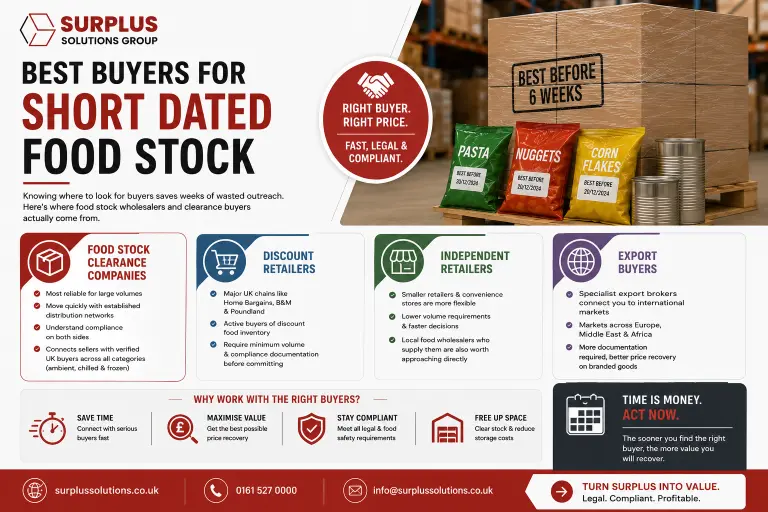
Knowing where to look for buyers saves weeks of wasted outreach. Here’s where food stock wholesalers and clearance buyers actually come from.
Food Stock Clearance Companies
Specialist clearance companies are the most reliable route for large volumes of short-dated food stock. They have established distribution networks, can move quickly, and understand the compliance requirements on both sides of the transaction. Our service connects sellers with verified UK buyers across all ambient, chilled, and frozen categories.
Discount Retailers
Major UK discount chains including Home Bargains, B&M, and Poundland are active buyers of discount food inventory. They typically require a minimum volume and need to verify compliance documentation before committing.
Independent Retailers
Smaller independent retailers and convenience stores are often more flexible on volume and timeline. Local food wholesalers who supply them are also worth approaching directly.
Export Buyers
Specialist export brokers can connect your surplus food stock with buyers in markets across Europe, the Middle East, and Africa. This route requires more documentation but can deliver better price recovery on branded goods.
Storage and Handling Best Practices
Proper storage during the clearance process is not optional. It’s a legal and commercial requirement.
Temperature Control
Chilled products must remain within their specified temperature range throughout storage and transit. A cold chain breach doesn’t just create a food safety risk. It gives buyers grounds to reject a delivery or claim a refund after the fact.
Inventory Rotation
Apply a strict first-in, first-out (FIFO) rotation to all short dated food stock. The products with the shortest remaining shelf life must be the first out of the door. Poor rotation is one of the most common causes of avoidable write-offs in food warehouse operations.
Documentation Standards
For every food inventory liquidation transaction, retain:
- Original purchase invoice showing date of acquisition
- Storage temperature logs covering the full holding period
- Delivery documentation showing date, buyer details, and product information
- Waste transfer notes for any stock that cannot be sold
How to Reduce Future Short-Dated Inventory
Prevention is always cheaper than clearance. Here’s how businesses reduce expiring food inventory before it becomes a crisis.
Better Forecasting
Most short-dated stock problems start with inaccurate demand forecasting. Investing in better sales data analysis, even at a basic level using spreadsheet models, significantly reduces overordering. Review actual sell-through rates monthly and adjust forward orders accordingly.
Inventory Tracking Systems
Software tools like Unleashed, DEAR Inventory, and Mintsoft allow food businesses to track shelf life by batch across multiple warehouse locations. Automated alerts when products reach a defined shelf life threshold give you time to act before the situation becomes urgent.
Supplier Coordination
Negotiate with your suppliers for shorter lead times and smaller minimum order quantities on fast-moving or seasonal lines. A slightly higher unit cost on smaller orders is almost always cheaper than writing off a large batch of near expiry food products every quarter.
Common Mistakes Businesses Make
These are the mistakes I see repeatedly. None of them are complicated to avoid once you’re aware of them.
Delaying Clearance Efforts
The longer you wait to act on short-dated food stock, the fewer options you have and the worse the price you’ll accept. Begin clearance activity the moment a product enters your short-dated threshold, not when it’s two weeks from expiry.
Poor Inventory Rotation
Mixing short-dated and long-dated stock in the same location without clear labeling creates confusion and leads to good stock being held while short-dated stock deteriorates unnoticed.
Inadequate Documentation
Selling discount food inventory without proper transaction records exposes you to liability if a quality complaint arises. Always document what was sold, to whom, when, and at what specification.
Failing to Monitor Regulations
UK food labeling and safety regulations do change. The Food Standards Agency publishes updates regularly. Businesses that haven’t reviewed their compliance position since 2020 may be operating on outdated assumptions.
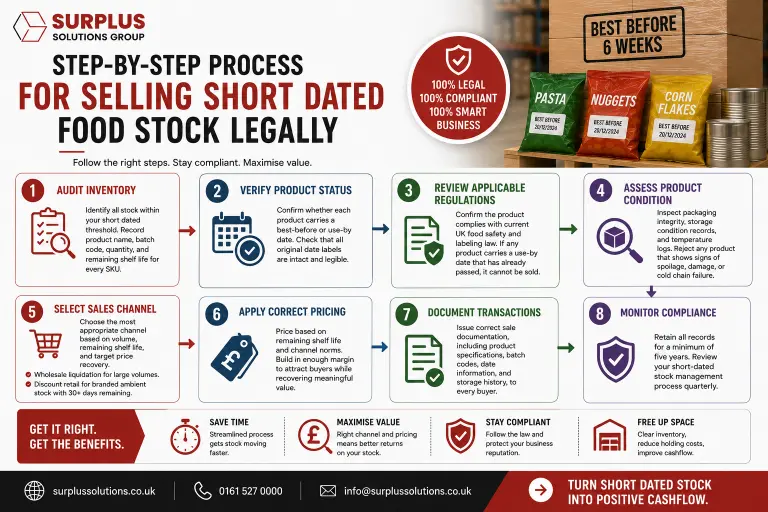
Step-by-Step Process for Selling Short Dated Food Stock Legally
- Audit Inventory: Identify all stock within your short dated threshold. Record product name, batch code, quantity, and remaining shelf life for every SKU.
- Verify Product Status: Confirm whether each product carries a best-before or use-by date. Check that all original date labels are intact and legible.
- Review Applicable Regulations: Confirm the product complies with current UK food safety and labeling law. If any product carries a use-by date that has already passed, it cannot be sold.
- Assess Product Condition: Inspect packaging integrity, storage condition records, and temperature logs. Reject any product that shows signs of spoilage, damage, or cold chain failure.
- Select Sales Channel: Choose the most appropriate channel based on volume, remaining shelf life, and target price recovery. Wholesale liquidation for large volumes. Discount retail for branded ambient stock with 30 or more days remaining.
- Apply Correct Pricing: Price based on remaining shelf life and channel norms. Build in enough margin to attract buyers while recovering meaningful value.
- Document Transactions: Issue correct sale documentation, including product specifications, batch codes, date information, and storage history, to every buyer.
- Monitor Compliance: Retain all records for a minimum of five years. Review your short-dated stock management process quarterly.
Final Thoughts on How to Sell Short Dated Food Stock Legally
Short dated food stock doesn’t have to be a write-off. With the right knowledge and the right buyer, it’s a recoverable asset. The businesses that manage this well are the ones that move early, understand their legal obligations, and build relationships with the right clearance partners before a crisis hits.
The UK food industry generates billions of pounds of surplus and short-dated stock every year. Most of it has real commercial value. The difference between recovering 30 percent and writing off 100 percent comes down to compliance, speed, and knowing who to contact. If you’re working through a food inventory liquidation challenge can be made. Right now, our “food stock buyers” service connects you with vetted UK buyers who understand date label compliance and can move quickly on large volumes. We also handle broader “company clearances” when a full inventory wind-down is needed.
The regulations are clear. The market is active. What’s holding your surplus food stock back from recovery?